
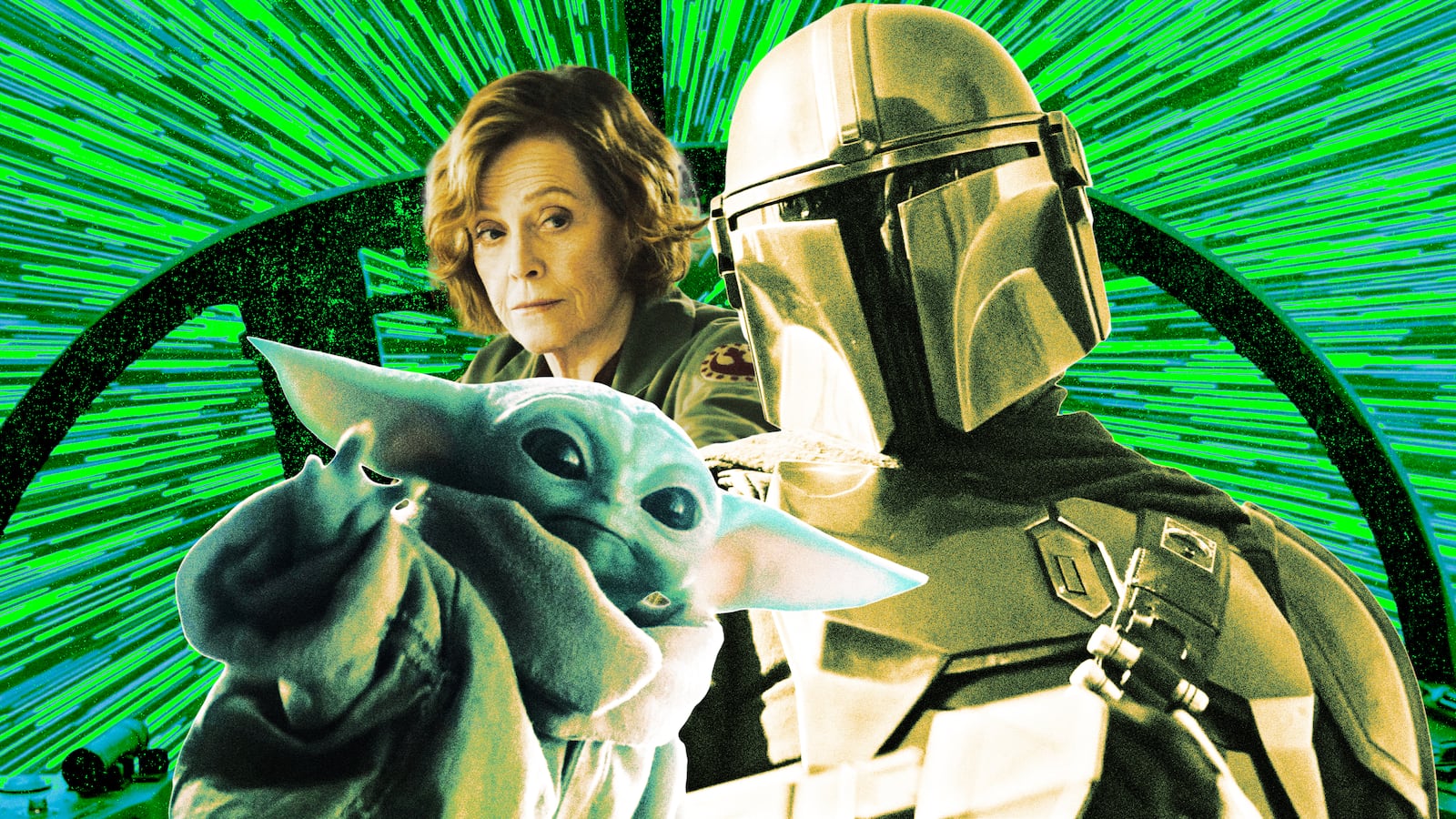
In the 14 years since Disney purchased the rights to Star Wars, the studio has produced five franchise movies and seven TV series, exactly two of which (both on the small screen) were worthwhile: Tony Gilroy’s Andor and Jon Favreau’s The Mandalorian.
It’s the second of those that’s first to get the feature-length treatment, and fortunately, The Mandalorian and Grogu proves a rousing multiplex return to the galaxy far, far away, delivering a swashbuckling space Western that deftly marries combative spectacle and kid-friendly cuteness. To quote its hero, “this is the way” you make a stand-alone sci-fi adventure—even if the Mouse House appears to be leaving money on the table by not calling the film The Mandalorian and Baby Yoda.
Though it’s preceded by a three-season Disney+ series (as well as a few key episodes of The Book of Boba Fett), The Mandalorian and Grogu (May 22) ignores most of the lore surrounding its title character, to the point that his real name Din Djarin is never uttered during this 132-minute endeavor. Rather, it picks up with the Mandalorian and his pint-sized surrogate son Grogu—a big-eyed, bigger-eared creature from the same species as Yoda who wields the Force—as they track down a former Imperial bigwig on an ice planet.
The period is some time after The Return of the Jedi, and Mando is working for the New Republic as a bounty hunter tasked with bringing to justice the remaining members of the defeated Empire. While he claims to be in it for the money, it’s clear that the perpetually helmeted “independent contractor” (to remove it is to earn excommunication from his clan) believes in his employers’ cause.
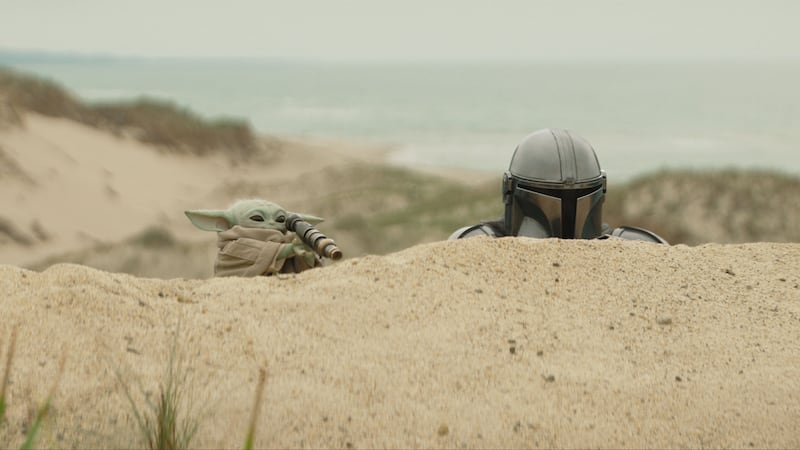
The Mandalorian and Grogu commences with a slam-bang clash involving hordes of stormtroopers and a trio of AT-ATs, and its CGI has just enough of a stop-motion feel to make it seem at once cutting-edge and nostalgic. That throwback style sets an enticing tone for the ensuing action, which is instigated by New Republic commander Ward (Sigourney Weaver) hiring the duo to apprehend a mysterious Imperial baddie whose whereabouts are only known by Jabba the Hutt’s twin siblings. To get them to talk, Mando must find their nephew Rotta (Jeremy Allen White), who’s apparently been kidnapped and is eagerly sought by his relatives.
Mando has no interest in doing scumbags’ business yet he reluctantly agrees to this plan and is soon traveling on the Hutts’ orders to an alien metropolis which resembles the rain-drenched city of Blade Runner, where he pries information about Rotta’s whereabouts out of a four-armed shopkeeper voiced by none other than Martin Scorsese.
Far from his immobile, sloth-like brethren, Rotta is a burly giganto-slug, boasting bulging muscles and a ferocity to match—as well as an impressive finishing body-slam move. More surprising to Mando, Rotta has no desire to be rescued; he doesn’t trust his uncle and aunt, and he covets the freedom he’s set to earn after winning his upcoming final match. Thus, he proves a difficult individual to retrieve, and that’s even before Mando winds up pitted against him in the ring—another of The Mandalorian and Grogu’s concussive showstoppers.
The Mandalorian and Grogu has ties to George Lucas’ original trilogy, but it’s largely a mythology-free affair that puts most of its energy into a series of thrilling few-vs.-many battles. Favreau’s staging is muscular and sophisticated, yet especially in the film’s latter half, it’s undercut by a familiar and frustrating visual schema marked by a dingy color palette and murky digital effects.
The extraterrestrial fiends that Mando fights are often rendered indistinctly, lacking the very sharpness that would make them memorable. That point is underscored by the hero’s tussle with a giant sea dragon whose luminous whiteness stands in sharp contrast to his fellow fuzzy monsters—and, consequently, makes him the proceedings’ best beast.
Scored by Ludwig Göransson with orchestral and synth-heavy flair (and a few variations on The Mandalorian’s quasi-spaghetti Western theme), Favreau’s film has light-speed-grade momentum that’s only hindered by a protracted forest-set sequence that grinds the material to a halt.
This passage is meant to highlight Mando and Grogu’s close father-son bond, but considering that their relationship has by this juncture already been sufficiently established, it merely leads to flabbiness. Still, there’s no denying that Grogu remains a preternaturally adorable addition to Star Wars, and screenwriters Favreau, Dave Filoni, and Noah Kloor grant him regular opportunities to do something worthy of an “awwww.”
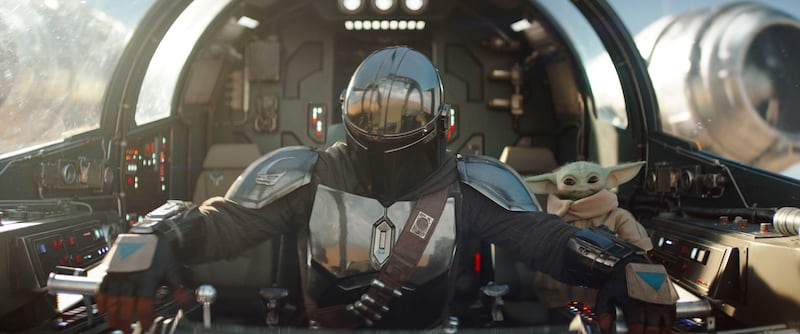
The Mandalorian and Grogu is light on its feet, and Pascal’s no-nonsense performance as the stoic bounty hunter continues to channel Clint Eastwood’s Man with No Name (facing a baddie, he announces, “I can bring you in warm or I can bring you in cold”). Removing his helmet merely once, Mando cuts a shiny, striking figure, and his aptitude with guns, cables, explosives, and flamethrowers—not to mention his trusty jet pack—enliven the film’s gargantuan skirmishes against an array of aliens and droids.
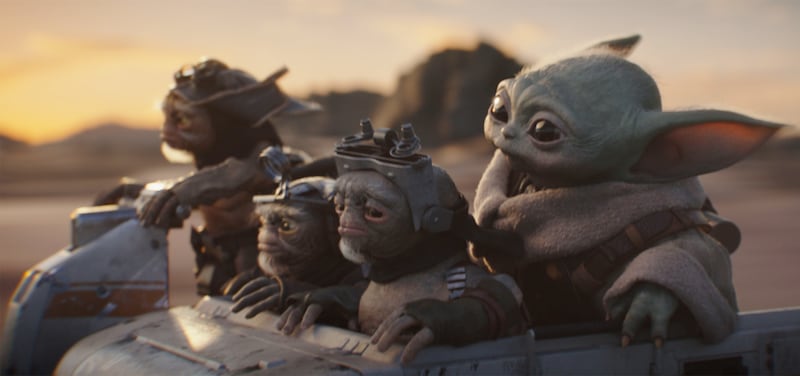
No matter that they’re sometimes less than wholly visible, the beings Mando and Grogu encounter are a captivatingly diverse bunch, and that includes a quartet of Anzellans (first seen in The Rise of Skywalker) whose twittering is almost as charming as Grogu’s cooing.
Whereas Mando’s TV series ran aground in its second season by indulging in misguided CG-enabled cameos, The Mandalorian and Grogu avoids such pitfalls. Designed as merely one installment of an ongoing serialized tale, it sends its protagonists on a self-contained mission that—aside from the participation of the Hutts—is never integrated, in any appreciable way, into the larger Skywalker Saga.
Its muddy and gloomy aesthetics prevent it from reaching the interstellar highs to which it aspires. However, as a course correction following Disney’s numerous cinematic Star Wars missteps, it lays the groundwork for a franchise future defined less by Luke, Vader, and their descendants than by the fascinating good and bad guys roaming the far corners of this universe.