
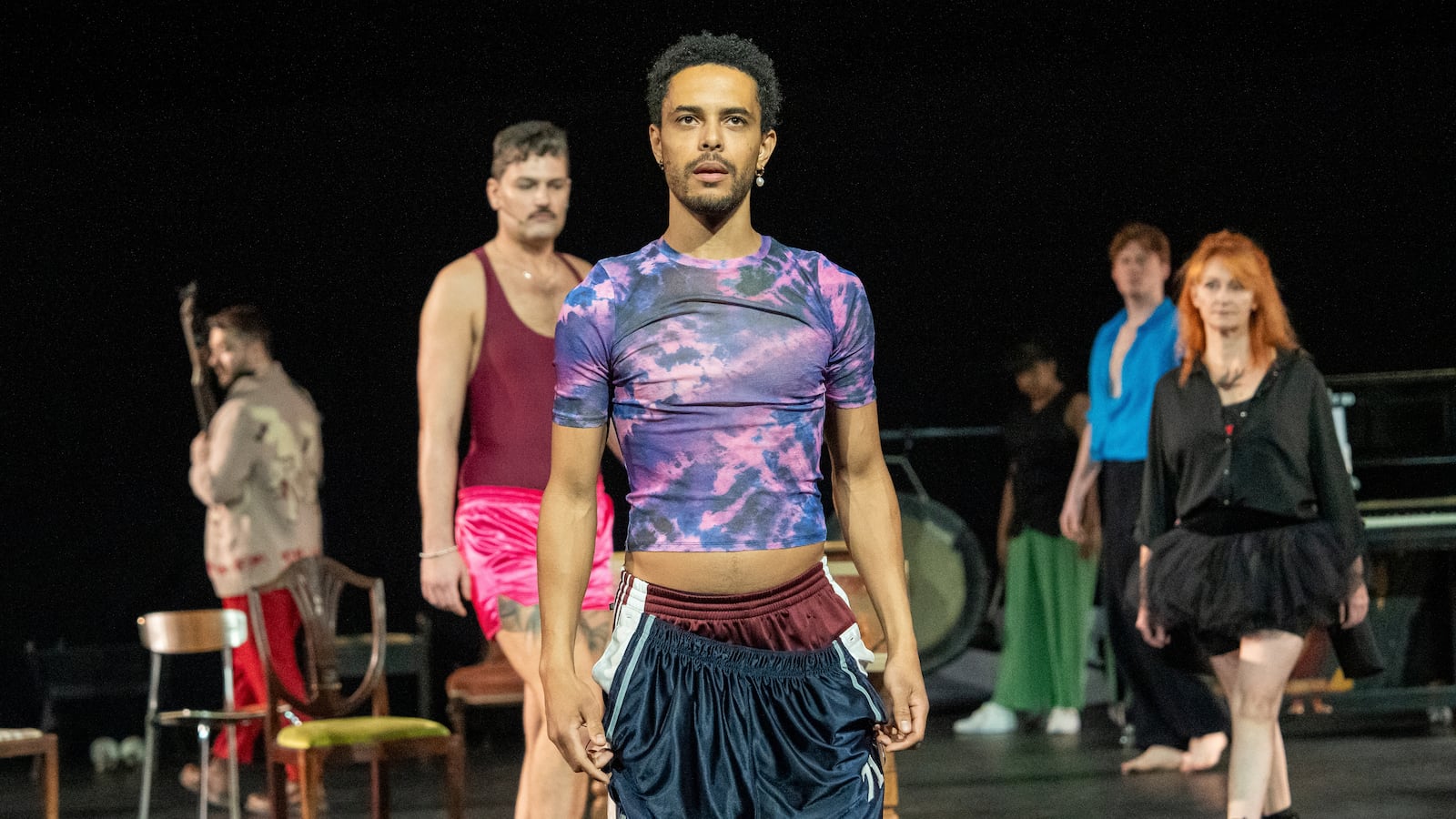
In the cavernous interior of New York City’s Park Avenue Armory, The F****ts and Their Friends Between Revolutions, until Dec 14) unfolds on a mostly blank stage. Close your eyes to imbibe its mixture of music, myth, manifesto, and polemic, and it feels like being around a campfire of wry and fantastical incantations.
The performance—adapted from a 1977 book by Larry Mitchell, with illustrations by Ned Asta—feels very much of the Lavender Hill Commune, a queer commune in Ithaca, New York, that Mitchell and Asta were founder members of. F****t—a term of anti-gay abuse that the Daily Beast does not write out in full—is here used as badge of honor and pride, both a warrior word and casual descriptor drained of its homophobic viciousness.
On stage are a group of performers who sing and tell stories of a group of men called “the f****ts” who undergo three revolutions, which leave them variously isolated, energized, and determined to bring down the patriarchy that seeks to control and mold them. Through a kind of vivacious grit, they prevail, victorious over the forces of repression.
Just like the communal living and ideals that it sprang from, Philip Venables’ music (much inspired by opera) and Ted Huffman’s “direction and text” majors on two things simultaneously—an examination and rejection of social superstructures, and the imagining of sex and pleasure-celebrating radical alternatives.
Within The F****ts and their Friends, the f****ts’ success is not measured in the setting up of one commune, or one alternative way of life, but that the alternative itself becomes the power—that it so successfully shatters the conventional order it becomes dominant.

Originally written eight years after the Stonewall Riots, F****ts and Their Friends brims with both an exhausted, truth-telling anger at the homophobia and anti-gay hysteria of the time, and a clever and at times very funny interrogation of capitalist patriarchy. Its wittiest slice of song and text is a rumination on how much “the men”—the patriarchy—love writing down everything on paper, then filing that paper, coveting the papers in vaults, and then building vast towers to continue their endless production of paper-coveting and writing.
Satirical rumination is also aimed at those within the queer community gravitating towards assimilation. Many of the “f****ts,” the show says, are drawn into this patriarchal world, which after one of the revolutions becomes known as Ramrod (the name of the iconic New York City gay leather bar of the late mid to late ‘70s). Those gays start taking on the characteristics of “the men” to survive in the glass towers of paper accumulation.
Themes of access to marriage and military service are raised, and why there should be a desire for equality in those areas when the systems they are embedded within are so repressive. The show proposes that true liberation is not about seeking this equality, but in finding a more revolutionary model of living. The f****ts draw alliances with other marginalized groups—and a route to a new, order-upending utopia takes shape.
While the show aims to emulate the collective spirit of its genesis, some performers stand out—particularly the spoken delivery and physical movement of Yandass and the trans performer Kit Green, who leads an audience singalong that seems at once discordantly out of sync with the rest of the show and also perfect for the same reason.
F****ts and their Friends feels very of its original era in the hippy-dippiness of its vibe, with performers wandering around and music-playing and dancing and appearing and disappearing. But it is also a glimpse of defiant imagining; of queer people, mid that period of immediate post-Stonewall liberation, contemplating what a different world could look like. And those questions persist to our present day of boomeranging progress and regression, and what a society free of divisions and hierarchies might ever come to be.
In this sense, the use of “f****t” in the show doesn’t denote a specific sexual identity, but a more amorphous definition of those who resist a dominant order—and what a radical reset could enshrine in its place. In 2025, however unlikely and distant that vista seems, just the show’s magical thinking may be a welcome splash of water for many, f****ts or not.