Movies, at their best, afford entrée into worlds, homes, and lives to which we’d otherwise have no immediate access. And The Rivals of Amziah King (August 14, in theaters) thrillingly offers such an invite.
The tale of a beekeeper whose colorful eccentricity, homespun artistry, and big-hearted compassion change the life of a woman he once knew, writer/director Andrew Patterson’s follow-up to his superb 2020 debut The Vast of Night is a backwoods fable of endless charm and poignant uplift, all revolving around a superlative Matthew McConaughey turn of magnetic, mandolin-plucking soul. As subtly sharp as it is sweet, it’s one of the year’s most enlivening standouts.
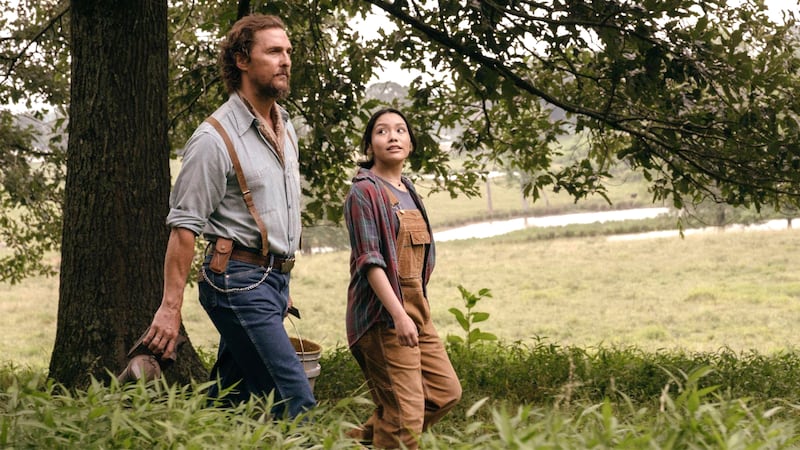
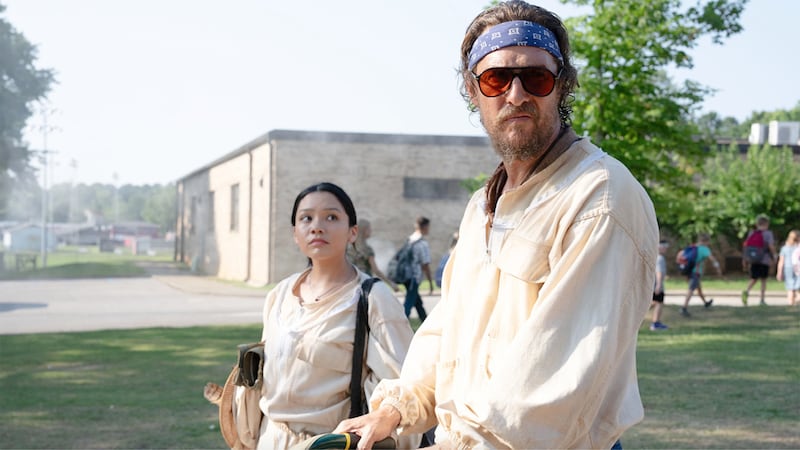
At a dusty Oklahoma drive-in populated by weatherbeaten pick-up trucks and SUVs, a bluegrass band slowly gathers around an outdoor table, led by Amziah King (McConaughey), who in a bandana and suspenders orders steaks and drinks via intercom before bursting into rollicking song. Shot in romantically hazy low light and embellished with freeze frames and cutaways to evocative details (a Styrofoam cup filling at a soda dispenser; a written order on a waitress pad; meat being tossed into, and removed from, a fryer), it’s a scene-setter par excellence, imparting the way this milieu not only looks and sounds but feels.
Moreover, McConaughey’s full-throated, lyrically mile-a-minute musical performance immediately marks Amziah as both salt-of-the-Earth and larger-than-life.
This recital is at once impromptu and the sort of thing that seems to be a regular occurrence, and it’s interrupted by the appearance of three officers, including level-headed Sunderland (Bruce Davis). Since Amziah is a notable beekeeper and honey merchant, they want to talk to him about the theft of a collection of barrels that, with one look, Amziah determines are housing honey—as much as a quarter of a million dollars’ worth, to be precise.
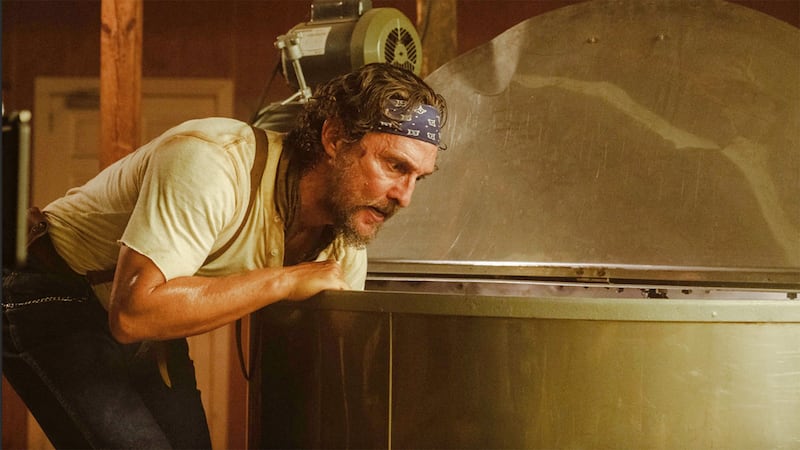
To investigate this, Amziah suggests melting the honey inside and checking the barrel’s interior for its owner’s signature. Consequently, they retreat to his plant, where they’re met by his friend Remick (The Vast of Night’s Jake Horowitz) and Remick’s buddy Colemar (Spider-Man: No Way Home’s Tony Revolori), the latter of whom is a formidable banjo player.
The Rivals of Amziah King moves quickly, expecting viewers to keep up as Amziah preps an exceedingly hot chamber (known as a warm room) where the honey will, if treated properly, slide right off the barrel. Before this process is completed, however, a gasp-inducing calamity transpires, throwing the proceedings into hectic overdrive and sending everyone to the hospital.
Patterson thus establishes the film’s ramshackle spirit, whose scruffiness is epitomized by Amziah’s patchy beard and whose humor is characterized by folksy declarations and off-the-cuff peculiarities. There’s an authenticity to this place and its down-and-dirty residents, and the director (who wrote the script under the pseudonym James Montague) celebrates these locals’ no-nonsense generosity and camaraderie without tipping things into saccharine cutesiness.
In the aftermath of this hair-rising crisis, Amziah visits a diner where he runs into Kateri (Angelina LookingGlass, making her film debut), a young Native woman whom he and his now-deceased wife once fostered along with her brother. When he invites her to his upcoming show, she accepts, and once he’s done playing, he explains the ins and outs of a traditional Oklahoma potluck—a sequence of humorous vignettes about each dish’s origins that underscores Amziah’s (and Patterson’s) fondness for southern-fried storytelling.
This scene is the second of The Rivals of Amziah King’s multiple showcases for no-frills bluegrass, whose twangy melodies and soaring harmonies are expressions of joy and love, and which weave the musicians together into something approaching a family.
A tentative Kateri is pulled into Amziah’s orbit and community, which includes his beekeeping operation, and in a beautiful centerpiece, McConaughey’s protagonist demonstrates drone and worker bees’ devotion by holding their queen between his fingers until her minions cover his hand.
Cinematographer Miguel I. Littin-Menz coats everything in warm hues and attunes his camera to these individuals’ movements, creating piercing engagement with their plight through purely aesthetic means. His and Patterson’s framing and staging, meanwhile, is unassuming and gorgeous, and there’s at least one taut, understated moment whose compositional dexterity warrants Spielberg comparisons.
There’s a tragedy at the center of The Rivals of Amziah King, and considering the preceding action’s success at drawing us close to its characters, it lands like a left hook to the jaw. From there, the film transforms into an altogether different beast—or, rather, reveals its true emphasis and purpose. Determined to right a terrible wrong, Kateri initiates an inquiry and, then, plans a heist, and Patterson orchestrates her mission with decisive urgency.
In an impressive screen debut, LookingGlass allows Kateri to come into gradual focus, and she proves a compelling center of attention as the drama veers into crime-thriller territory.
Though the old maxim preaches that an eye for an eye leaves the whole world blind, The Rivals of Amziah King doesn’t buy it, instead recognizing that sometimes the way to both survive and to honor the wronged is to strike back with no remorse. Given cinema’s litany of anti-revenge revenge tales, such a viewpoint is not simply refreshing but, in Patterson’s assured hands, convincing, and the film doesn’t pull its punches as it details the ruthless tactics employed to take down a shady Oklahoma villain.
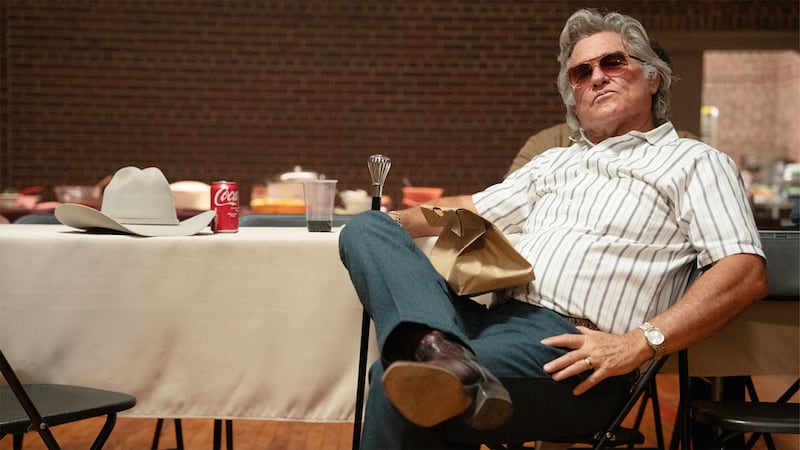
Furthermore, it benefits from having Kurt Russel play that part; as Dob McCoy, a businessman who carries himself with laconic confidence, the Hollywood legend brings an added measure of heft to the material, while Cole Sprouse gives it some quirky personality as a fast-food restaurant worker with a knack for procuring information.
None of The Rivals of Amziah King works, however, without its headliner, who radiates easygoing cool and bountiful kindness without making Amziah resemble merely another of his laid-back, southern-drawling gentlemen. The role may be in McConaughey’s wheelhouse, but he’s neither a retread nor a caricature, and the Oscar-winner wields his amiable charisma to energize the film at the same time that he spikes it with delicate traces of sorrow and regret.
It’s a performance so great, it looms over everything—and serves as a reminder that when he’s really cooking, McConaughey is much more than just alright.