
Acclaimed Japanese director Kiyoshi Kurosawa is one of cinema’s most eclectic auteurs, his filmography populated by sterling horror shows (Cure, Pulse), thrillers (Cloud, Serpent’s Path, Wife of a Spy), dramas (Bright Future, Tokyo Sonata), comedies (Doppelganger), and science fiction fantasies (Before We Vanish, Real).
Now, he tackles two new genres at once with The Samurai and the Prisoner (July 31, in theaters), melding feudal period-piece intrigue (à la Shogun) and Agatha Christie-style mystery for a riveting adaptation of Honobu Yonezawa’s 2021 novel of the same name. Intricate, enthralling, and as psychologically rich as his best work, it’s another feather in the illustrious artist’s cap.
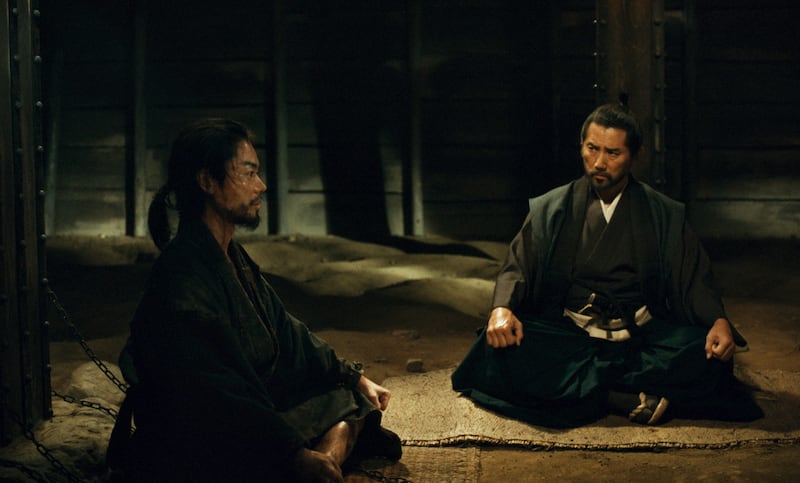
In 1578, Lord Araki Murashige (Masahiro Motoki), the head of the Setssu clan, has his back against the wall. Having rebelled against the fearsome Oda Nobunaga—known as the “Great Unifier” of Japan, as well as a “Demon King”—Murashige finds his Arioka Castle surrounded by his former master, making him, his wife Chiyoho (Yuriko Yoshitaka), and his war council prisoners in their own home.
While Oda’s encircling army is the gravest threat to his security, there are equal dangers inside his fortress, as he discovers upon meeting with Kuroda Kanbei (Masaki Suda), a cunning intellectual who’s revealed as a Nobunaga ally and confined by Murashige to a dingy basement dungeon.
Murashige’s decision to keep Kanbei captive rather than kill him—as is dictated by samurai code—is an initial sign that he doesn’t play by the rules. And The Samurai and the Prisoner’s action is to a large extent driven by his staunch disinterest in taking lives, no matter that he’s at war with a ruthless adversary.
Motoki’s performance is solemn and contemplative, but better is its evolving complexity, capturing Murashige’s persistent struggle to reconcile his own ambitions with the realities of his situation, which grows knottier with every deliberate choice and unexpected development.
To wit: by chaining up rather than beheading Kanbei, Murashige signals to Nobunaga that Kanbei must have switched sides—an insinuation that puts Kanbei’s son (who remains in Nobunaga’s care) in grave trouble.
Moreover, the commander makes a mess for himself by similarly declining to execute eight-year-old Jinen (Yuto Makiki) even though the kid’s father is a turncoat who’s thrown his lot in with Nobunaga. This calls into question Murashige’s honor, and things get worse when Jinen is shortly thereafter murdered, making it seem like Murashige was lying about sparing his life. More puzzling, the arrow that ended Jinen’s life is nowhere to be found, and Murashige and his right-hand men can’t deduce precisely how this crime was committed.
Jinen’s demise leads Murashige back to Kanbei, who functions as his personal Hercule Poirot-via-Hannibal Lecter, a keen sleuthing mind whose loyalty is open for debate.
This investigation comprises the first of The Samurai and the Prisoner’s four segments, each of them taking place during a different season, and it’s marked by storytelling that places a premium on its protagonist’s complicated internal and external circumstances. Kurosawa’s script is as patient and methodical as Murashige’s preparation of tea, and only slightly hampered by an avalanche of names and relationships that—because not every key player appears on-screen—can be a tad confusing.
Working with cinematographer Yasuyuki Sasaki, the director choreographs his material with precision and grace, his visuals at once clean, refined, and evocative. Kurosawa’s framing subtly conveys Murashige’s uncertainty and shifting standing in this palace drama, and Kôichi Takahashi’s crisp editing is likewise attuned to the character’s changing position vis-à-vis his associates and adversaries.
The Samurai and the Prisoner has the formal confidence one expects from the Japanese filmmaker, and its poised construction smartly contrasts with Murashige’s increasingly tumultuous reality.
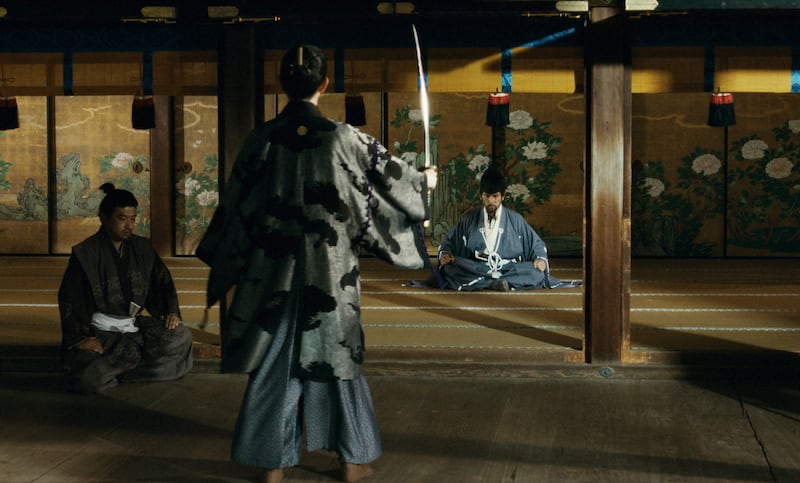
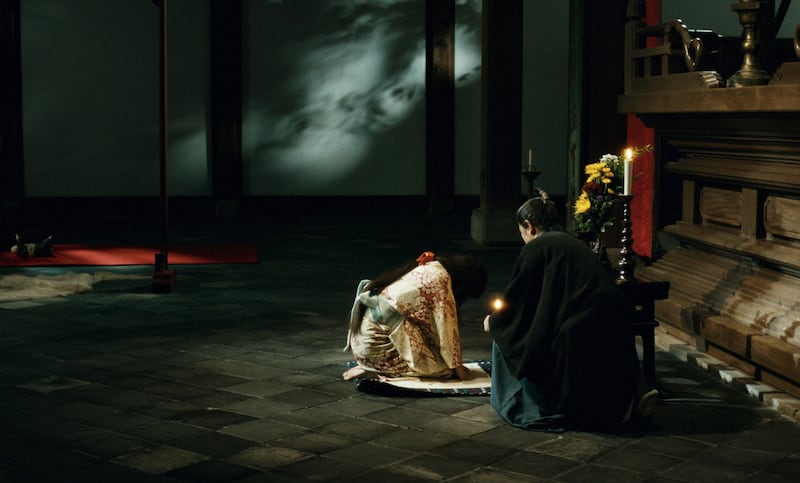
Jinen’s assassination is merely the start of The Samurai and the Prisoner, whose tale saddles Murashige with additional cases involving a defeated foe’s severed head (which becomes inexplicably deformed and is viewed as a bad omen) and the deaths of other foes and comrades. The answers the hero seeks are wrapped up in strategic considerations regarding how best to combat Nobunaga, as well as spiritual dilemmas raised by Chiyoho, who’s still suffering from PTSD following a brutal years-earlier uprising against Nobunaga which she barely survived.
Challenging questions abound in The Samurai and the Prisoner: how to victoriously wage war without bloodshed; how to die without fear; and how to believe without (and with) divine signs. Devotion and treachery, sacrifice and selfishness, and kindness and cruelty are all ingredients in this 16th-century saga, and Kurosawa navigates them deftly.
The micro and macro, personal and political, are intertwined throughout, and the resultant push-pull dynamics inform Murashige’s quest for clarity when it comes to both the strange whodunits at his castle and the best way to keep his people safe.
There’s a certain modernity to The Samurai and the Prisoner’s portrait of Murashige, who’s cast as a thoughtful leader determined to ascertain a peaceful way out of his quandary. If Kurosawa intends his latest to be read in timely political terms, however, he doesn’t let on, instead focusing on the rhythms of his milieu and its inhabitants, whose adherence to convention is another of the many obstacles standing in the way of a definitive diplomatic resolution.
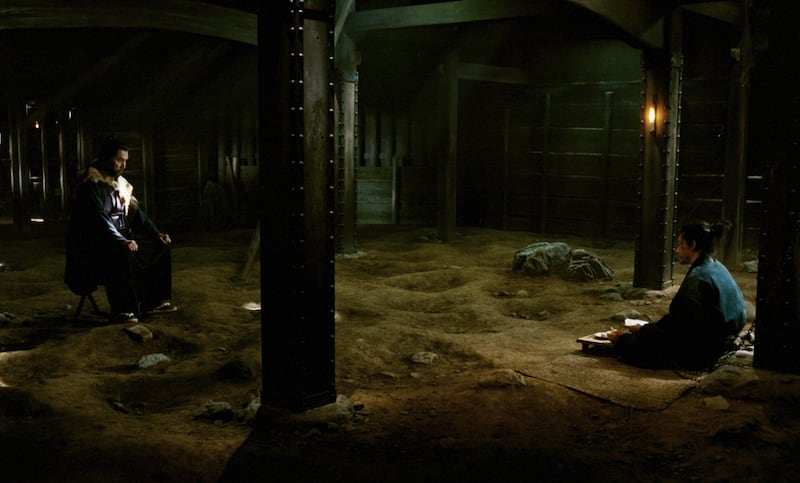
Motoki and Suda’s scenes together in the castle’s prison cell lend The Samurai and the Prisoner its cat-and-mouse verve, although that energy also exists within Murashige, a man constantly wrestling with the various (dicey) options at his disposal.
As it wends its way toward a conclusion rife with revelations about the faithfulness of Arioka’s residents, the film develops an urgency that’s less about basic plot machinations than about Murashige’s ability to thread a needle by staying true to his convictions while simultaneously protecting those he cherishes. Even so, Kurosawa’s refusal to conclude things with fireworks is part and parcel of his calm and collected approach, which is in harmony with its main character’s disposition.
Debuting mere months after the stateside premiere of Chime—a horror gem that would be a lock for top-ten accolades if not for the fact that it runs a disqualifying 45 minutes—The Samurai and the Prisoner reaffirms Kurosawa’s standing as international cinema’s preeminent jack of all trades. Simply put, he can do anything—which makes one intensely eager to see what he delivers next.