The FBI’s manhunt for the Unabomber—a terrorist who primarily targeted airline employees and university academics with homemade bombs and was eventually identified as Ted Kaczynski—was the longest and most expensive in the agency’s history. And though Unabomber may not be the definitive account of that mission, it strikes a taut balance between suspense and psychological insight.
With Shailene Woodley as a federal agent on the case, Russell Crowe as a Harvard bigwig with ties to the young madman, and former child star Jacob Tremblay (Room)—in a convincingly disturbing turn—as the bitter and dangerous Kaczynski, it’s a straightforward history lesson elevated by sturdy craftsmanship.
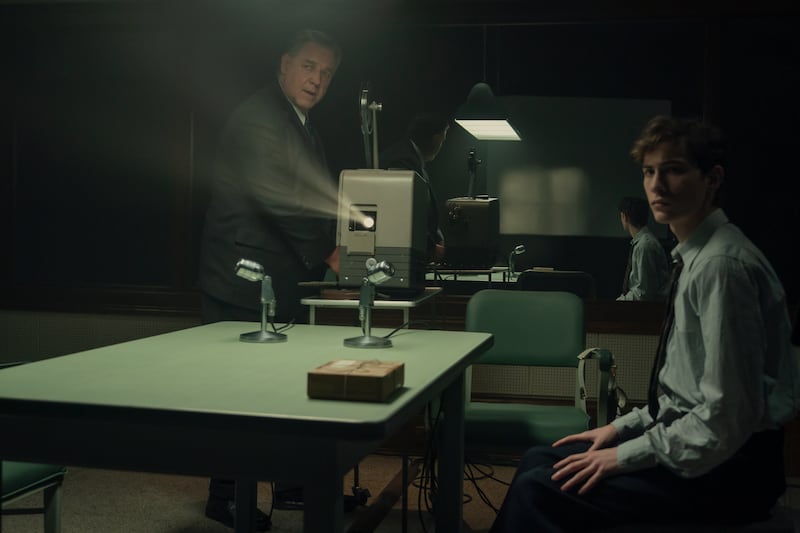
Unabomber (September 25, on Netflix) splits its action, alternating between the 1995 law enforcement quest to stop the bomber’s reign of terror and Harvard circa 1958, where Ted (Tremblay) studies math as a 16-year-old prodigy. Despite sharing a house with classmates, Ted is a decidedly antisocial “boy wonder.” He’s additionally arrogant and defiant, and regardless of his domineering father Turk’s (Bruce Ramsay) objections, he signs up for what he believes to be a debate club run by Professor Henry Murray (Crowe).
Ted is attracted to the prospect of defending his “life philosophies” in these sessions. Yet during the first sit-down, he’s surprised to be strapped into monitoring equipment and then pitted against a stranger called Mr. G (Jace Fleming), who caustically berates his Thoreau- and Hobbs-inspired ideas.
Unabomber is urgent and ominous—the result of the fact that, when it picks up in 1995 San Francisco with agent Joanne Miller (Woodley), Ted is already responsible for 15 bombings over 16 years, killing two and injuring twenty-three. In response to this mayhem, The Washington Post and The New York Times agree to the killer’s demands and print portions of his manifesto, “Industrial Society and Its Future,” in which he rails against the modern age. While Joanne’s boss Dean Kaplan (Steven Ogg) has her and partner Leo Driver (Alexander Ludwig) stake out newsstands in the hopes of catching the villain as he buys his press clippings, that effort goes for naught.
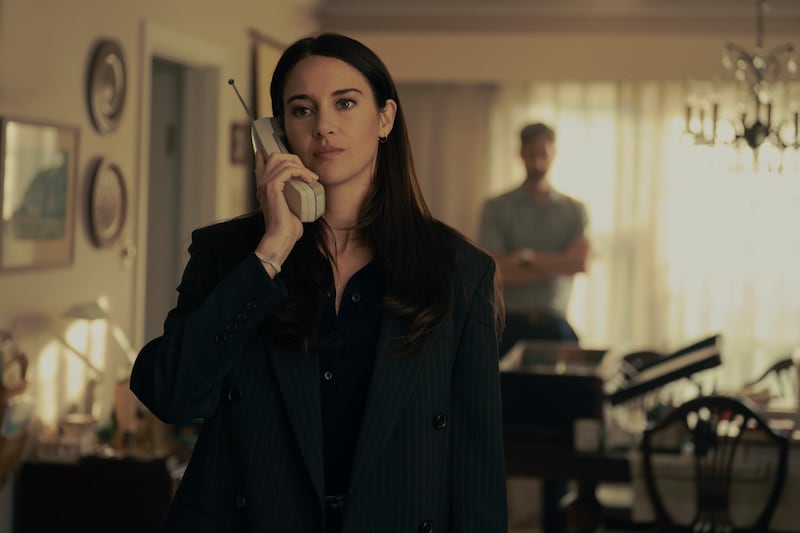
Joanne is convinced that the key to nabbing the Unabomber lies in studying the manifesto’s linguistics, and she gets her big break via a call from the Chicago FBI office informing her that a man named David (Matthew Kevin Anderson) claims that there are similarities between the manifesto and a letter written by his brother.
As anyone familiar with this story knows, David is Ted’s sibling, and his hunch is right on the money; no matter that—true to life—he’s more than a bit hesitant about conclusively pointing the finger at his relative (played, as a grizzly adult, by Michael Laurence). His reluctance notwithstanding, Joanne is quickly convinced that she’s found her fiend, even if Leo and Dean are less enthusiastic about the lead.
Unabomber’s 1995-set material thrums with as much anxiety as could be expected from this final chapter, and director Janus Metz (working from Sam Chalsen and Nelson Greaves’ script) draws regular parallels between it and Ted’s time in Cambridge. Tremblay’s Ted is an awkward, narcissistic outcast whose dead-eyed inexpressiveness speaks to his underlying fanaticism and instability, both of which manifest in the sessions he runs with Henry and his colleague Christiana Morgan (Annabelle Wallis).
Crowe’s professor is a smooth-talking, Moby Dick-referencing intellectual who encourages and flatters Ted, and Ted falls for it, convinced that his own notions (borrowed from others) about free will and society are revolutionary.
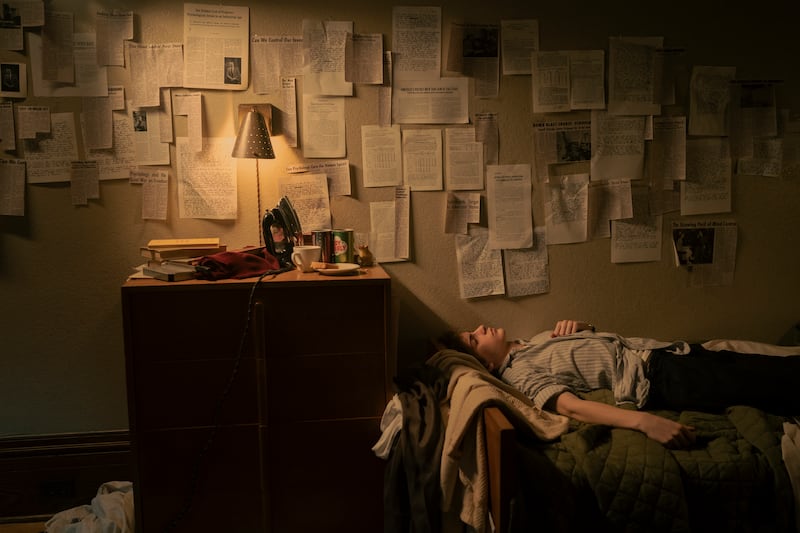
Tremblay makes Ted slightly unhinged and creepy without resorting to exaggeration or overt demonization. Boasting elements of autism and sociopathy, his character is a misfit and recluse with grandiose convictions and deep, underlying anger, which emerges in his second tête-à-tête with Mr. G, during which he follows Henry’s advice that “when the battle starts, just keep up the fight.”
That guidance is, of course, something he’ll continue to embrace during his subsequent bombing campaign. Yet the film doesn’t underline these points, instead prioritizing its psychological portrait of Ted while detailing Joanne’s investigation.
Joanne’s segments of Unabomber are compelling in a formulaic procedural fashion, but the fact that she’s obviously correct—and her naysaying (quasi-sexist) colleagues are wrong and dumb for not listening to her—sabotages some of their oomph. More interesting are Ted’s college experiences and the psych profile Henry crafts.
On a double date with his roomie, a girl kisses Ted, and he promptly freaks out and flees. Afterward, he admits to Henry that he feels like a “Martian” and that “I don’t belong here… I think there’s something wrong with me.” That there is, and Unabomber ultimately categorizes it as schizophrenia—a diagnosis that’s been disputed in real life but seems at least in the general ballpark.
As the psychologist behind the Thematic Apperception Test (TAT)—designed to help measure and define personality—Crowe laces Henry’s friendliness and encouragement with traces of malevolence that become pronounced late in Unabomber, thereby making him, at least when it comes to ego, similar to Ted. Wallis has less to do as Henry’s partner (in work and love), Christiana, and the rest of the film’s characters are more functional than fully developed.
Still, the material is brisk, and Metz’s shadowy visuals contribute to the gloomy atmosphere, which culminates with the raid on Ted’s remote Lincoln, Montana cabin and, simultaneously, Ted’s fiery showdown with Henry.
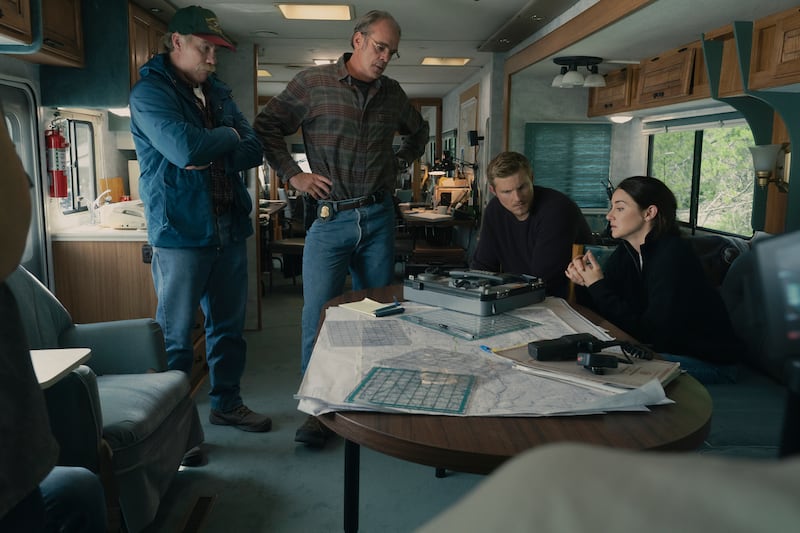
Using old news reports to keep the proceedings concise, Unabomber manages the not-inconsiderable feat of drumming up edginess from a famous story whose outcome is never in doubt. Much of that credit goes to Tremblay, whose persuasive performance seeks to understand the title character not as a boogeyman but as a fierce and deranged zealot whose anti-technology worldview was shaped, in large part, by the frustrations and resentments of his own life.
It’s also, however, a testament to the competent stewardship of Metz, who treats his subject with gravity and curiosity while never putting his thesis about Ted—and his not-so-subtle condemnation of Henry and his CIA-backed “experiments”—ahead of his baseline obligation to unnerve.