There’s drama in divorce, but virtually all of it is ugly, unpleasant, and depressing, shining a spotlight on the greed, heartlessness, and cruelty of people who once professed to be in love. HBO’s War (October 1) mires itself in that muck via a fictional high-profile split and the legal battle that ensues. And to be sure, it mines its characters’ nastiness for tense, cutthroat conflict. What it doesn’t do, however, is say anything about divorce (and those engaged in it) that isn’t obvious and unoriginal.
Paling in comparison to the likes of Marriage Story, whose realism it can’t touch with a 10-foot pole, it’s merely a cornucopia of truisms in service of a painfully predictable tale about noxious characters doing noxious things for angry, selfish ends.
Despite its best efforts, War features not a single character deserving of empathy, either because they’re cretinous or, in the case of married lawyers Serena (Phoebe Fox) and Nicholas (James McArdle), cornball bores. The founders of the Taylor & Byrne firm, Serena and Nicholas have been hired to represent movie star Carla Duval (Sienna Miller) in her legal separation from billionaire husband Morgan Henderson (Dominic West), who’s amassed his fortune by developing a responsible, non-toxic social media platform.
Carla and Morgan have fallen out of love in part because of his cheating, and after winning an award, he proves that he still has a wandering eye (among other body parts) when he’s followed to his room by twentysomething Flora Monroe (Rose Williams), and he succumbs to temptation.
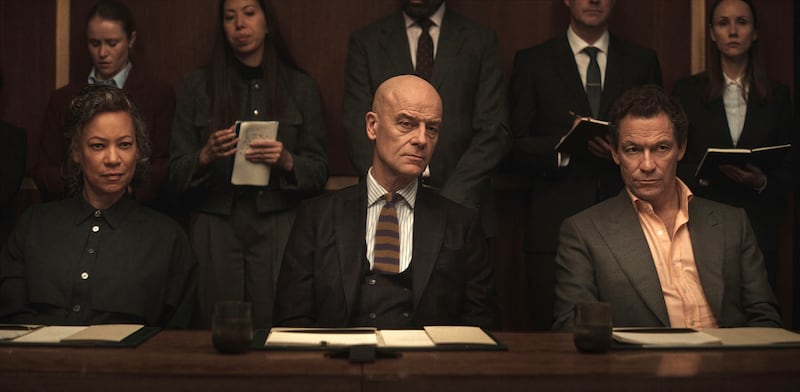
The morning after this dalliance, Flora takes a selfie of herself and a sleeping Morgan in bed because, it turns out, she’s been commissioned to catch him being unfaithful by Carla. This is a problem for Serena and Nicholas, since such honey trap tricks are bound to go over poorly in the ensuing negotiations. Nonetheless, so will Morgan’s infidelity, as is recognized by his powerhouse lawyers at Cathcarts, St. John (Pip Torrens) and Beatrice (Nina Sosanya), who are almost preternaturally composed, confident, and ruthless.
War clunkily juxtaposes the two legal teams—Serena and Nicholas’ office is all glass, bright light, and sharp angles; St. John and Beatrice’s base is mahogany, dark, and luxurious—and creates further friction by having Morgan’s attorneys covertly recruit upstart lawyer Johnny (Archie Renaux) and then have him get hired by their opponents in order to function as their inside man.

War paints lawyers as cunning strategists who rarely pass up opportunities to gain an advantage, and yet for all its supposed even-handedness, its focus on Serena and Nicholas’ marriage and impending parenthood—and its disinterest in anything about St. John and Beatrice outside of the case—immediately slants the proceedings. So too does the fact that Serena and Nicholas are wary of paying Flora to sign an NDA, whereas St. John and his mates (such as Miles Jupp’s David Shill) are gung-ho about using their mole Johnny.
As for Morgan and Carla, the show’s sympathies are likewise tilted toward the latter, who’s treated in far kinder terms than the former, both as an individual and when it comes to her desire to break the couple’s prenuptial agreement.
The sole means of making that cause work is to skew the drama in ways that are not believable given the nature of these characters and legal agreements, and a later ruse (involving Morgan’s attempt to hide assets) rings as total fantasy—unless, that is, the U.K. allows people in such circumstances to do things that American courts logically do not.
War’s portrait of divorce is superficially knotty, but its every complication is a cliché, right down to Carla’s 16-year-old son Gabriel (Aran Murphy, son of Cillian) acting out over the split and being callously exploited by both sides. It’s not that kids aren’t weaponized by one parent against another in contentious splits; it’s that the series does nothing with that idea except trot it out as supposedly novel.
War is transparent about its intentions and destinations to the point that it seems to want viewers to always be three steps ahead of it. Each maneuver’s outcome is easily deduced before it’s been set in motion, and the result is that suspense is as nonexistent as is any compassion for its protagonists. Morgan is a callous horndog (a West specialty, after The Affair) who isn’t very nice to his employees, and Carla is an entitled fading celebrity who believes that being the nominal inspiration for Morgan’s business—and enjoying an elevated lifestyle because of his success—should invalidate her prenup.
West and Miller do what they can with these unlikable upper-crusters, but their respective plights are hardly worth caring about, and feints toward equity notwithstanding, creator/writer George Kay’s bias is so apparent that the whole thing reads like a rigged game.

Much early energy in War is spent on mediation and arbitration hearings that are doomed to fail, since War runs eight episodes and is thus destined for the courtroom. When it gets there, unconvincing speechifying runs rampant and anticipated late twists materialize. Through it all, only St. John stands out; Torrens’ refined smugness and severity is a spark in these dim proceedings.
The rest, however, is varying degrees of phony and absurd, and those who make it to the conclusion of this battle—which, you see, is like war because it’s brutal and dreadful and comprised of several mini-campaigns—will be depressed to learn that Kay’s grand idea about how to resolve things is to go spineless and mushy in a laughably implausible manner.
Johnny’s caught-in-the-middle dilemma (which is exacerbated by an unexpected romance) is simply one of the series’ many schematic elements, which include peripheral goings-on involving his co-workers Saeed (Shaheen Jafargholi), Molly (Emma Laird), and Michael (Ted Lasso’s Nick Mohammed, in a nothing role).
War details how lawyers impede resolutions as much as they facilitate them by stoking clients’ fury and avarice, orchestrating delays and difficulties, and turning things nasty. Yet even then, it doesn’t have the guts to truly censure them because it wants to have it all ways; better to leave everyone with happily-ever-after warm and fuzzies.
Moreover, War refuses to come down hard on the legal profession because it’s been designed as an anthology, and its second iteration—once again focusing on a contest between Cathcarts and Taylor & Byrne—is already in the works. Let’s hope audiences declare a mistrial before that happens.