What if what we’re all craving right now is the world of Wonka?
Bear with me. It won’t solve the real problems, but maybe what we all need is candy, silly songs and dances, and time in a magical factory. And what’s more dreamily surreal than a foppish man creating delicious sweets in a mysterious factory? Even stranger, one staffed by an antic crew of singing and dancing Oompa-Loompas?
Willy Wonka’s absurdism has enchanted us since 1964, when Roald Dahl published Charlie & the Chocolate Factory. Seven years later, Gene Wilder’s Willy Wonka & the Chocolate Factory arrived, a box office disappointment that later became beloved.
That film’s spirit fuels Netflix’s reality series Wonka’s The Golden Ticket, which premieres Sept. 23. Over nine episodes, a dozen teams of two take on gooey challenges. Initial pairs are quickly dissolved, and it’s clear people would sell out their own parents for the $3 million grand prize.
Last October, I traveled to the Australian set to experience just how fabulous and intricate it is—and, most importantly, gauge just how Wonkian the show really might be. Contestants had not yet arrived. And the host wasn’t there either. That’s understandable–he is dead. For this latest adventure, AI brings Gene Wilder’s unmistakable voice eerily to life. Netflix gained Wilder’s estate’s blessing to use the favorite Wonka’s words.
Hearing Wilder say, “The losing team will say goodbye to anyone still trapped on their side,” is slightly creepy, given that he died over a decade ago. Yet it’s undeniable he’s the beloved Wonka, and the right voice to usher us into this very strange world.
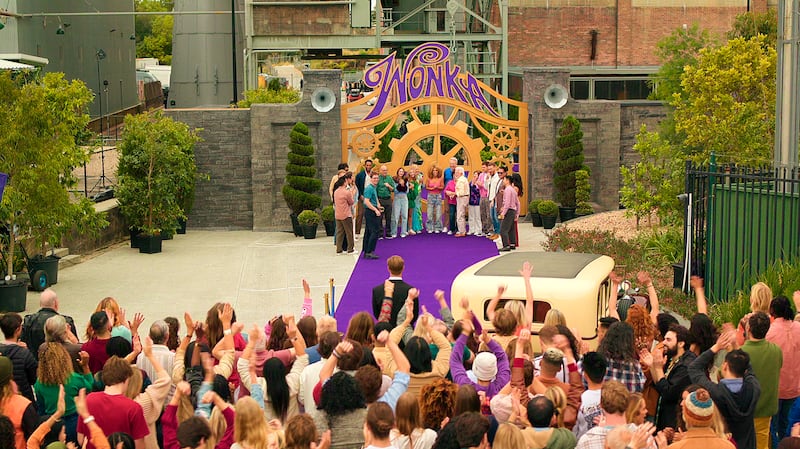
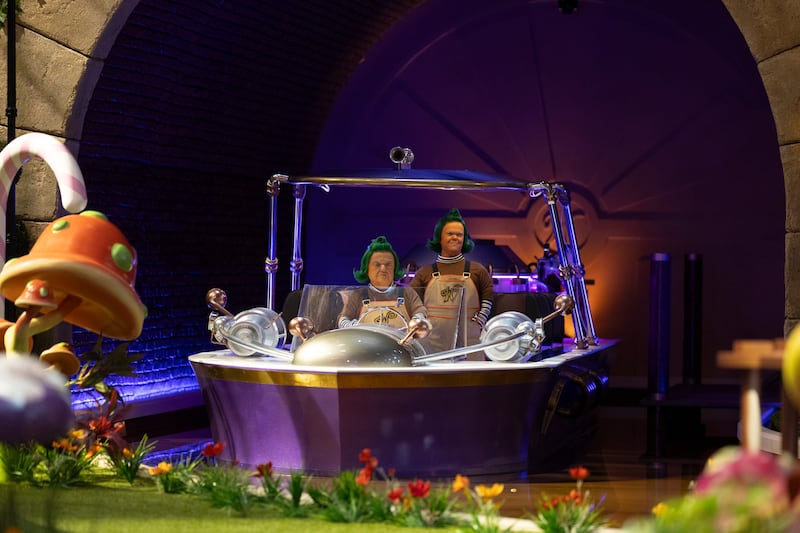
The co-showrunner, production designer, and magic consultant, however, were happy to chat as they put final touches on the wacky, edible set. I can confirm that last detail: I snacked on grass and mushrooms (not those) at Village Roadshow Studios, on Australia’s Gold Coast. And I rode the Wonkatania, a customized boat that chugs along a chocolate river, fed by a chocolate waterfall.
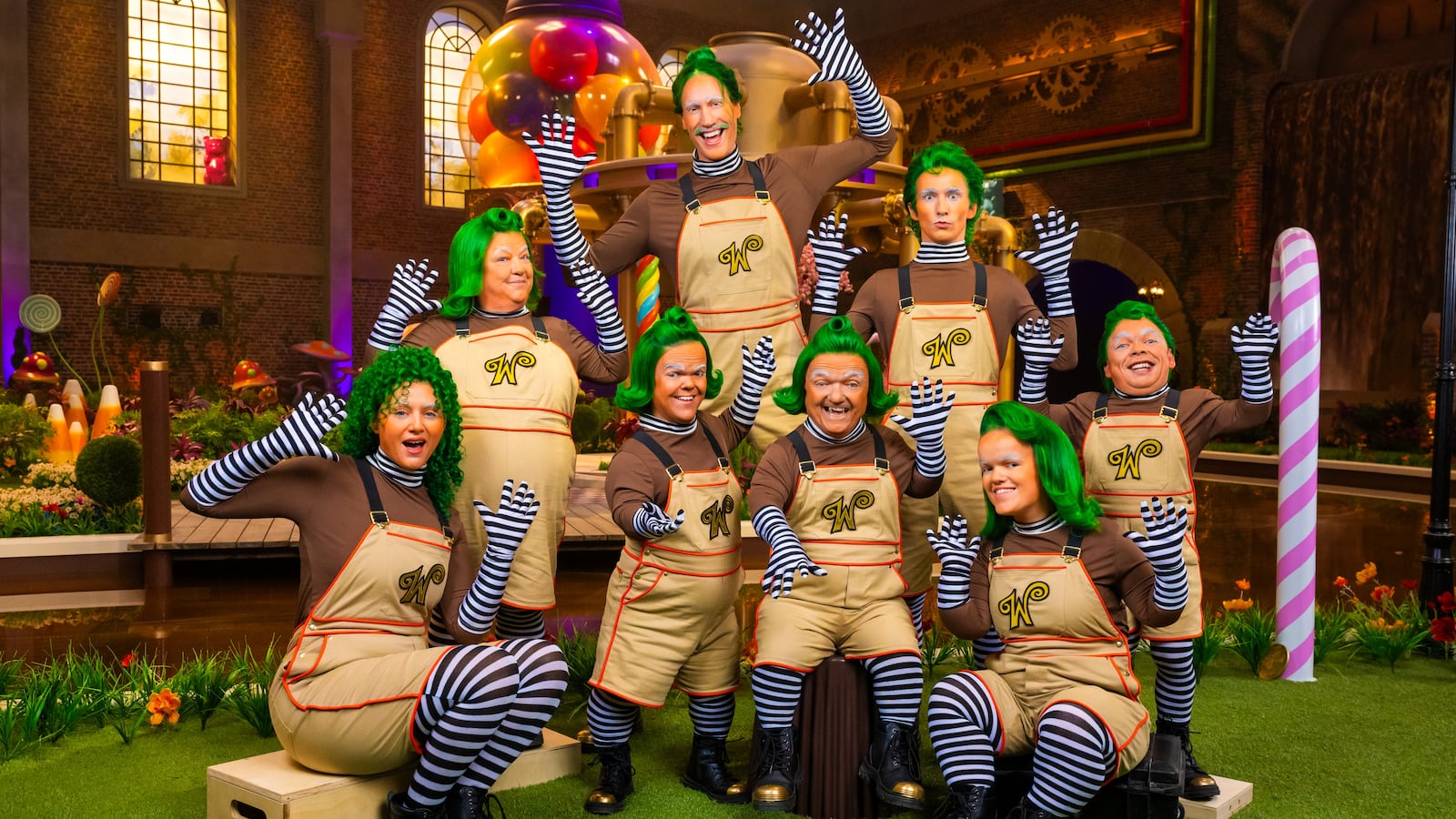
Rusty Goffe, an original Oompa-Loompa and the series’ star, was on board as we floated on 27,000 gallons of actual melted chocolate.
Then 24, Goffe was the youngest Oompa-Loompa in the film. He’s now 77 and intrinsic to the series. Some challenges involve him, or at least his image, as players gaze at a gallery of Rusty portraits and try matching them with that game’s main clue. (It’s harder than you’d think.)
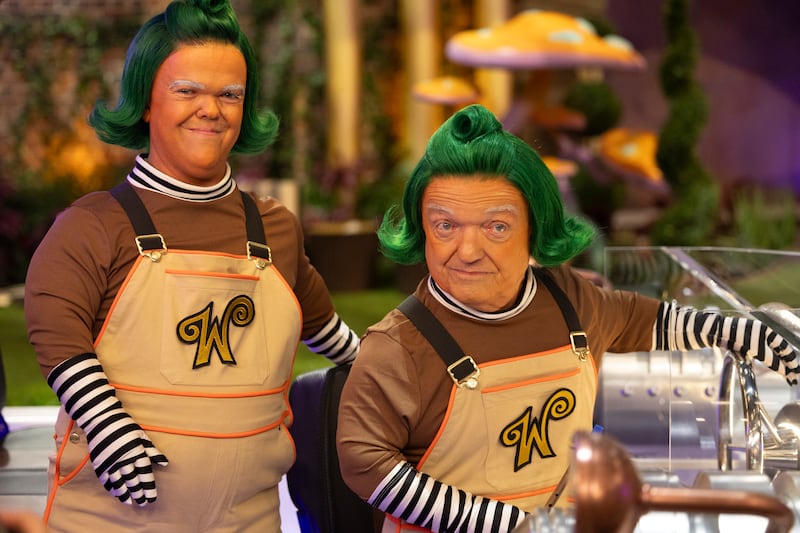
As we wend down the river, Goffe couldn’t help but compare this set to the movie’s. That waterway “melted and it all stunk,” he said. “This smells better. That was water with dye, and sugar, and cream in it, and everything got stuck. They had to take two weeks off and clean the river.”
Also improved, he said, is the process that transforms humans into Oompa-Loompas.
“This is absolutely fantastic,” Goffe said. “The makeup is different. It’s really thin. Then it was a paste. We used to hide from the makeup artist. And the wigs are more comfortable.”
When he wasn’t chatting, Goffe consistently tooted a sweet, if not particularly tuneful, melody on a pennywhistle. Shooting the Netflix series “reminds me of a happy time in my life,” he said. “When I heard Gene Wilder had passed, I cried. He was just a lovely gentleman.”
Like so many, Goffe watched the film repeatedly with his family. His son, Ben, vouches for this. Also outfitted as an Oompa-Loompa on the series, he’s along for the ride.
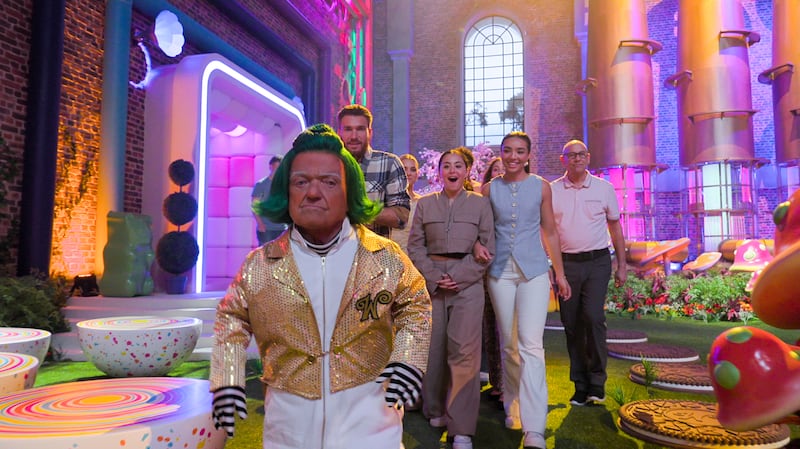
I’m forever indebted to Ben for teaching me a valuable, albeit underrated, skill: the Oompa-Loompa dance. (You never know when you need to win a bar bet or liven up a party.) I may end up being less grateful for the earworm, “Oompa-Loompa doompety doo/I’ve got a perfect puzzle for you/Oompa-Loompa doompety dee/If you are wise, you’ll listen to me,” which has played on loop in my head ever since.
The dance is simple when you leave out the cartwheels. Learning choreography from a little person in orange makeup, a retina-searing green wig, lederhosen, and striped stockings, while the aroma of chocolate floods your senses, is a strange way to spend a fall afternoon. Yet, that wasn’t even the weirdest part of the day.
When our small group of reporters and Wonka VIPs entered the sound stages where the Wonka factory loomed, we were given chocolate bars with the golden foil “W” tucked inside. We briefly teamed up, and I was paired with Joe Hegyes, a 6-foot-4-inch content creator from Brooklyn in full Oompa-Loompa drag.
“I made an Oompa-Loompa video, a parody, and here we are,” he said.
We walked down a long hallway that feels like an optical illusion, but is quite real as the ceiling slopes toward the floor. At 5-foot-3, I rarely have to duck, but I was crouching by the time we reached the end of the room; Hegyes was doubled over. Along the way, we passed so many doors, I expected Salvador Dali to alight from behind one, walking a giant anteater.
As we perched on little chairs, a gumball machine between us, a disembodied voice instructed us to twist the handle. A gold and a purple candy popped out. We ate the marzipan balls, and a cold fog filled the room. Within seconds, I couldn’t see Hegyes, though he was just inches away. Losing sight of a very tall man in an Oompa-Loompa get-up is disconcerting, yet he vanished–hustled out one of those doors.
On the show, those pulled through the little doors are placed in an enormous bubblegum machine, and their partners must free them. Folks liberate one another during various challenges, and initial groupings quickly dissolve during eliminations.
There are many ways to go missing in this game. Wonkavision 2.0, the candyman’s television invention, adds a new dimension to getting canceled as contestants disappear. There are also myriad ways to get gooey; challenges often involve sticky substances. Players climb up a slick slide to rescue other contestants trapped in a honeycomb’s cells. Keeping with a Wonka sense of realism, 5,000 gallons of honey were used in this challenge.
People sleep in beds resembling marshmallows, hang out in the conversation pit where velvet furniture looks like blueberries, or in the candy-crammed kitchen, and plot revenge on other players.
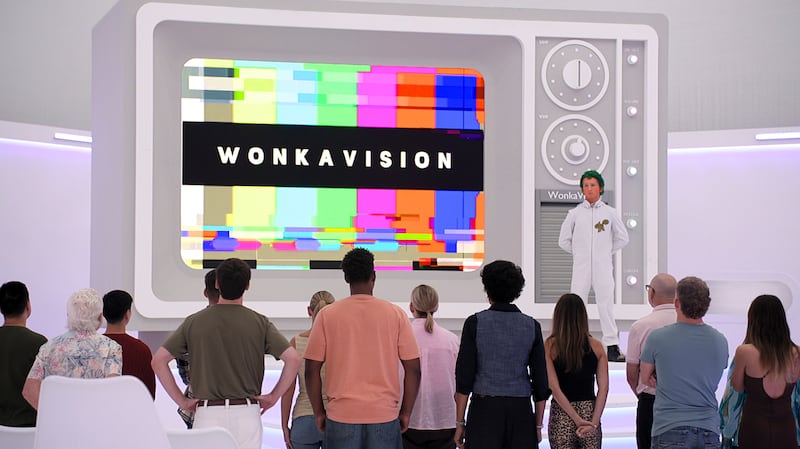
What separates this from many reality shows is a playfulness baked into the challenges. Wonka’s The Golden Ticket avoids the desperation of shows where contestants compete for love and fame. After all, does candy ever leave you for a younger version? When has chocolate let you down?
Inevitably, some reality tropes are familiar: contestants overshare, baby Machiavellis try to forge alliances, and swear eternal devotion to someone they didn’t know days ago. Twelve teams of two compete, including what a Wonka show should have: a grandson and grandfather, harkening to Charlie and Grandpa Joe.
Everyone, understandably, wants the $3 million prize, which the show touts as “a lifetime supply of money.” That much money can’t be dismissed. But what puts the icing on this show is Wonka himself. Wilder’s voice from beyond isn’t overused, managing to be, at once, weird, jarring, yet comforting. The actor’s AI voice is broadcast over speakers in the sleeping quarters, saying, “Good morning, dreamers, time to rise and shine.”
Wonka, in any version, is a brilliant, arrogant character who was an excellent judge of people.
Generations love this story, the music, and the magic. Wonka creates candies and machines the rest of us can’t imagine. We also love his sense of justice. The story has a few miserable brats put in their place, and the good guy wins in the end. Translating that to a reality show required hewing close to the world of Wonka while expanding it to include the contestants and the audience.
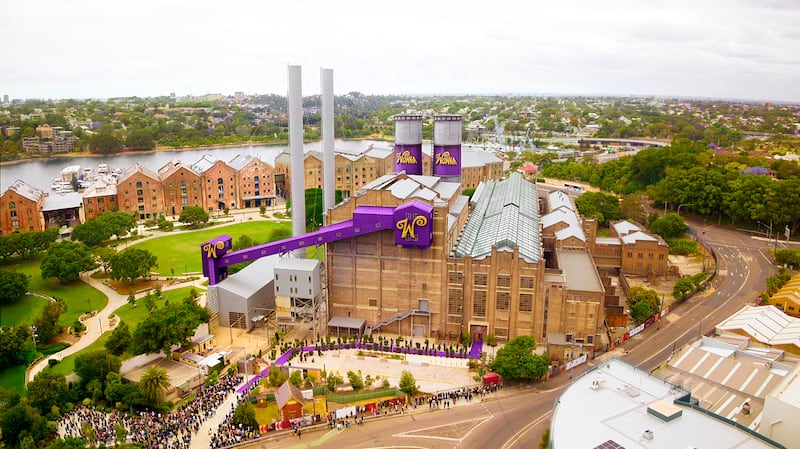
The behind-the-scenes artisans and execs felt a tremendous responsibility to get this series right. After all, Wonka’s had three theatrical films to live up to: the Wilder one, Johnny Depp’s 2005 acid trip, Charlie and the Chocolate Factory, and Timothée Chalamet’s earnest run in 2023’s Wonka. It’s also been on stage as a ballet, an opera, and a Broadway musical.
Netflix bought Dahl’s literary rights five years ago and can reformulate his works in any format.
“There’s just such an appetite for this movie, right?” said Emer Harkin, an executive producer and co-showrunner. “We all grew up with it. We all know it inside out. And is there anything more experiential than putting people living in Wonka’s chocolate factory? I feel like every adult on the planet wanted that golden ticket, and so we just thought it would be just such an amazing experience to create for a global audience, to actually live the dream–or nightmare.”
Dream or nightmare, a Wonka series must include magic. Any candy maker who can make people inflate like giant balloons, turn purple, or have their bones turn to taffy is a magician, so the series needed one.
“Whenever I work on any kind of production within a world, especially one that has IP attached, there are rules, and we need to play by the rules, so it makes sense,” Adam Mada, the production’s magic consultant, said. “It wouldn’t make sense for an Oompa-Loompa to come out and start doing a magic show or do any magic themselves, because the Oompa-Loompas are not magic.
“And because there is no Wonka, Wonka is the factory, it is the space, it is the world,” Mada continued. “We had a little bit of creative license on this production, but what’s important is that the magic effectively comes from the space, from the building; it’s things happening to people in the space.”
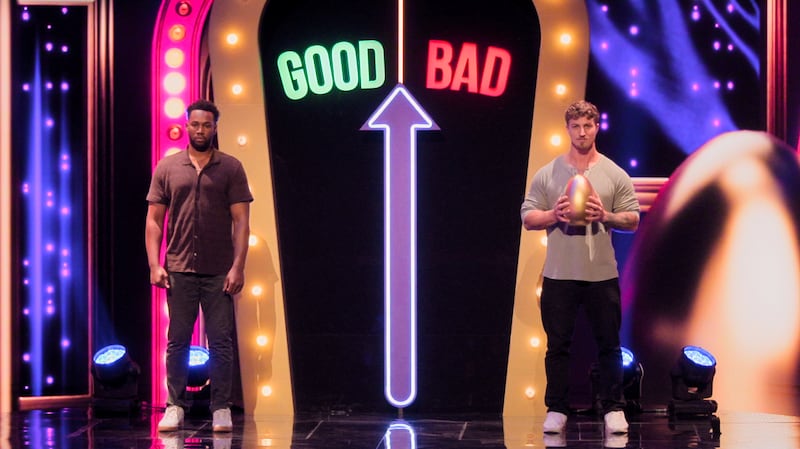
One challenge has contestants lick edible wallpaper to reveal clues. It adds another level of surreal as players get way too personal with walls. Gummy-like statues, in the image of Goffe, accessorize rooms. The design intent all along was to keep Wonka’s particular brand of steampunk.
“I wanted it to be more realistic and less CGI,” said Christopher Batson, production designer.
The explosion of bright colors and general sense of happiness encourages viewers to imagine what it would be like to walk down a chocolate cobblestone path, and how they would cope with challenges.
“I think it’s just about experiential television and an evocative, meaningful material that touches an audience and sort of makes you go–what would I do?” Harkin said. “‘Oh, my God, I don’t know what I would do in that situation.’ And I think that’s been sort of our focus as we approach. We really wanted to do something different here, and very much live within the brain of Wonka, and stay true to Wonka, and sort of dull out all of the noise and just say, like, ‘What would Wonka do?’”