

Brave are the artists who seek to remake or adapt an icon, braver still those who mount such attempts with something as universally cherished as It’s a Wonderful Life. A modest jewel of a show bearing the same name at New York City’s Irish Repertory Theatre—playing until Dec. 31—succeeds in its mission by mounting something extremely small-scale, short (just 70 minutes), polished, and lovingly crafted.
The charm of Anthony E. Palermo’s witty reimagining of Frank Capra’s classic 1946 movie is in the simple, precise execution of the project (first staged in 2015), and the ensemble talents of its cast: Rufus Collins, Ali Ewoldt, Reed Lancaster, Ashley Robinson, and Leenya Rideout.
With a fully decorated Christmas tree beside the stage (lovely, but not just there to make the audience feel festive), James Morgan’s compact stage design conjures the studio of the WIRT Radio Station in New York City. It is Christmas Eve, 1946 (four days after the original release of Capra’s movie), and a cast of five actors prepares to play It’s a Wonderful Life’s multiple characters in a radio-play version of the film.
There are tall microphones, tables with various objects ready to be used to create secondary sounds, and—hidden behind the cast—musical director David Hancock Turner tunefully ratcheting up the drama on a piano.

If you are a fan of radio (and radio drama in particular; I’m a longtime addict of BBC Radio 4’s The Archers), what unfolds, directed with a subtle ingenuity by Charlotte Moore, is a particular treat. The actors not only play an array of the movie’s characters, but also—when not speaking—supply all the production’s incidental sounds, like footsteps on gravel made by striking a pair of boots against a suitcase.
The story and plot of the original have been edited, but not fundamentally tampered with. Lancaster plays the put-upon George Bailey with the same flustered charm and raw desperation that James Stewart bought to Capra’s movie—a suicidal George realizing the value of life, family, friendship and community by being allowed to see, via an angel Clarence (keen to help George and get his wings), what would have happened to his loved ones and the town of Bedford Falls had he never existed.
Early plot points like his courtship and marriage to wife Mary (Ewoldt) pass by in a flash. Robinson brings a perfect haplessness to Uncle Billy—whose misplacing of $800 into the hands of robber baron villain Mr. Potter (a boomingly malevolent Collins) ultimately leads George to contemplate taking his own life.
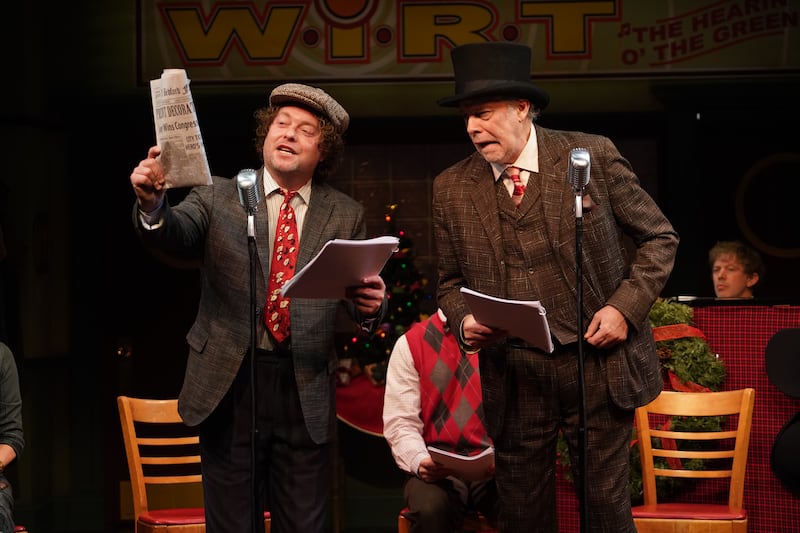
The play (with fine ‘40s costuming by David Toser) is a tribute and testament to radio; the urgency of Clarence’s mission and George’s personal odyssey feel just as epic and wrenching on a small stage in an imagined radio studio as they do on the screen. The show manages to hook us into the original story, while also showcasing the skills of a radio cast and crew rendering such a production on a shoestring. (Rideout is particularly funny, playing a variety-packed gallery of secondary characters, including a gruff bartender and cop.)
Threaded within the 70 minutes are era-specific commercials to break up the action, and songs for each actor and the company as a whole (including seasonal favorites such as the climactic “Auld Lang Syne”). And for the final reveal of whether dear Clarence will finally get his wings, the play conjures one last winning moment to delight the audience.