
Genre cinema endures because of its malleability—its themes and tropes are compatible with any number of psychological, cultural, and political takes.
Your Mother Your Mother Your Mother (September 25, in theaters) confirms this fact, embracing the conventions of both action movies and neo-noirs to tell the story of a Muslim hitman attempting to protect his children while caught between warring factions. Riven by clashing impulses, it doesn’t completely cohere. Nonetheless, it gives two-time Oscar winner Mahershala Ali a role of gripping intensity and (until its climax) compelling complexity—resulting in his finest performance since 2016’s Moonlight.

When he receives word about his wife’s passing, Latif (Ali) is busy murdering a man in a public bathroom with a giant engraved blade. The killer’s black Islamic garb suggests he’s a professional, though that doesn’t mean things go smoothly. Discovering that there are no available paper towels, he has to use baby wipes to clean his weapon before leaving the bagged-and-duct-taped corpse on the floor so he can tend to his family business.
Latif’s sloppy departure earns him numerous phone calls from his employer, Mike Mahmoudi (Laith Nakli), which he strategically avoids. At the service for his deceased spouse, he can’t pray; too consumed are his thoughts (and heart) with anger at God for taking his beloved and then expecting him to bow before Him. Latif has lost his faith, and he suffers a scolding from his imam, Abdul Malik (Giancarlo Esposito), for skipping prayers and also for being a hitman.
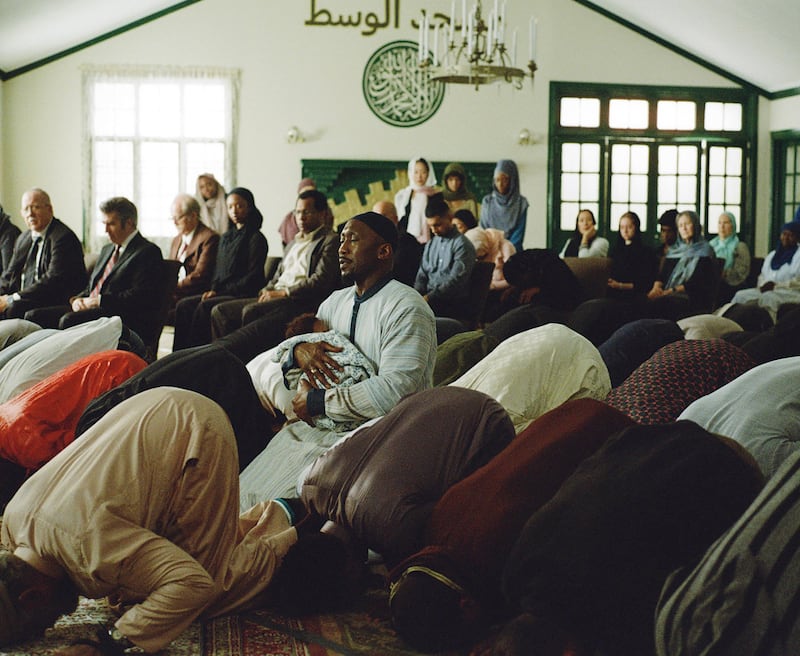
“Violence was a last resort,” says Abdul about Latif’s latest slaying, to which Latif replies that he was avenging a holy man and confesses that he uses a sword rather than guns because, “I’ve got my own code.”
That may be true, but the precise nature of it is a tad too vague in Your Mother Your Mother Your Mother. Its strength lies more in its immersion in Latif’s devout religious life and strained domestic circumstances. There’s an authenticity to writer/director’s Bassam Tariq’s portrait of Latif’s belief in, and adherence to, Islamic rituals that extends to the man’s dynamic with his teenage daughter Fatiha (Adia), 10-year-old son Quadir (Jahleel Kamara), and infant daughter.
The last of these becomes the film’s unusual catalyst. Because the baby won’t stomach formula and Latif is determined to keep her on breast milk (as her mother would have wanted), he embarks on a quest to find her natural sustenance.
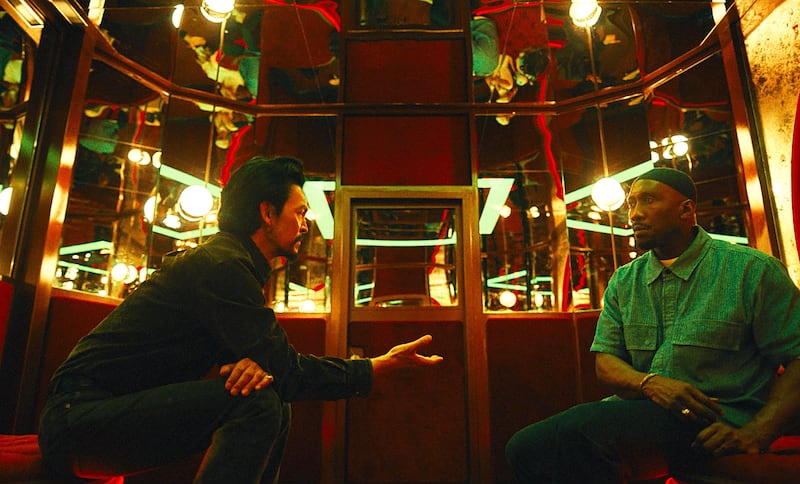
That Your Mother Your Mother Your Mother revolves around finding breast milk is the first of many idiosyncrasies that bestow it with unique character. In search of the coveted liquid, he visits a clinic where Fatiha attempts a robbery. This is a headache almost as great as the one posed by Mike, who demands that Latif help his scumbag nephew Hatty (Abubakr Ali) by executing Pastor Hwan Yoon (John Cho), a militant cowboy hat-wearing Christian zealot who believes that his aunt’s prayers brought him back to life post-Iraq War injury. Hwan intends to cleanse the Earth of Hatty and his porn movie business (which he thinks is a cover for worse crimes), and Latif’s dilemma isn’t that he can’t take him out—it’s that both Hatty and Hwan are equally distasteful.
Latif would prefer to stay out of this feud and focus on providing for his grieving family and wrestling with his grief over having been MIA when his wife was dying. Ali has a stoutness and gravity that speaks to Latif’s formidable lethality, yet he leaves room for remorse and self-loathing about his personal and parental failings. The latter, alas, don’t stop piling up, and after his kids are left in the company of Hatty’s working girls (much to his chagrin) and his baby decides that it wants to suckle on one of them, he determines that the prostitute may be the key to solving this problem.

He’s wrong, and Your Mother Your Mother Your Mother soon situates him in the middle of a war between two sides that both want him gone. Ali’s evocation of Latif’s desperation, frustration, and ruthlessness transforms the protagonist into a magnetic center of attention. Tariq’s script melds domestic drama, spiritual angst, and kill-‘em-all mayhem, and this combination, if not entirely unique, imbues the material with weight. So does a kinetic score by Son Lux, which keeps the mood taut and ominous, melding Islamic and Western traditions to create something fittingly eclectic.
Unfortunately, however, Your Mother Your Mother Your Mother can’t quite synthesize its disparate elements, to the eventual detriment of its excitement. Leaning so heavily into Latif’s rapport with his offspring—in particular, Fatiha, played movingly by Adia—may contribute to its depth, but it means that there’s far too little focus on the adrenalized action that is its calling card. Tariq’s centerpiece skirmishes are suitably fearsome and, better still, laced with doubt, regret, and fanaticism. Yet it’s as if Tariq can’t quite pin down his priorities, and the byproduct of his indecisiveness is a shortage of slam-bang moments.
As the proceedings’ faith-fixated villain, Cho—sporting gold grills, scraggly facial hair, and a crazed messiah-complex look in his eyes—is such an appealing figure that it’s too bad he’s never granted the opportunity to blossom into three dimensions. Nonetheless, Your Mother Your Mother Your Mother is unmistakably Ali’s show, and the headliner carries it with a sincerity, severity, and, in quieter instances, sensitivity that marks Latif as a kindred spirit to big-screen assassins gone by (such as Forest Whitaker’s slayer in Ghost Dog: The Way of the Samurai).
Wrestling with his contrasting desires and responsibilities, his Angel of Death is transfixing. Still, he’s sabotaged by a finale that opts for the most predictable salvation-centric route and, in the process, reveals some of the preceding action’s knottiness to be a pose.
For all its intriguing embellishments, Your Mother Your Mother Your Mother hews a tad too closely to tradition—or perhaps it’s just that its optimism (about the possibility of salvation and the power of faith) resonates as too comforting for a tale that seemed to comprehend the inescapable contradictions of its main character. Nonetheless, when Ali is trying to slice and dice his way to safety, Tariq’s film proves a daunting and devoted genre disciple.