Organized Labor has been Hurting Since Well Before the Passage of Right to Work in Michigan
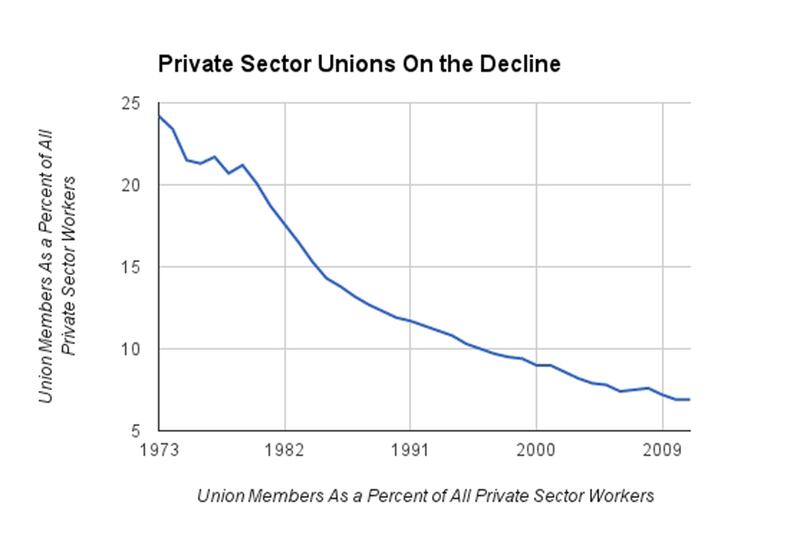
Chart of the Day: the fall of the house of labor.

Bill Pugliano/Getty
The recent passage of a right-to-work law in Michigan, once the beating heart of the union movement and its auto-industry base, will sharply curtail the ability of unions to charge dues to the workers they represent. It is just another in a long line of defeats for organized labor.
Union membership peaked in the 1950s at around 35 percent of all workers. The 50s were also the height of America’s postwar industrialization and the union power that accompanied it. Since then, the industries in which unions were the strongest—heavy manufacturing—have shrunk, moved offshore, or moved to states in which unions couldn’t gain much traction.
The chart above shows the private-sector union membership rate since 1973, when it stood at 24 percent, according to data collected at unionstats.com. The proportion has been steadily declining ever since then, falling off by more than two thirds. Now, just under 7 percent of all private-sector workers are union members, compared with 37 percent of all public-sector workers, and 11.8 percent of all workers. For the private sector, it’s gone from about one in every four workers being in a union to nearly 1 in every 14.
See more of our coverage in your search results.

Got a tip? Send it to The Daily Beast here.
Register below to read this article for free or subscribe
to unlock unlimited access to The Daily Beast.
Monthly
$1
First month then $5.99/month
Annual
$35
First year then $59.99/year
Premium
$79
First year then $119.99/year
*Substack access provided by the next business day, using your subscription email. Choosing the Premium plan constitutes your permission to share your subscription email with Substack and your agreement to Substack’s Privacy Policy.
Already have an account? Sign In
Looks like you already have a subscription!
You're all set!
Thanks for subscribing.