RFK Jr. Gets Brutally Fact-Checked by The New York Times
The newspaper said he dodged the real story about cuts to life-saving medical funding.

Kevin Lamarque/REUTERS
Get The Swamp newsletter delivered straight to your inbox
By clicking “SIGN UP” you agree to our Terms of Use and Privacy Policy.
Robert F. Kennedy Jr. is at war with The New York Times over a story about a 5-year-old girl with incurable brain cancer.
The Nov. 15 piece investigated major changes to scientific grant funding under the second Trump administration, specifically its November 2025 decision to terminate the Pediatric Brain Tumor Consortium (PBTC).
After the health secretary accused the Times of publishing a “deceptive hit piece,” the Times responded on X: “Mr. Secretary, your points are already included in the piece,” the paper wrote. “What you don’t address here is the main point of the article: how the Trump administration’s decision to dismantle this longstanding research effort has put children like Ryleigh Schecter in a position where they have fewer options.”

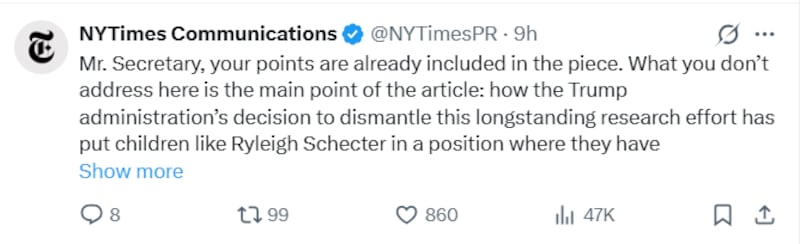
The New York Times told Health Secretary Robert F. Kennedy Jr. that his complaints were "already included" in its story.
NYT / X
In his lengthy X post, Kennedy, 72, accused the paper of distorting the facts, claiming it “implies that Trump administration officials are terminating pediatric cancer research and omits key facts about the administration’s continued funding and support for that work.”
Kennedy blamed Joe Biden, 84, for the program’s demise and accused the paper of leaving out data he called a “critical part of the story.”
He argued that the National Cancer Institute (NCI) “did what it takes to expand research on pediatric tumors by putting more funding, more expertise, and more institutions (42 instead of 16) behind this research.”
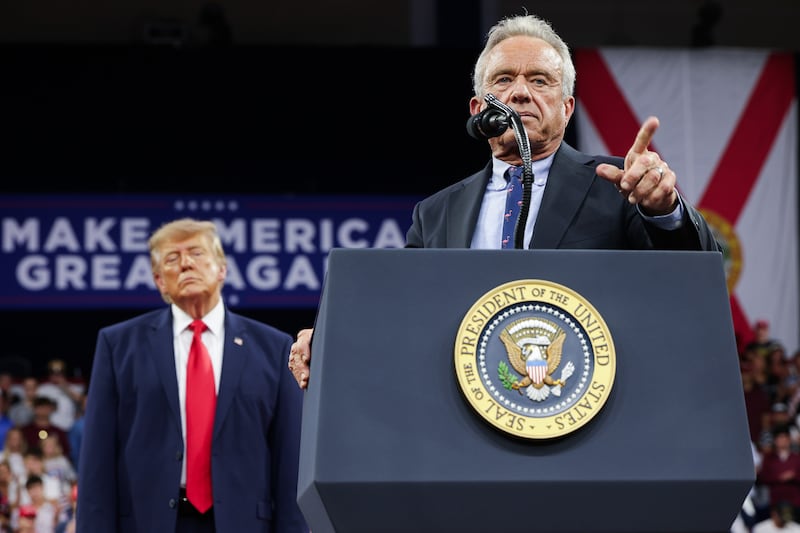
Health Secretary Robert F. Kennedy Jr. speaks at a rally in Fort Myers, Florida, on Oct. 23 as President Donald Trump looks on.
Alex Wong/Getty Images
“A grant ending is not a research commitment ending,” Kennedy concluded. “The Times should correct its story. Patients and families deserve the complete facts.”
Schecter, from Twinsburg, Ohio, was diagnosed this spring with DIPG, a tumor that grows in the brain stem and enmeshes itself in the surrounding tissue in such a way that surgeons can’t remove it. There is no proven treatment beyond radiation therapy, and children typically die within 12 months of their diagnosis, according to The Times.

At the heart of the battle between Kennedy and the Times is the PBTC: a 27-year-long alliance of 16 children’s hospitals which the Times reports was a “cornerstone” of the battle against childhood brain cancer. That is, until August 2025, when the National Cancer Institute declined to renew the consortium’s $4 million grant, and eight studies were shut down or put on hold.

Health Secretary Robert F. Kennedy Jr. speaks at a rally in Fort Myers, Florida, on Oct. 23 as President Donald Trump looks on.
Alex Wong/Getty Images
The paper reports the Schecter family once had multiple sites within half a day’s drive of their home running DIPG trials. Dr. Ira Dunkel, the pediatric oncologist who chaired the consortium, called the shutdown “catastrophic.”
In response, the NCI said the shutdown was “not a cost-cutting measure,” but instead the result of low enrollment in its studies. They argued that folding the work into a larger network focused on all childhood cancers would make it more efficient.
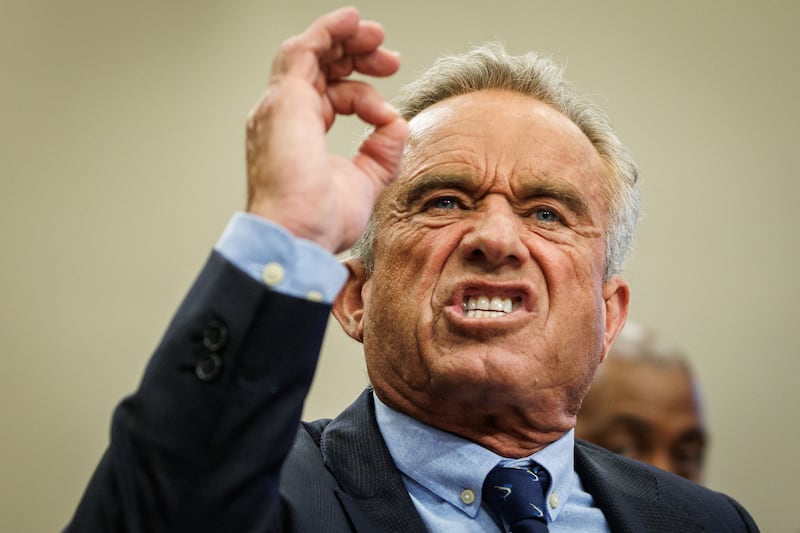
Samuel Corum/Getty Images
The administration has since rolled out new grants for other pediatric cancer studies, but the PBTC has not returned. The Times wrote that for parents counting their child’s life in months, a 15-month bureaucratic lag is “agonizing.”
Ryleigh’s family eventually tracked down TarGeT-A, a Phase 2 trial run out of Nationwide Children’s Hospital in Columbus, Ohio. Seven months after her diagnosis, she’s reportedly doing well.
After The Times asked about the suspended trials, the NCI updated its website on Nov. 3 to say three of the consortium’s studies “are planned to reopen to enrollment in late 2026 or early 2027.”

Robert F Kennedy Jr.
MARK MAKELA/REUTERS
The online feud comes as Kennedy faces growing criticism over how he runs the country’s health agencies. A longtime vaccine skeptic with no formal medical training, Kennedy has continued to question treatments backed by decades of safety data. Immunization rates have slipped on his watch, and the U.S. is facing its worst measles surge in more than 30 years, losing its official measles-free status this month.

The Department of Health and Human Services did not immediately respond to the Daily Beast’s request for comment.
See more of our coverage in your search results.

Got a tip? Send it to The Daily Beast here.
Unlock a year of full access to The Daily Beast for $35.
Monthly
$1
First month then $5.99/month
Annual
$35
First year then $59.99/year
Premium
$79
First year then $119.99/year
*Substack access provided by the next business day, using your subscription email. Choosing the Premium plan constitutes your permission to share your subscription email with Substack and your agreement to Substack’s Privacy Policy.
Looks like you already have a subscription!
- Account (completed)
- Payment (completed)
- Confirmation (completed)
You're all set!
Thanks for subscribing.
- 1Account
- 2Payment
- 3Confirmation
Sign in or create an account
Register below to read this article for free or subscribe
to unlock unlimited access to The Daily Beast.
Monthly
$1
First month then $5.99/month
Annual
$35
First year then $59.99/year
Premium
$79
First year then $119.99/year
*Substack access provided by the next business day, using your subscription email. Choosing the Premium plan constitutes your permission to share your subscription email with Substack and your agreement to Substack’s Privacy Policy.
Already have an account? Sign In
Looks like you already have a subscription!
- Account (completed)
- Payment (completed)
- Confirmation (completed)
You're all set!
Thanks for subscribing.
- 1Account
- 2Payment
- 3Confirmation
Sign in or create an account
Login dialog
Loading comments…