Should Palestinians Visit Nazi Concentration Camps?
A Palestinian professor takes his students to visit Auschwitz to learn about the roots of their conflict with the Israelis.
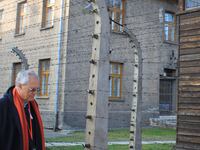
Photo courtesy of Dr. Mohammed Dajani
“We are breaking a big taboo. We are challenging the collective narrative of the Palestinians regarding the Holocaust.” Dr. Mohammed Dajani has become known worldwide as the Palestinian professor who led a group of students to visit the Auschwitz concentration and extermination camp. But he began life with a very different point of view. “We grew up in an environment that was totally anti-Jewish,” Dajani—a native of Jerusalem—explains. “People harbored a lot of anger towards the Jews for causing the Nakba (Catastrophe). They lost their property, they lost their home, they lost their identity. I grew up on the idea that the Holocaust was a conspiracy.”
But something happened during Dajani's early adulthood that helped change his black-and-white view of Israelis. And recently, he organized a trip that caused a firestorm. The plan was to take 30 Palestinian students to visit Auschwitz. At the same time, 30 Israeli students planned to visit a Palestinian refugee camp, where they would hear from refugees of the Nakba. Dajani strongly believes that reconciliation between the two communities will never happen without each community understanding the historical, and current, trauma of the other.
“Palestinians should not compare the Nakba with the Holocaust,” he says. “While the Holocaust was the Final Solution for the Jewish people, the Nakba was not the Final Solution for the Palestinian people. It wouldn’t have been possible for Jews to sit with Nazis and reach an agreement. Within the Palestinian-Israeli conflict, it is possible for Palestinians and Israelis to reach a comprehensive, just settlement that will accommodate both peoples. That’s why I think that teaching about the Holocaust is important. For Palestinians to realize that there is hope, and that in negotiation the path to peace lies.”
At the same time, he is deeply uncomfortable with Jews using the Holocaust “to rationalize, for us [Palestinians], why they had to deport us from our homes in order for them to come and live in them. It doesn’t mean,” he insists, “that if we learn about the Holocaust we will not demand our rights, or [will] lose our national identity.”
But this nuanced message was lost on those who stirred up controversy following the trip. Students at Al Quds University—where Dajani was the head of the American Studies Department and library director—boycotted him, claiming that he was “trying to sell Palestinians the Zionist story,” or was “collaborating with the Israelis to undermine Palestinian nationalism.” Dajani knew to take things seriously when he started receiving threatening letters at his office.
Get the best of The Beast delivered right to your inbox
By clicking “SUBSCRIBE” you agree to our Terms of Use and Privacy Policy.
His students also faced negative responses to the trip, as well. However, “many of them were courageous,” Dajani says proudly, “to stand up and say, ‘We went to learn, and we learned a lot.’”
See why Dajani persists with his work, how one student was affected by the trip and, most surprising, who else wants to go:
See more of our coverage in your search results.

Got a tip? Send it to The Daily Beast here.
Register below to read this article for free or subscribe
to unlock unlimited access to The Daily Beast.
Monthly
$1
First month then $5.99/month
Annual
$35
First year then $59.99/year
Premium
$79
First year then $119.99/year
*Substack access provided by the next business day, using your subscription email. Choosing the Premium plan constitutes your permission to share your subscription email with Substack and your agreement to Substack’s Privacy Policy.
Already have an account? Sign In
Looks like you already have a subscription!
You're all set!
Thanks for subscribing.