Stopping the Small Hands of Slavery
The Peace Prize for Kailash Satyarthi and Malala Yousafzai was well deserved. But their work is just a beginning. And the problem of forced child labor is enormous.
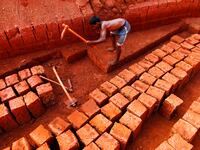
Danish Siddiqui / Reuters
MUMBAI, India—More than a decade ago, I accompanied Kailash Satyarthi on one of his rescues. It was dusk when we drove into a dusty village in eastern Uttar Pradesh and made our way into a carpet factory, which was really a mud hut with some looms. There were only adults there. Satyarthi stepped outside and pointed some flashlights in the fields. His fellow activists ran off, and soon returned with a bunch of emaciated children, all of them child workers who had been told to hide because the word had spread: the Bachpan Bachao Andolan people had arrived.
Satyarthi founded the grassroots organization, the name of which translates as Save the Childhood Movement, in 1983 to help free little boys and girls from forced labor. In India, economic pressures force poor and marginalized families to hand over their children as bonded labor in lieu of loans, or children end up working alongside their families in bondage.
For his work— identifying and rescuing children from slavery with the help of other nongovernmental organizations, and helping to rehabilitate them— Satyarthi was awarded the 2014 Nobel Peace Prize last week. He shares this with Pakistan’s Malala Yousafzai, a tenacious advocate for the rights of all children, and girls in particular, to go to school and receive a quality education, free from discrimination, attacks and fear. By honoring Satyarthi and Yousafzai, the Nobel Committee spotlights the need to protect the rights of children in the subcontinent and around the world in what should be the beginning of a global mission to end abuses against children.
On December 9, 2012, when Yousafzai was shot and severely wounded by a gunman as she was taking a bus from school in Swat, Pakistan, she became a symbol of the challenges students face amid internal conflict and war.
Human Rights Watch has been campaigning for years to make schools safe. In some cases, armed groups target teachers and schools because they see them as symbols of the government. In other cases, groups carry out attacks because they oppose what is being taught, or to whom. Students, schools, and education are also endangered when national armed forces or armed groups use schools for military purposes during armed conflict.
Get the best of The Beast delivered right to your inbox
By clicking “SUBSCRIBE” you agree to our Terms of Use and Privacy Policy.
But many children in both India and Pakistan don’t make it to school at all. Instead, they end up as child workers. Human Rights Watch has found that employers sometimes prefer children—even when adults are available—because they are cheaper and easier to control.
According to the International Labour Organization, there are still 168 million child workers in the world—more than half, 85 million, are in hazardous work. For instance, child tobacco workers in the United States are exposed to nicotine and toxic pesticides, and child miners in Mali and Tanzania use mercury to extract gold from ore, which can cause them enormous harm. There are an estimated 15 million child domestic workers worldwide who often work long hours for little pay, and are particularly vulnerable to trafficking, forced labor, and physical and sexual abuse.
Millions of children in India endure miserable and difficult lives. Children in India weave carpets and saris, work in the fields, pick rags in city streets, make bricks, polish gemstones, roll beedi cigarettes, package firecrackers, and work as domestics in the home, cooking and cleaning.
Bonded labor is a form of modern slavery where a child is handed over for a debt, and must work without pay until the debt is paid—which can be a lifetime.
Apart from rescuing such children, one of Satyarthi’s key initiatives has been to try and ensure that children have greater access to education. So the recognition of Satyarthi should also draw attention to gaps in enforcing India’s ambitious Right to Education Act, which provides free and compulsory schooling to all children up to age 14. While enrollment has spiked because of this 2009 law, a new Human Rights Watch report documents how children, especially from tribal communities and Dalit or “untouchable” castes, are dropping out and joining the work force, partly due to ugly discrimination in the classrooms. Child workers, even when they are brought back into the classroom, are unable to cope without proper bridge courses.
When notified of the award, both 17-year-old Yousafzai and 60-year-old Satyarthi responded similarly: they said the real work lies ahead to ensure the protection of children.
The Nobel Peace Prize should serve notice that children everywhere have an enforceable right to go to school and not to work in conditions of modern-day slavery. It’s time to make that a reality.
See more of our coverage in your search results.

Got a tip? Send it to The Daily Beast here.
Register below to read this article for free or subscribe
to unlock unlimited access to The Daily Beast.
Monthly
$1
First month then $5.99/month
Annual
$35
First year then $59.99/year
Premium
$79
First year then $119.99/year
*Substack access provided by the next business day, using your subscription email. Choosing the Premium plan constitutes your permission to share your subscription email with Substack and your agreement to Substack’s Privacy Policy.
Already have an account? Sign In
Looks like you already have a subscription!
You're all set!
Thanks for subscribing.