

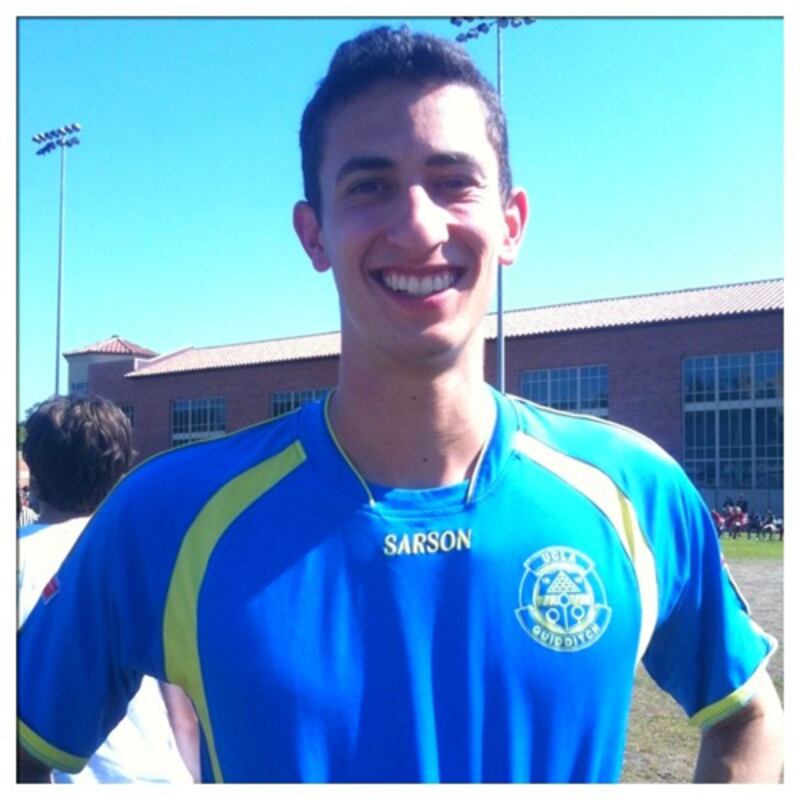
UCLA Quidditch President Asher King Abramson is one of the team’s beaters. His role within Quidditch gameplay is a combination of offensive and defensive. Armed with a bludger (think of it, more or less, as the equivalent of a dodgeball), the beater attempts to hit opponents with the ball—sending players back to the goalposts at the beginning of the pitch—while at the same time blocking adversaries’ bludgers from hitting his or her own team. At any given time, two beaters can be in play and there are three bludgers available on the field.
“Quidditch is different from other team sports because it has such a theatrical element,” said Abramson. “The sport is really brutal: everyone on our team has a bruise somewhere on their body from being tackled of bludged.”
Gryffindor beaters included Fred and George Weasley in the Harry Potter novels.
Courtesy of Jace Lacob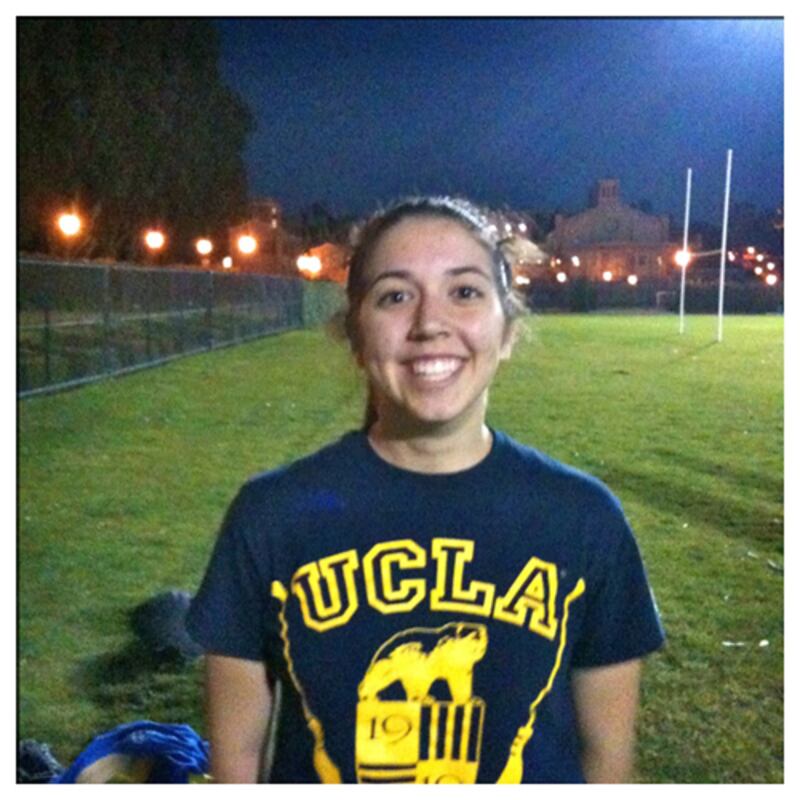
One of the UCLA Quidditch team’s chasers is Katelynn Kazane. The chaser’s job is to score goals by throwing the quaffle, a volleyball, through one of three goals (each goal scores 10 points) and block their competitors from doing the same. They can run with the quaffle, pass it, or kick it. “We’re point scorers,” said Kazane. “It’s more offensive and we play man-to-man defense, but we’re after the quaffle.” There can be three chasers in play at a given time, but if they’re hit by a bludger while carrying the quaffle, they have to drop the quaffle and return to their goalposts.
In the novels, Gryffindor chasers have included Angelina Johnson, Katie Bell, Alicia Spinnet, and Ginny Weasley.
Courtesy of Jace Lacob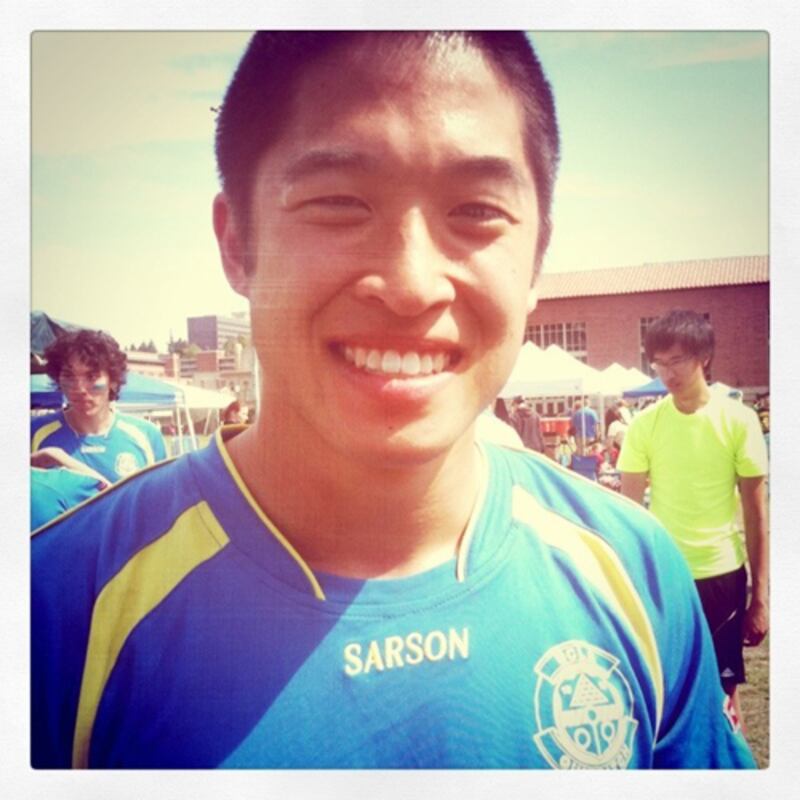
Perhaps one of the most physically demanding positions on a Quidditch team is that of the seeker. Jeffrey Lin, pictured here after ending a scrimmage game by grabbing the snitch after a tumultuous and rather physical fight, is the UCLA Quidditch team seeker. It’s his job to catch the Golden Snitch, who can be anywhere within roughly a square mile of the pitch. Seekers search within that vast space for the Golden Snitch and attempt to grab the snitch itself, a tennis ball tucked into a yellow sock. While he can’t tackle the snitch (though the reverse is allowed), if he’s able to seize the snitch, his team wins 30 extra points (unlike in the books, where it is a 150 points) and the game immediately ends. (The game, however, doesn’t end until he’s able to successfully grab a hold of the snitch.)
Harry Potter served as Gryffindor’s seeker in Rowling’s novels.
Courtesy of Jace Lacob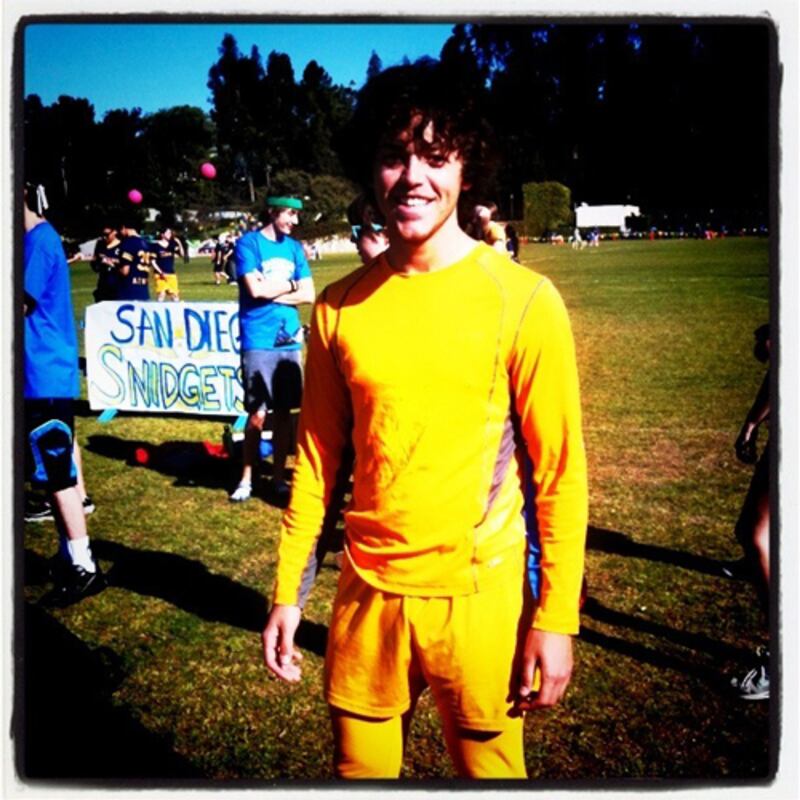
One of the main differences between J.K. Rowling’s fictional version of Quidditch and the “Muggle” version is that the Golden Snitch isn’t a winged golden ball soaring through the air at high speeds, but rather a living person, dressed all in yellow, who has a tennis ball in a sock in their waistband. They can move anywhere within a set radius of the pitch and can disrupt gameplay by any means necessary: stealing brooms, tackling or throwing players, stealing the quaffle, dressing up in outlandish costumes, etc. Brady Stanley, pictured, is UCLA’s resident snitch.
“There are a couple of rules,” said Stanley. “You can’t bring bikes or wheels onto [the UCLA intramural] field, there are certain buildings you can’t go on top of. But you can play with foam swords or wear a banana suit. Anything goes.”
Courtesy of Jace Lacob
The goalkeeper in Quidditch is known as the “keeper,” a role analogous to the goalie in soccer or hockey, though he has three goals to guard at the same time. Fulfilling the role for the UCLA Qudditch Western Cup team is Alex Browne. In some versions of the game, the keeper is not affected (though can still be accidentally hit) by the “knockout effect” of the bludgers, so long as they are within the “keeper zone.”
In the books, Ron Weasley and Oliver Wood served as Gryffindor keepers.
Courtesy of Jace Lacob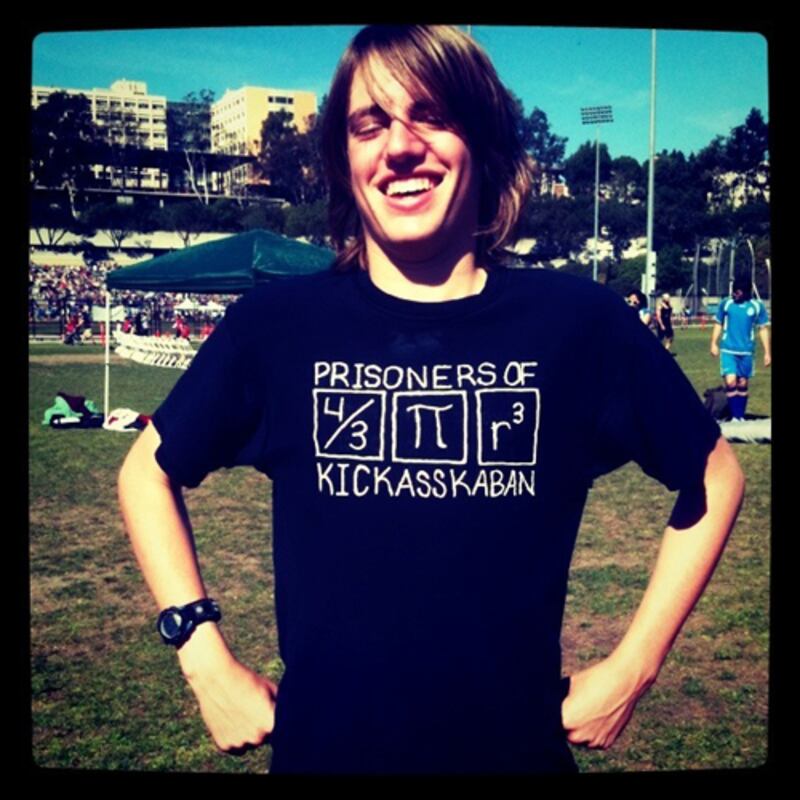
Quidditch teams tend to have tongue-in-cheek names, such as The Prisoners of Kickasskaban (pictured here), or utilize allusions to the J.K. Rowling novels. Some of the teams participating in the Western Cup included the Power Grangers, Silicon Valley Skrewts, The Golden Snitches, Qwertyrians, The Dirigible Plums, Lost Boys, Marauders, Hollywood Harpies, the Narwhals, and the Crimson Fliers, to name a few.
Courtesy of Jace Lacob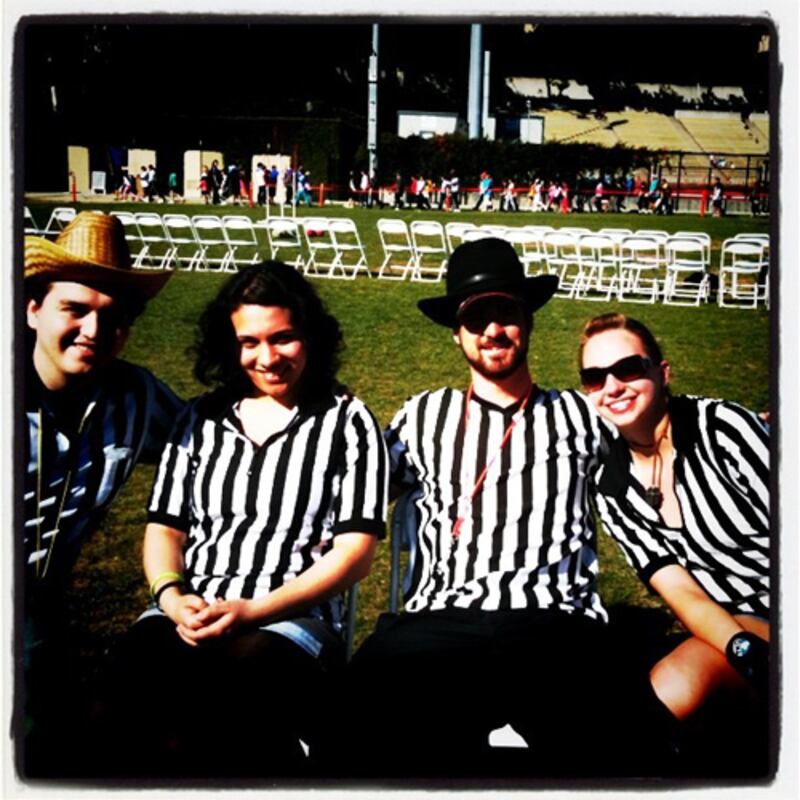
There were no fewer than 40 referees involved in the Western Cup. Pictured here are four of those refs: Evan Bell, Sequoia Thomas, Alex Clarke, and Rebecca Logan, the last of whom housed an entire Quidditch team—whom she had only known through Facebook—during the World Cup last fall. But not everyone can just decide to become a Quidditch referee; there’s an arduous process to go through involving the International Quidditch Association, the game’s official governing body. (“If they like Quidditch,” she said, “they can’t be that bad, right?”)
“There’s a new certification process that they have to undergo through the IQA,” said Bell, “in which they have to be observed on the field, take a written test, and once that happens, you are certified to be official and can ref for any tournament that you want.”
Courtesy of Jace Lacob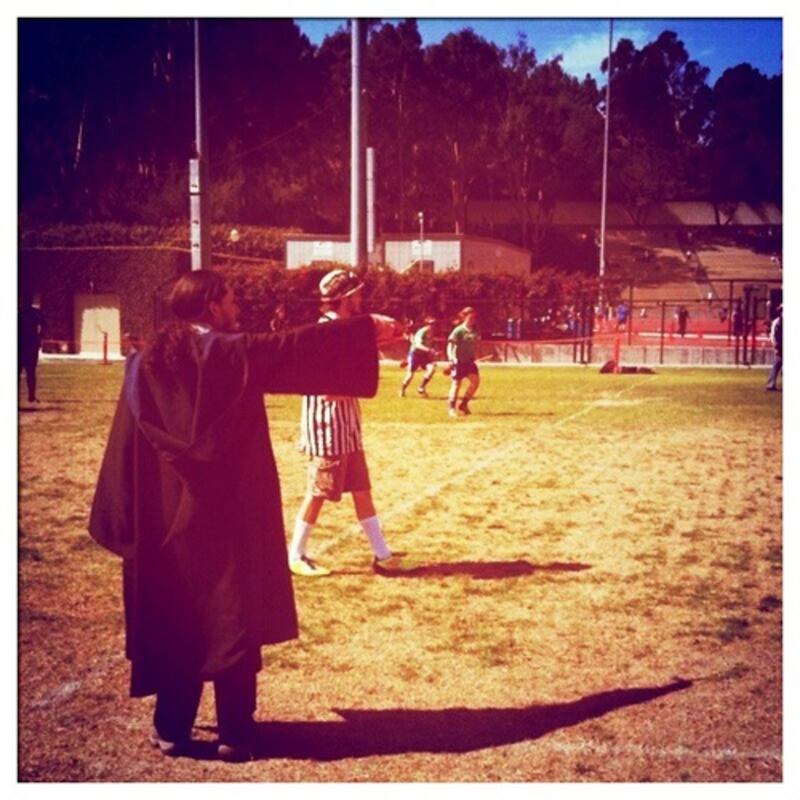
The head referee (shown here) was dressed in the full robes of a Hogwarts professor and was armed with the official Quidditch rulebook, now in its fifth edition. The 39-page rule book contains rulings on such things as fouls, player count (at least seven and no more than 21), and the gender ratio (each team must have at least two members of the opposite sex in order to qualify for gameplay).
The current edition is credited to Will Hack, Jared Kowalczyk, and the IQA Rules Council, based on the first edition by Alex Benepe (the current Quidditch Commissioner), based on rules adapted by Xander Manshel (the first Quidditch Commissioner), and based on the game created by J.K. Rowling. Or as it says in parentheticals on the cover, “It’s been a group effort.”
Courtesy of Jace Lacob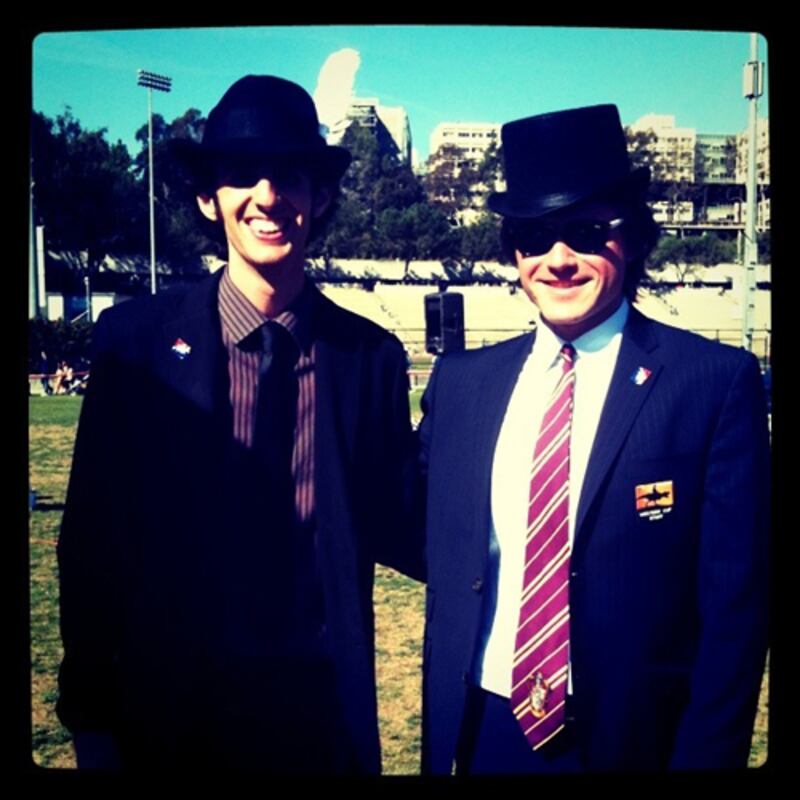
Two of the IQA’s representatives, including Harrison Homel (left), the director of the Western Region, and Alex Benepe, the current Quidditch Commissioner, were on hand to open the Western Cup. Both were dressed in full suits and feathered hats, despite the blazing heat. The IQA defines itself as “a magical nonprofit dedicated to promoting the sport of Quidditch and inspiring young people to lead physically active and socially engaged lives.”
Courtesy of Jace Lacob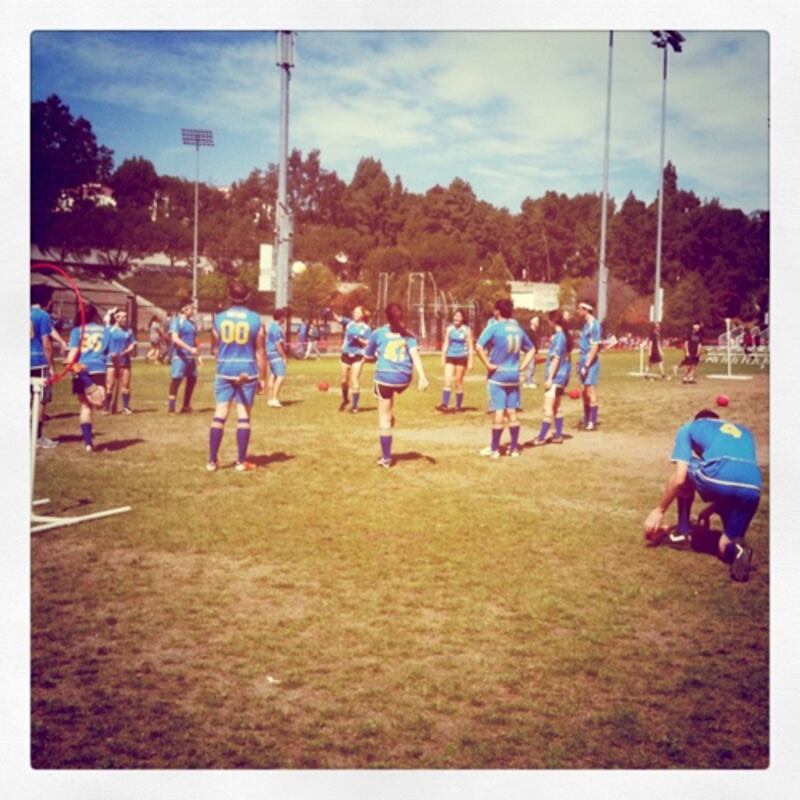
The UCLA team warms up before the official opening ceremonies of the Western Cup. Depicted is a traditional Ground Quidditch pitch, which measures 48 yards in length by 33 yards in width, but it’s worth noting that the pitch’s shape is actually an oval. Three upright hoops are set at opposite ends of the pitch; these are the goals.

All 19 of the team participating in the Western Cup took to the pitch to shout out their individual team chants before walking around the field in a clockwise route. A group huddle ended with their hands in the air, marking out a “W” for West Coast, representing the Western Division of the IQA, the fastest-growing division in the league.
Courtesy of Jace Lacob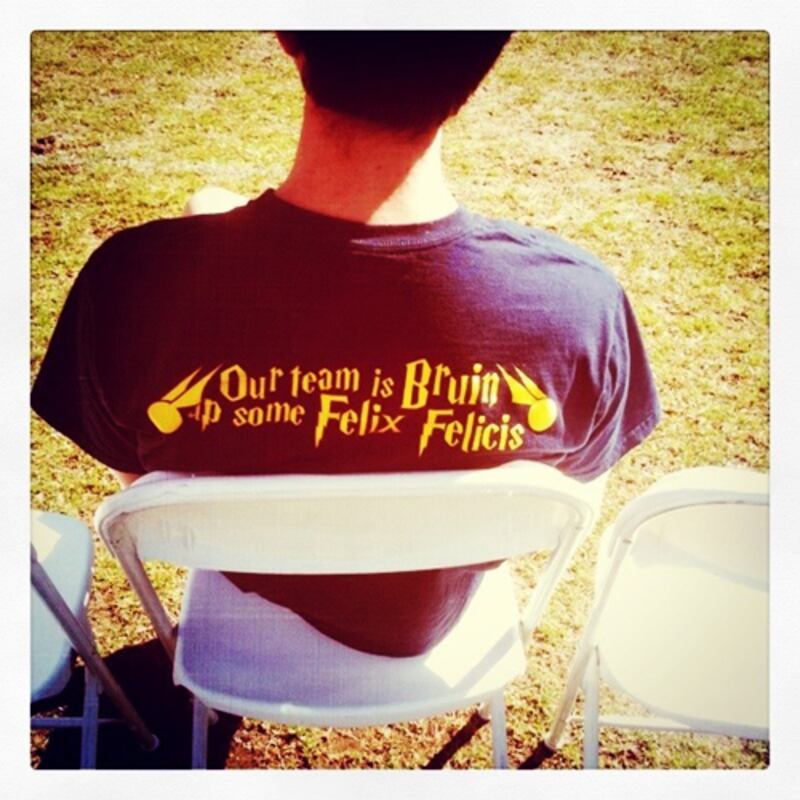
In addition to some punny team names and nicknames (UCLA’s team is sometimes unofficially referred to as the Quid Pro Quos), teams often have individual mottos or sayings. One of the UCLA Quidditch team’s many mottos includes that pictured here, “Our team is Bruin up some Felix Felicis,” referring to both the UCLA Bruins and Felix Felicis, a potion in the Harry Potter universe that is essentially liquid luck. (In the books, Harry Potter himself wins a vial from Professor Slughorn in Potions class and pretends to slip some to Ron in order to boost his confidence, though the substance is banned from use in Quidditch.)
Courtesy of Jace Lacob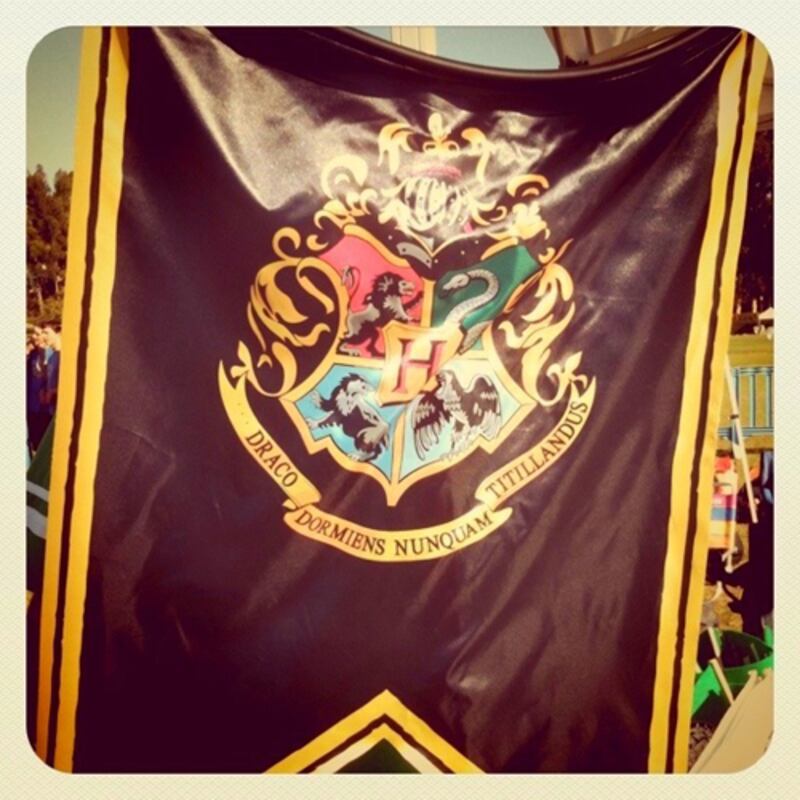
No Harry Potter-derived event would be complete without a little bit of Hogwarts in the mix. Here, the official coat of arms of the Hogwarts School of Witchcraft and Wizardry is depicted on a banner set up outside the four pitches at the Western Cup. The four quadrants represent the four houses: Gryffindor (lion), Slytherin (serpent), Ravenclaw (eagle), and Hufflepuff (badger). The motto that appears on the crest (“Draco dormiens nunquam titilandus”) translates from the Latin as “Let sleeping dragons lie.”
Courtesy of Jace Lacob