
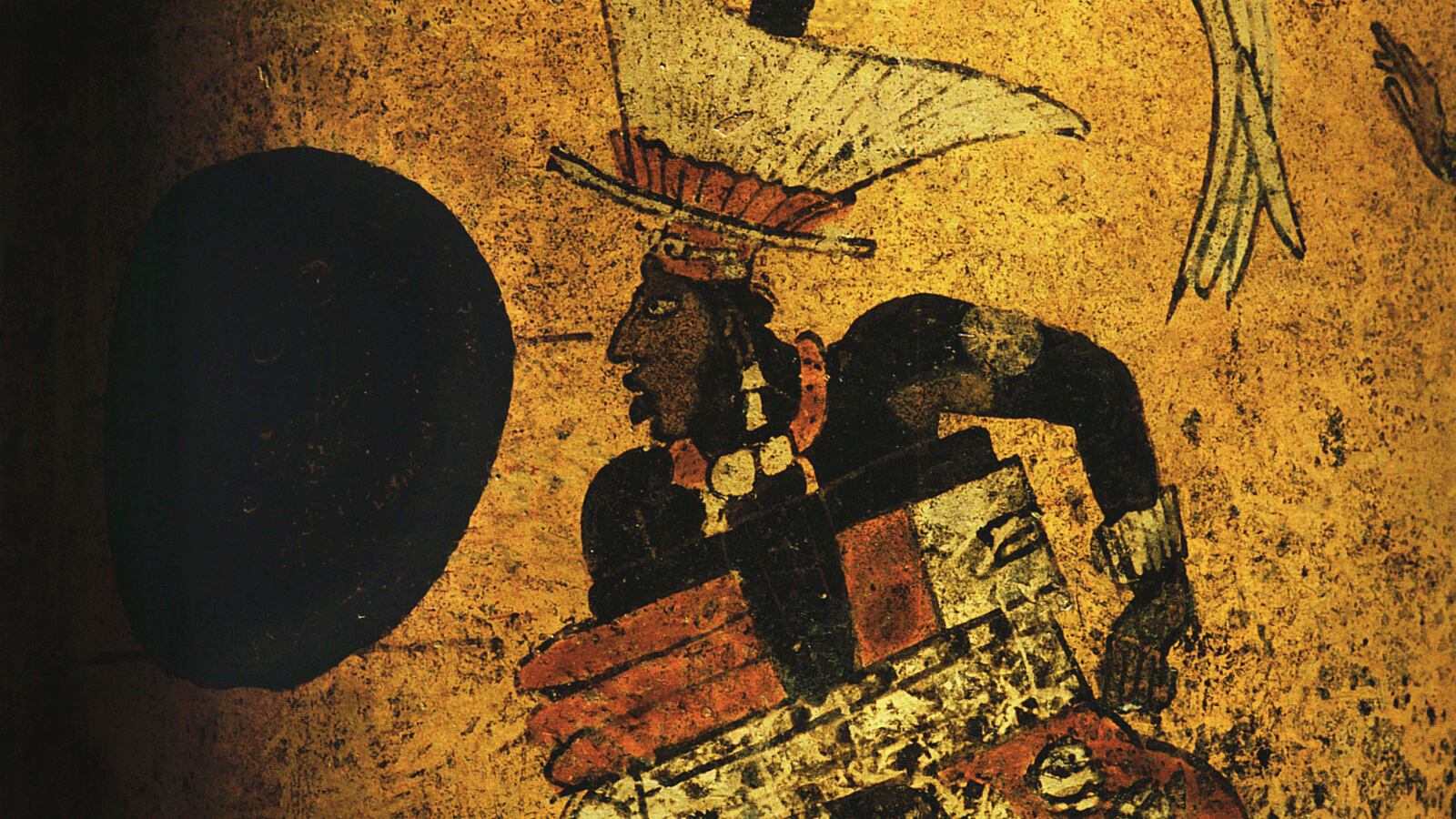
When you finally shuffle off this mortal coil, what would you like to happen to your remains? A traditional burial, or perhaps you want your ashes sprinkled at sea? Maybe you’d like to be turned into jewelry, travel to space, or decompose into a tree? If you were an ancient Mayan, a new archaeological theory suggests, perhaps your goal wasn’t a generation in a vase on the family mantle, but rather to spend your ashy afterlife as the innards of an ancient ballgame?
For scholars, the “ballgame,” as it is known, was one of the most important religiously and culturally significant aspects of Mayan society. The game, which used a rubber ball, was played by two opposing teams on an “I” shaped court. Ball courts have been identified in numerous ancient Mayan cities and literary and artistic references to them are found throughout the Pre-Columbian Americas. The rules of the game are unclear and fiercely contested, but some have likened it to racquetball. The ball itself ranged in size from that of a softball to that of that of a soccer ball. Though the rules of the game undoubtedly changed over time and throughout this large region, the ballgame is one of the cultural links that connects the Mayan cultures of Mexico, Honduras, Belize, and Guatemala. Archaeological evidence suggests that it was played as far north as present-day Arizona and New Mexico, and as far south as Colombia.
Mythological portrayals of the Mayan ballgame depict it as a violent and somewhat macabre underworld pastime. Popol Vuh, the three-thousand-year-old Mayan creation story of the K’iche’ people, recounts how the underworld included a ball court on which a game was played with the heads of humans or gods. According to the myth, the first set of twins, Hun-Hunahpú and Vucub-Hunahpú, also known as the Maize Gods, were invited to the underworld (Xibalba) to play a ballgame with the Lords of the underworld. The invitation was complimentary, but it was a ruse. (Allegedly the brothers had irritated the lords of Xibalba with the noise they made playing ball). Once they arrived in Xibalba they faced a series of deceptive and grueling trials that eventually lead to their death. They were sacrificed and buried at the Crushing Ballcourt there. The head of Hun-Hunahpú was hung from a tree and took on magical powers: it spat in the palm of one of daughters of the Lords of Xibalba and impregnated her. She then conceived the Hero Twins who returned to avenge and resurrect their father.
On the earthly plane, the Mayan ballgame may have been equally violent. Ball players wore protective equipment to protect them from the stone walls of the court and the slick hard surface of the court. Some scholars have theorized that losing players were sacrificed at the end of the game, but it’s unlikely that this was routinely the case. When participants were killed, they were almost certainly captives. As Christophe Helmke, of the Institute of Cross-Cultural and Regional Studies at the University of Copenhagen has said, the sacrifices “weren’t an integral part of the game.” Those who died at the conclusion of the event would have died anyway.
In 2020, a team led by archaeologist Juan Yadeun Angulo of the National Institute of Anthropology and History, Mexico, discovered a 1,300-year-old crypt beneath a Pyramid in Toniná in Chiapas, Mexico. The Pyramid in question, the Temple of the Sun, is just one of the many pyramids that rise as high as 233 feet (approximately 21 stories) over the central plaza. The complex of ancient ruins, which mostly date to the sixth and seventh centuries, also includes two ball courts.
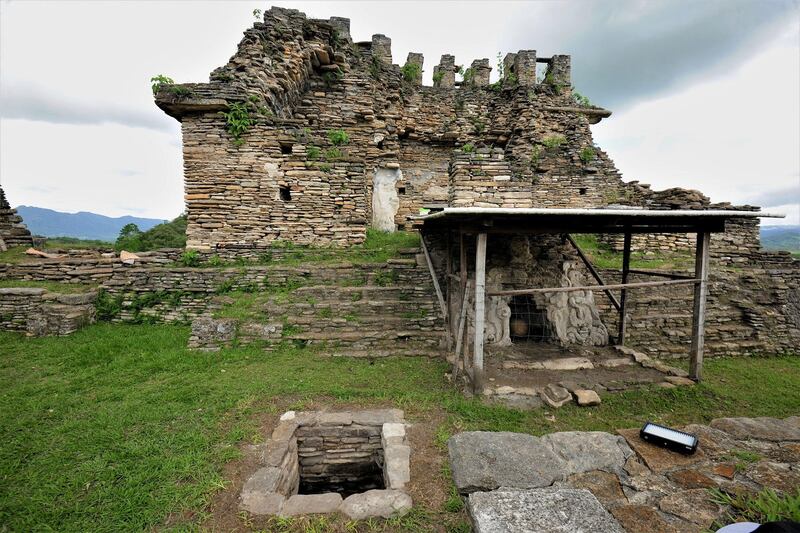
Tonina pyramid, in Ocosingo, Chiapas state, Mexico, where archaeologists from the National Institute of Anthropology and History (INAH) have found remains that reveal cremation rites for Mayan rulers.
INAH/Handout via ReutersThe crypt beneath the Temple of the Sun might be more accurately described as a kind of labyrinth of stairways connecting small vaults and chambers to one another. Here, in small niches, Angulo and his team found about 400 vessels that had once held organic materials that included charcoal, ash, plant roots, and natural rubber. Noting that the analysis of the remains reads a bit like an ingredients list for the vulcanization of rubber, Angulo and his team hypothesize that the ashes are the remains of cremated rulers. The “transformation of the body” into the balls, Angulo speculates, allowed the rulers to live after death.
Further visual evidence for the use of human remains in the ballgame may be found at the neighboring archaeological site of Yaxchilán. Anthropological analysis of the artwork carved onto sculptures there shows wealthy players tossing balls that contain human captives. Angulo sees this as further evidence for the use of human remains in the game. “The discoveries in Toniná provides a more accurate idea of how interesting and complex the Mayan religion was within the Mesoamerican worldview.”
We should note that not all scholars are convinced by Angulo’s theories. Speaking to Owen Jarus at Livescience, several anthropology professors expressed skepticism about the findings, and said that more research is needed to connect the balls used in the game with the ashes of ancient rulers.
Though this may all seem quite dark, the mythological origins of the game, coupled with its important role in Mayan religious and cultural life, suggest that it was far from being just a game. Moreover, the mingling of athletics, execution, and religion is present in other ancient societies as well. The games celebrated throughout the Roman empire often included reenactments of events from history and mythology, gladiatorial battles, and the execution of criminals. It’s only fairly recently, and in modern Western societies, that religion has been compartmentalized from other areas of life.
For the diehard baseball fans or sports entrepreneurs out there perhaps the evidence from Toniná is inspiring. Though the recipe for the Delaware based mud that is used to coat MLB issued balls is a closely guarded secret, perhaps there’s a business opportunity in postmortem wish-fulfillment to be grasped. After all, if trekkies and one-time aspiring astronauts can have their DNA shot into space after their deaths, perhaps any of us could make it to Fenway Park or Wimbledon.