

Despite the booze, clothes, and midafternoon romps, knowledge on Mad Men isn’t exclusively carnal. Around the curves of the show’s hedonism is a different kind of sensibility, a more high-minded one: colleagues burn when copywriter Ken Cosgrove lands a story in The Atlantic (“Tapping a Maple on a Cold Vermont Morning”); Don Draper stumbles through New York, puzzling over Frank O’Hara’s 1957 Meditations in an Emergency.
Of course, this is Madison Avenue we’re talking about. Don’s reading tends to be as much about enrichment as enlightenment. If the ad man wants to know What Women Want, he picks up Rona Jaffe’s 1958 The Best of Everything. Faced with a similarly challenging conundrum, selling tourism to Israel (What Jews Want), he grabs Leon Uris’s Exodus.
As the third season of the AMC show premieres Sunday, The Daily Beast offers some advice on how to read like a Mad Man:

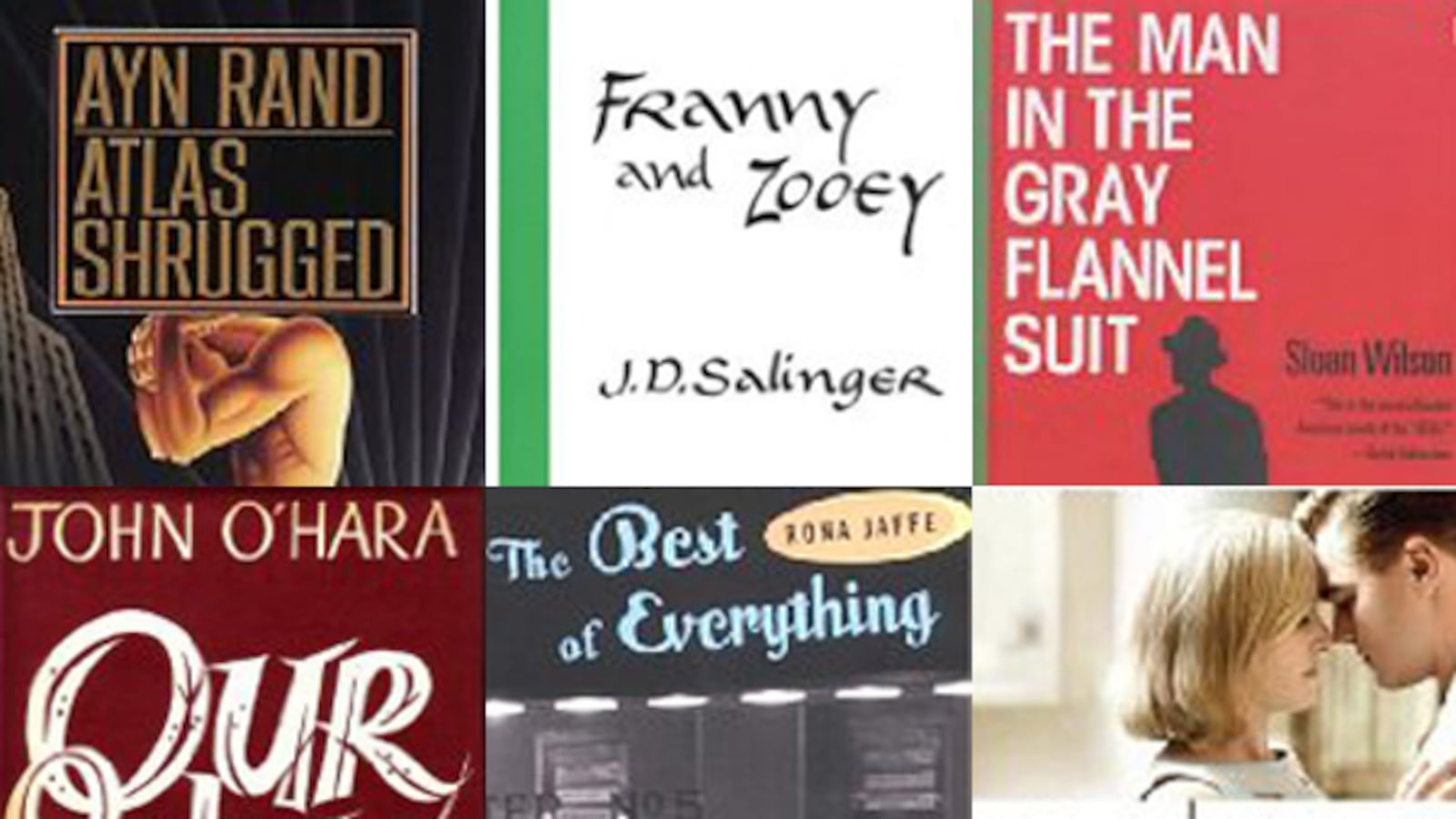
The Man in the Gray Flannel Suitby Sloan Wilson (1955).
Gregory Peck starred in the film version released one year later. Comedian Jimmy Barrett piques Don by nicknaming him “the man in the gray flannel suit.”
The Organization Manby William H. Whyte (1956).
The Black Swan of its day, Whyte’s book became the standard text on the workplace and its impact on American society. A writer at Fortune, Whyte profiled the same corporate heads that Sterling Cooper, the advertising firm of Mad Men, try to woo.

Atlas Shruggedby Ayn Rand (1957).
Bert Cooper, the eccentric co-owner of Sterling Cooper, is an admirer of the philosopher and author Rand. Her Atlas Shrugged profiles the terror of government control; its emphasis on individualism and free markets has made it a popular text once again in these days. Among noteworthy acolytes was former Fed chairman Alan Greenspan.
Meditations on an Emergencyby Frank O’Hara (1957).
With Greenwich Village seen as some exotic land for the men of Sterling Cooper, avant-garde culture is generally treated with disdain or confusion. Apparently, there’s some guy name Bob Dylan singing down there. They also smoke pot. The show tries to bridge the gap between the two places with Don’s embrace of Frank O’Hara’s poetry.

The Best of Everythingby Rona Jaffe (1958).
Jaffe was the Candace Bushnell of the atomic age, painting a picture of the life of single working women in New York City. Don reads this one in bed next to his wife, Betty.
Exodusby Leon Uris (1958).
When the Israeli Department of Tourism comes knocking, Don checks out this work of historical fiction about the founding of the state of Israel. Of course, he hopes it will also provide insight into the state of a Jewish woman he’s pursuing. The book’s popularity increased in 1960 with the release of a film version starring Paul Newman as protagonist Ari Ben Canaan.

Ourselves to Knowby John O’Hara (1960).
Without John O’Hara, you’d never have the later Johns who came to define suburbia and status in the Eisenhower and Kennedy years: Updike and Cheever. In 1960 O’Hara’s Ourselves to Know rose to the top of bestseller list.
The Agony and the Ecstasyby Irving Stone (1961).
Peggy Olson’s mom, the devout Catholic, reads this early-’60s bestseller about painter Michelangelo Buonarroti, who took the Holy Father’s city by storm in 1496.

Revolutionary Roadby Richard Yates (1961).
A young married couple moves into a Connecticut bedroom town with a son and daughter in 1955 and then their lives fall apart. Sound familiar? Of course, the story is probably most familiar for moviegoers who saw Leonardo DiCaprio and Kate Winslet take star turns in the story in 2008. Show creator Matthew Weiner told The New York Times, “Revolutionary Road was given to me three years after I wrote the pilot.” He said if he had read the book, he probably wouldn’t have tried to write the show. “Yates was there. This is what he was writing about.”
Ship of Foolsby Katherine Anne Porter (1962).
With her marriage on the rocks, Betty starts reading this novel satirizing Nazism. On the publication of Porter’s letter, The New York Times observed, “In no time the book was one of those frequent hapless phenomena—the novel that sells like hot cakes but is soon abandoned as unreadable.” Hot and unreadable—a perfect choice for Betty Draper.

Franny and Zooeyby J.D. Salinger (1961)
The allure of publishing a short story, which drives Pete Campbell, is certainly fueled by the prestige of writers like J.D. Salinger. These two novellas were first published separately in The New Yorker in the 1950s, but came together as a bestseller for Little, Brown in 1961, Mad Men season one.
The Bell Jarby Sylvia Plath (1963).
At least one long shot of the isolated Betty Draper and her stare into the kitchen oven had The Daily Beast thinking of the fate of early-’60s feminist author Sylvia Plath. The heroine of Plath’s novel, Esther, may be more like Peggy Olson, the striving copywriter at Sterling Cooper, than like stay-at-home mom Betty. Published under a pseudonym in England a month before Plath’s suicide, The Bell Jar didn’t see American publication until 1971.
Season 5:
Episode 13 — "The Phantom"Third Girl by Agatha Christie
Episode 12 — "Commissions and Fees"Nat Turner's Slave Rebellion by Herbert Aptheker
Episode 11 — "The Other Woman"Goodnight Moon by Margaret Wise BrownNature by Ralph Waldo Emerson
Episode 9 — "Dark Shadows" The Black Cauldron by Lloyd Alexander Odds Against by Dick Francis “Ozymandias” by Percy Bysshe Shelley
Episode 8 — "Lady Lazarus" The Crying of Lot 49 by Thomas Pynchon
Episode 7 — "At the Codfish Ball" The Fixer by Bernard Malamud The Berlitz Self-Teacher: French
Episode 6 — "Far Away Places" The Tibetan Book of the Dead
Episode 4 — "Mystery Date" Where Love Has Gone by Harold Robbins
Episode 3 — "Tea Leaves" Mein Kampf by Adolf Hitler Sterling’s Gold by Roger Sterling
Episode 1 and 2 — “A Little Kiss”Johnny Got His Gun by Dalton TrumboThe Sand Pebbles by Richard McKennaA Thousand Days: John F. Kennedy in the White House by Arthur Schlesinger
Season 4:
Episode 13 — “Tomorrowland”You Are Not the Target: A Practical Manual of How to Cope With a World of Bewildering Change by Laura Archera HuxleyGazella by Stuart CloeteThe Spy Who Came in From the Cold by John le CarréThe Adventures of Huckleberry Finn by Mark Twain
Episode 11 — “Chinese Wall”Meeting With Japan by Fosco MarainiGames People Play: The Psychology of Human Relationships by Eric BerneSterling’s Gold by Roger Sterling
Episode 9 — “The Beautiful Girls”The Clue of the Black Keys by Carolyn Keene
Episode 5 — “The Chrysanthemum and the Sword”The Twenty-One Balloons by William Pène du BoisThe Chrysanthemum and the Sword by Ruth BenedictThe Horse That Liked Sandwiches by Vivian L. Thompson
Season 3:
Episode 10 — “The Color Blue”The Group by Mary McCarthyHelping Yourself With Psychiatry by Frank CaprioSet Theory and Logic by Robert StollMeeting With Japan by Fosco MarainiThe Corps by W.E.B. Griffin
Episode 9 — “Wee Small House”The Bible
Episode 7 — “Seven Twenty Three”Confessions of an Advertising Man by David OgilvyBe My Guest by Conrad Hilton
Episode 6 — “Guy Walks Into an Advertising Agency”The Adventures of Tom Sawyer by Mark Twain
Episode 3 — “My Old Kentucky Home”The History of the Decline and Fall of the Roman Empire by Edward Gibbon
Episode 2 — “Love Among the Ruins”The Compact Edition of the Oxford English Dictionary
Season 2:
Episode 11 — “Jet Set”The Sound and the Fury by William Faulkner
Episode 10 — “The Inheritance”Junior Classics, Volume One: Fairy Tales and Fables and Volume Seven: The Animal Book
Episode 9 — “Six Month Leave”Ship of Fools by Katherine Anne Porter
Episode 8 — “A Night to Remember”Admiral Hornblower in the West Indies by C.S. Forester
Episode 4 — “Three Sundays”“The Diamond as Big as the Ritz” from Babylon Revisited and Other Stories by F. Scott Fitzgerald
Episode 3 — “The Benefactor”Marjorie Morningstar by Herman Wouk
Episode 2 — “Flight 1”The Agony and the Ecstasy by Irving Stone
Episode 1 — “For Those Who Think Young”Meditations in an Emergency by Frank O’Hara
Season 1:
Episode 8 — “The Hobo Code”Atlas Shrugged by Ayn RandThe Crisis of the Old Order by Arthur M. Schlesinger Jr.The Americans: The Colonial Experience by Daniel J. Boorstin
Episode 6 — “Babylon”The Best of Everything by Rona JaffeExodus by Leon Uris
Episode 4 — “New Amsterdam”Nursery Friends From France translated by Olive Beaupre MillerItaly by Herbert Kubly and the editors of Life
Episode 3 — “Marriage of Figaro”Lady Chatterley’s Lover by D.H. Lawrence
Episode 1 — “Smoke Gets in Your Eyes”The Crisis of the Old Order by Arthur M. Schlesinger Jr.The View From Chivo by H. Allen SmithThe Peking Man Is Missing by Claire TaschdjianLa Presidenta by Lois GouldMasterpieces of World Literature in Digest Form by Frank N. Magill
More than one episode:
Better Homes and Gardens New Cook Book Betty Crocker’s Hostess Cookbook