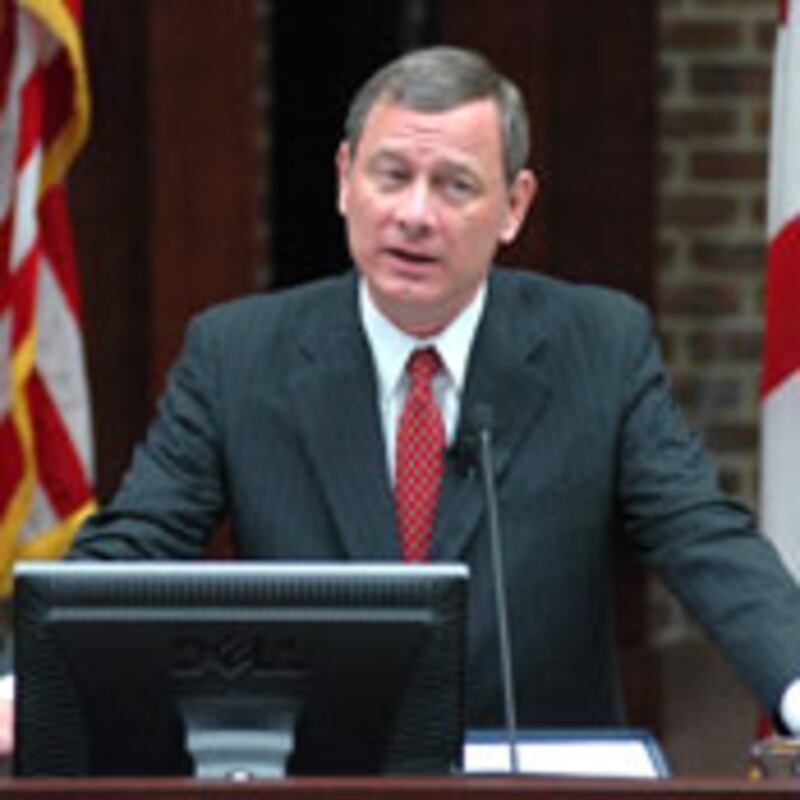
United States Chief Justice John G. Roberts, himself an astute political herder of eight other black-robed cats, is shocked ( shocked!) that political speech would break out at a nationally televised State of the Union address delivered by a president to members of Congress. And he says it’s “ very troubling ” to him that those justices who volunteer to show up for the speeches have to remain “expressionless” while the political brew (“cheering and hollering” is how he put it) bubbles up around them in the House Chamber.
This whine and cheese, delivered to students at the University of Alabama, is unbecoming of the leader of the third branch of government. First, re-visiting the State of the Union kerfuffle long after people had stopped talking about it makes the chief justice and the court look even more political than most people already think they are. Second, the prissy remarks this week reinforce the growing perception that the justices are becoming even more detached from public discourse (and accountability) than they are supposed to be.
If Chief Justice Roberts was really so offended by those few sentences from the president, then no one should stop him if he wants to stay home next time.
They ought to have thicker skin that this, right? That is why the chief justice’s comments make a bright, personable, important man look petty. Sure, the president injected into his 70-minute-long speech a few sentences worth of criticism about the court’s recent campaign-finance ruling (with which a clear majority of Americans disagree). But the remarks were dank and detached compared with the razor-hewed junk that spews out of the mouth of the politicians who speak from that same podium during regular business hours on Capitol Hill.
Here, judge for yourself. Here is what the president said that night:
" With all due deference to separation of powers, last week, the Supreme Court reversed a century of law to open the floodgates for special interests—including foreign corporations—to spend without limit in our elections. Well I don't think American elections should be bankrolled by America's most powerful interests, or worse, by foreign entities. They should be decided by the American people, and that's why I'd urge Democrats and Republicans to pass a bill that corrects some of these problems."
Whether the point is right or wrong, should a justice or the court itself be immune from such respectful public criticism? Why, because of some self-styled need for decorum in a decidedly indecorous forum and venue? Because it’s suddenly disrespectful to talk candidly to someone you invite to your home? Because a sitting president can’t public criticize an unpopular Supreme Court ruling if the justices are in the room? Because the justices have decided they cannot get up and clap or boo when they want to? Who made the chief justice the etiquette master of the State of the Union ceremony?
It’s also true that the hundreds of federal legislators and executive branch officials who surround the justices (only six of whom bothered to show up for this year’s speech) can get a bit rowdy from time to time when the cameras are on them during State of the Union speeches. But it has been forever thus—including on each of the occasions when the chief justice sat and listened to his patron, George W. Bush, deliver rousing cheer-filled State of the Union speeches. During those years, the chief justice did not publicly criticize the “cheering and hollering” (from both sides of the aisle) and did not imply that he would not longer attend the affair.
President Obama criticized the court on a contemporary matter of debate and substance—as other presidents have done sporadically throughout history during State of the Union speeches and otherwise. Instead of calling upon the court to reverse its wrong, as other presidents have done before, the president called upon the Congress to work around the court’s unpopular ruling. This is as unremarkable an event during these speeches as are the cutaways showing the grumpy faces of those whose party is not in power. That the savvy, forever-Washington-based chief Justice would think it is something unusually “tjoubling” just baffles me.
Another famous legal scholar, Yogi Berra, once said that “if the fans don’t come out to the ball park, you can’t stop them.” If Chief Justice Roberts was really so offended by those few sentences from the president, then no one should stop him if he wants to stay home next time. If you can’t run with the big dogs, you really are better off staying on the porch.
Legal analyst Andrew Cohen writes the “Open Bar” column at Vanity Fair Online and is a correspondent for TheAtlantic.com.