Three years ago, when I was imprisoned in Iran and falsely accused of espionage, I longed for an attorney to stand up for me. First my captors told me I couldn’t have one until I passed their lengthy interrogations. Then they tried to discourage me, reasoning: “Lawyers are useless. We make the decisions around here.” When I finally retained an attorney more than five weeks after my arrest, I wasn’t allowed a chance to discuss my case with him before my trial, which resulted in an eight-year prison sentence.
I requested two additional lawyers—Mohammad Ali Dadkhah and Abdolfatah Soltani—for my appellate trial, but the prosecutor warned me against using human rights attorneys. “They will not help your case,” he said. “They will only hurt you.” He was particularly opposed to Soltani, who once had the audacity of filing a complaint against him. “If you take Soltani as your attorney,” he said, “I will prevent him from ever meeting you, and if the appellate court rules in your favor, I will object.”
Under these threats, I kept my original lawyer and retained another one the prosecutor had recommended. I was freed on appeal, but then my lawyers spread falsehoods about me—presumably because of pressure by Iranian authorities. Last year, Dadkhah was sentenced to nine years in prison on a trumped-up charge of “attempting to overthrow the ruling Islamic system.” Soltani is serving a 13-year jail term for supposedly taking part in “anti-regime propaganda” and “acting against national security.”
They belong to a growing number of Iranian human rights defenders who since 2009 have been imprisoned, forced into exile, or scared into silence, leaving prisoners of conscience and political prisoners struggling to find competent lawyers to defend them.
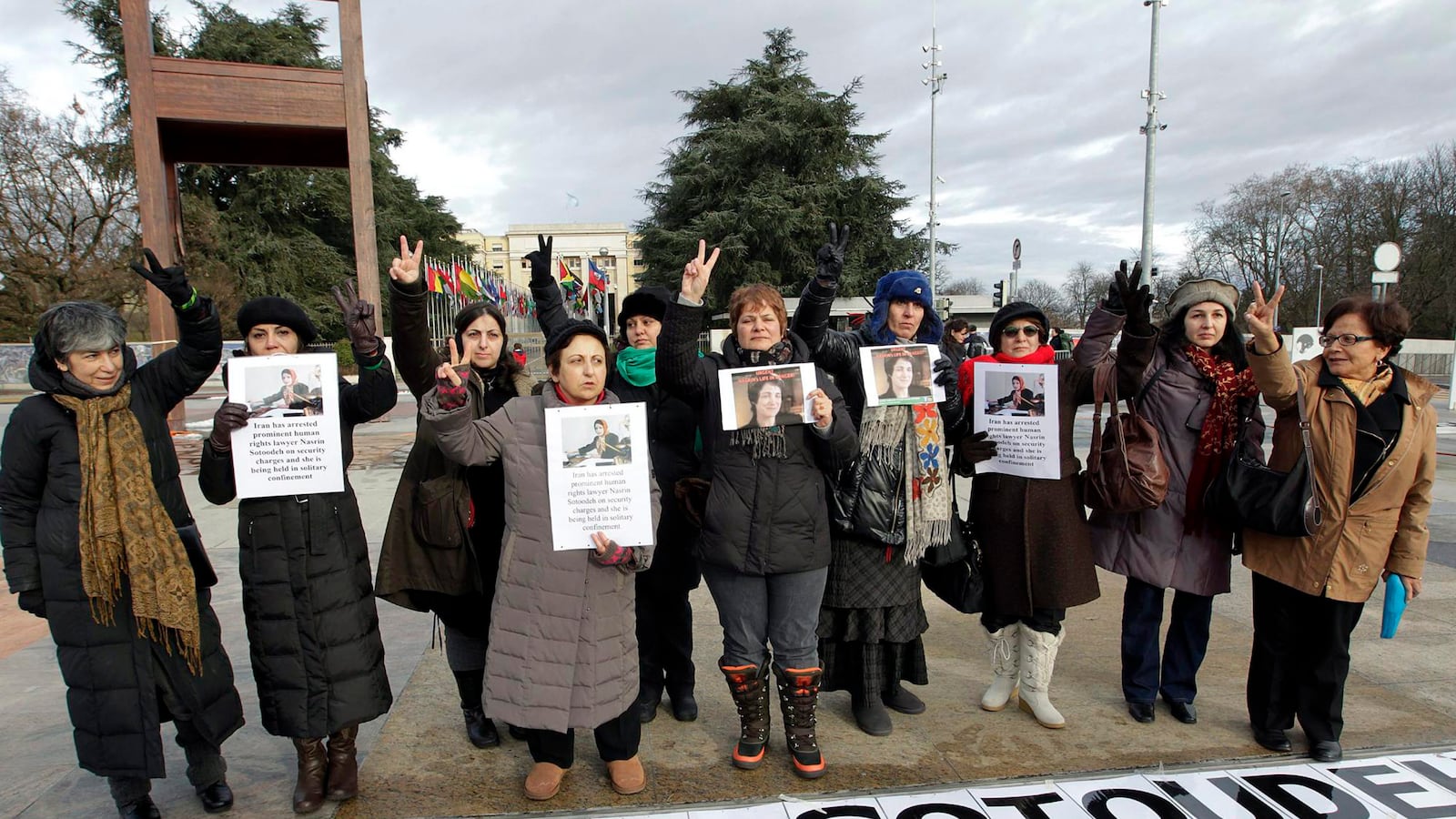
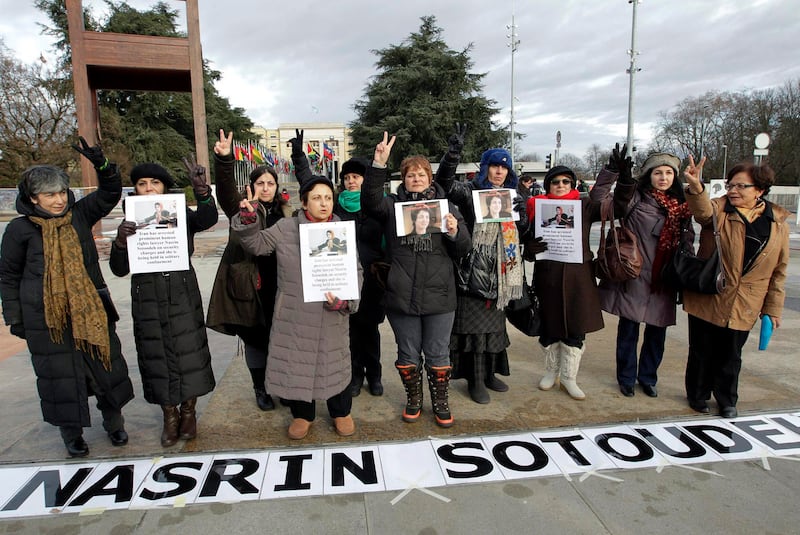
Another jailed attorney Nasrin Sotoudeh, who on Friday—along with Iranian filmmaker Jafar Panahi—received the prestigious Sakharov prize for human rights and freedom of thought from the European Parliament. Known for defending women’s and children’s rights, Sotoudeh is serving a six-year prison sentence for “acting against national security” and “spreading propaganda against the regime,” charges that human rights advocates say are baseless.
Earlier this month, she began a hunger strike in Tehran’s Evin Prison. And she will continue her strike until Iranian authorities meet her demands, including the removal of a travel ban on her 12-year-old daughter, according to Shirin Ebadi, an exiled Iranian attorney and Nobel Peace Prize winner. “She is a firm and strong-willed person,” Ebadi told The Daily Beast, “but I’m very worried about her.”
According to a list Ebadi shared with the United Nations, since June 2009, six human rights lawyers have fled Iran while others have been released on bail as they await trial. Twelve, including Dadkhah, Soltani, and Sotoudeh, remain behind bars. Several have reported being tortured, pressured to make false confessions, and held for lengthy periods in solitary confinement with no access to their families or legal counsel.
“With all the attorneys in prison and in exile, there’s no one left with the courage to defend political prisoners and prisoners of conscience,” says Abdol-Karim Lahidji, president of the Paris-based Iranian League for the Defence of Human Rights.
One of these political prisoners is Amir Hekmati, a former U.S. Marine held in Iran’s notorious Evin Prison since August 2011. He is accused of spying for the C.I.A., a charge his family denies. Hekmati was sentenced to death in January of this year, but months later, a judge tossed out the conviction and ordered a retrial. “A lot of attorneys the family wanted were too afraid to take on the case,” a source close to the Hekmati family told The Daily Beast, requesting anonymity because of the sensitivity of the issue. “Some who were willing weren’t approved by the judge. So the family ended up retaining a government-appointed attorney.”
Such attorneys do little to defend their clients, according to Hadi Ghaemi, executive director of the International Campaign for Human Rights in Iran. “In many cases, defendants say they carried the arguments of the judge and did them more harm than good,” he said. “It’s a very difficult situation. If someone gets in trouble in Iran today, they won’t have any legitimate representation.”
Masoud Shafii, an outspoken lawyer who defended three American hikers jailed in 2009, has said that Iran’s judicial authorities told the Hekmati family they couldn’t work with him. He also said that since the last two hikers were freed in 2011, he has been threatened, barred from leaving Iran, and unable to continue his law practice.
“Mr. Shafii tried very hard to defend us, and he is a good person,” said his former client Kamiar Alaei, an AIDS doctor who was freed in 2010 and now lives in the United States. “We have to help him and highlight his situation and explain that this is the job lawyers are supposed to do. They’re supposed to work on behalf of their clients.”
Iran’s imprisoned attorneys have little recourse inside the country, according to Ebadi, the Nobel Peace laureate. “Worst of all is that Iran’s Central Bar Association doesn’t support them because it’s not independent,” she said. “Iran’s attorneys have no refuge.”
Ebadi has been advocating for them outside Iran. She sends regular updates to the U.N. Special Rapporteur on Human Rights in Iran, who announced last month he was “alarmed by reports of government actions targeting lawyers” in Iran.
Lahidji, of the Iranian League for the Defence of Human Rights, says the international community must do more to help Iran’s persecuted lawyers. “Now Iran’s nuclear energy program is an issue,” he says, “but the issue of human rights must be addressed, too.”