
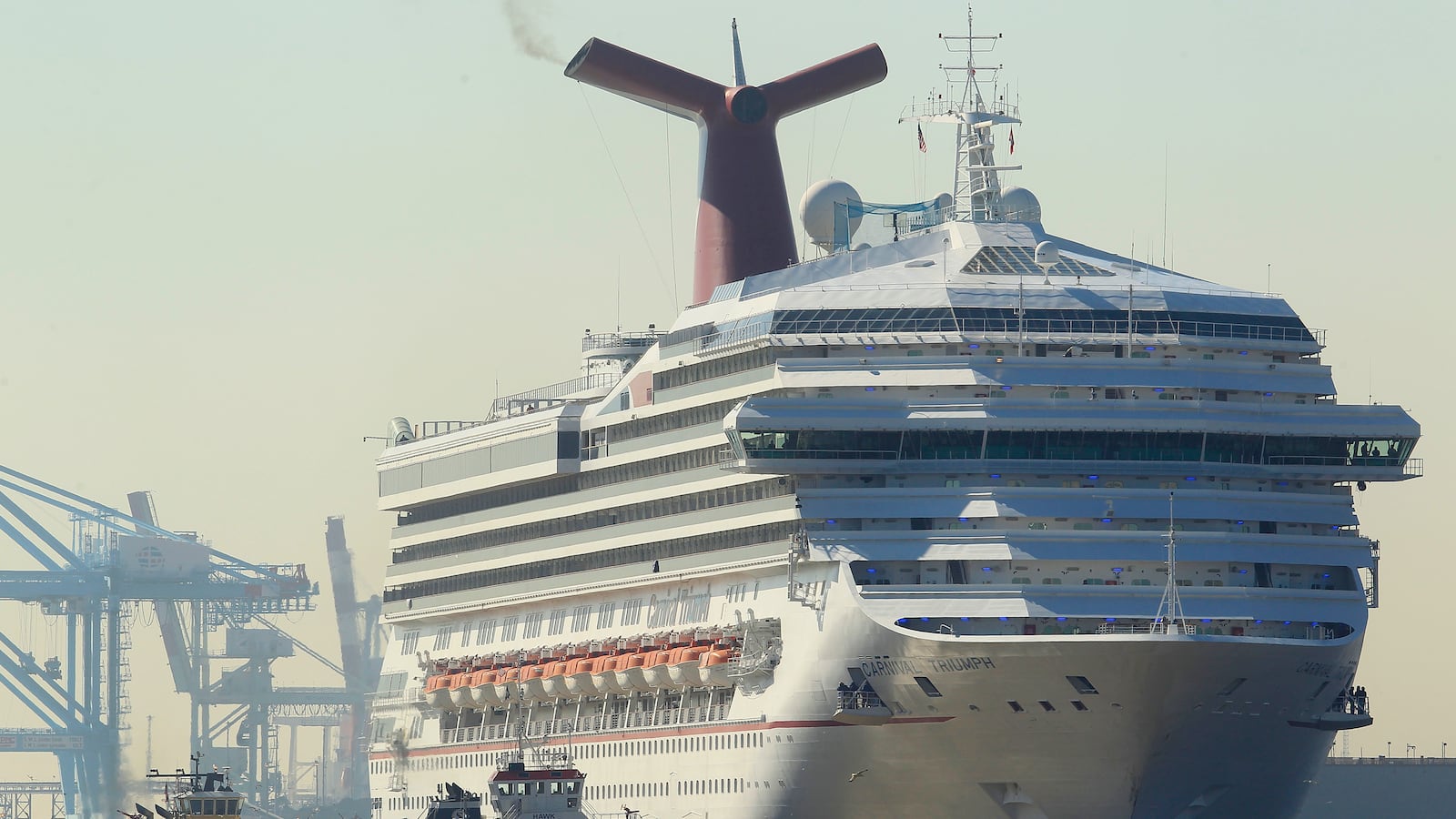
The five-day chart below doesn’t look like the stock of a company that suffered an epic failure last week; whose inability to provide its basic service was revealed in real time, causing significant discomfort to paying customers; whose problems were the subject of wall-to-wall media coverage. Rather, it looks like the stock of a company that hit a bit of rough weather and is riding out the storm.

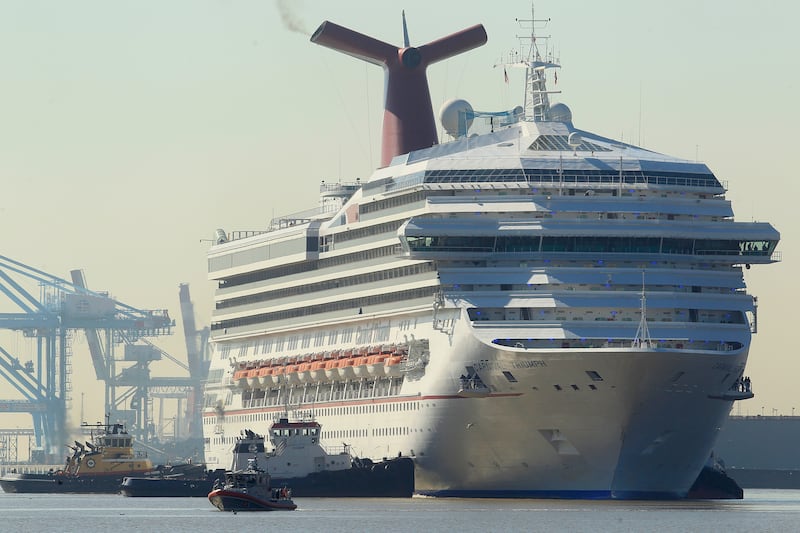
Of course, this is the chart showing the last five days of stock trading in Carnival, the company whose Triumph conked out in the Gulf of Mexico this week, effectively marooning customers on a floating septic tank for a few days.
Stock markets are famously futures markets, in which investors place bets on the future prospects of the company. The Triumph fiasco will certainly cost Carnival money—the refunds it’ll have to pay, lawsuits it might have to battle and cash it will have to spend to repair damage to the brand. So it’s understandable that Carnival suffered some selling pressure. But investors clearly don’t believe the episode will sink the company. Here’s why.
First, as companies go, Carnival is more like an aircraft carrier than a dinghy. It has a market capitalization of $28.7 billion, making it among America’s largest firms. Its ships and lines of business span the globe. And so it takes more than just one bad trip to put a real dent in the company’s business. Indeed, Carnival has weathered worse incidents in the past. It owned the Costa Concordia, which famously ran aground and sank off the coast of Italy in January 2012, causing nearly two dozen deaths. Sure, the bad publicity surrounding these disasters cause some cancellations and deter some potential cruisers. But as economic growth continues, millions more people around the world are able—and willing—to take cruises. And Carnival’s ships are there to meet them at the dock. The first day of trading after the Costa Concordia debacle, the company’s stock fell nearly 15 percent. But it quickly rebounded. On Friday, the company’s stock was still up about 25 percent from its post Costa Concordia low.
Second, the event was bad, but it wasn’t that bad. Yes, the passengers will be dining out on tales of misery and woe for the next several months. Websites, cable channels, and all sorts of news outlets (including ours) couldn’t resist the images of sewage seeping through the walls. But there were no deaths, and as of yet, there have been no serious outbreaks of disease. The Triumph’s voyage will go down as an ordeal, not a tragedy. It’s much easier to draw a line under liabilities and projected damage to the brand when the human impact of the debacle is contained.
Third, for reasons that escape me, going on cruises is a very popular undertaking. And in the evolving economic climate, cruising continues to offer a real value to many Americans. Incomes have generally stagnated over the last several years. But travel has become more expensive in many ways. As we’ve noted, reduced airline capacity is leading to higher ticket prices. After falling in the recession, hotel room prices are on the rise. Add it up, and the price of a vacation is increasing. By contrast, cruises like the ones that Carnival offers can be quite affordable. Steve Loucks, a spokesperson for Travel Leaders Group, told USA Today that “rates in the Caribbean are already under $100 per person per night.” I just priced a four-day Carnival cruise in the Western Caribbean for March for four people. The quoted cost: $1,268.
Finally, in light of the conditions on the Triumph, Carnival may even find itself with a new line of business on its hands. Think about it. Millions of Americans are overweight. And cruise ships are notorious all-you-can-eat food fests. If you’re looking to slim down, a cruise ship isn’t the place to do it. But something tells me that, given the conditions on the Triumph, most of the passengers disembarked weighing less than they did when they got on. If Carnival can re-create that experience, minus the seeping sewage, of course, it could rechristen Triumph as The Slimmer and offer weight-loss cruises.