
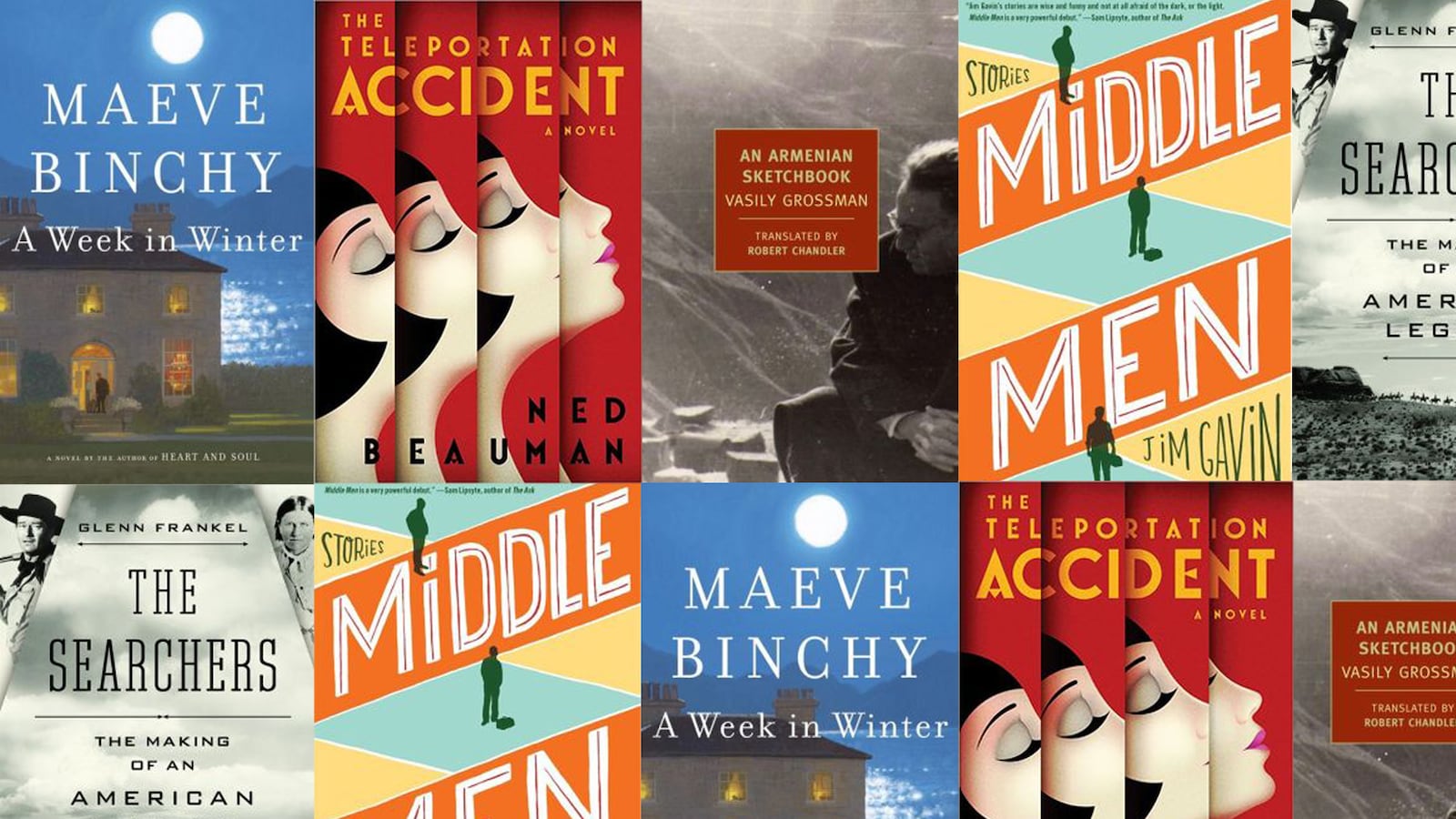
Middle Men by Jim Gavin
Manhood in Southern California stalls along the highways in this story collection.
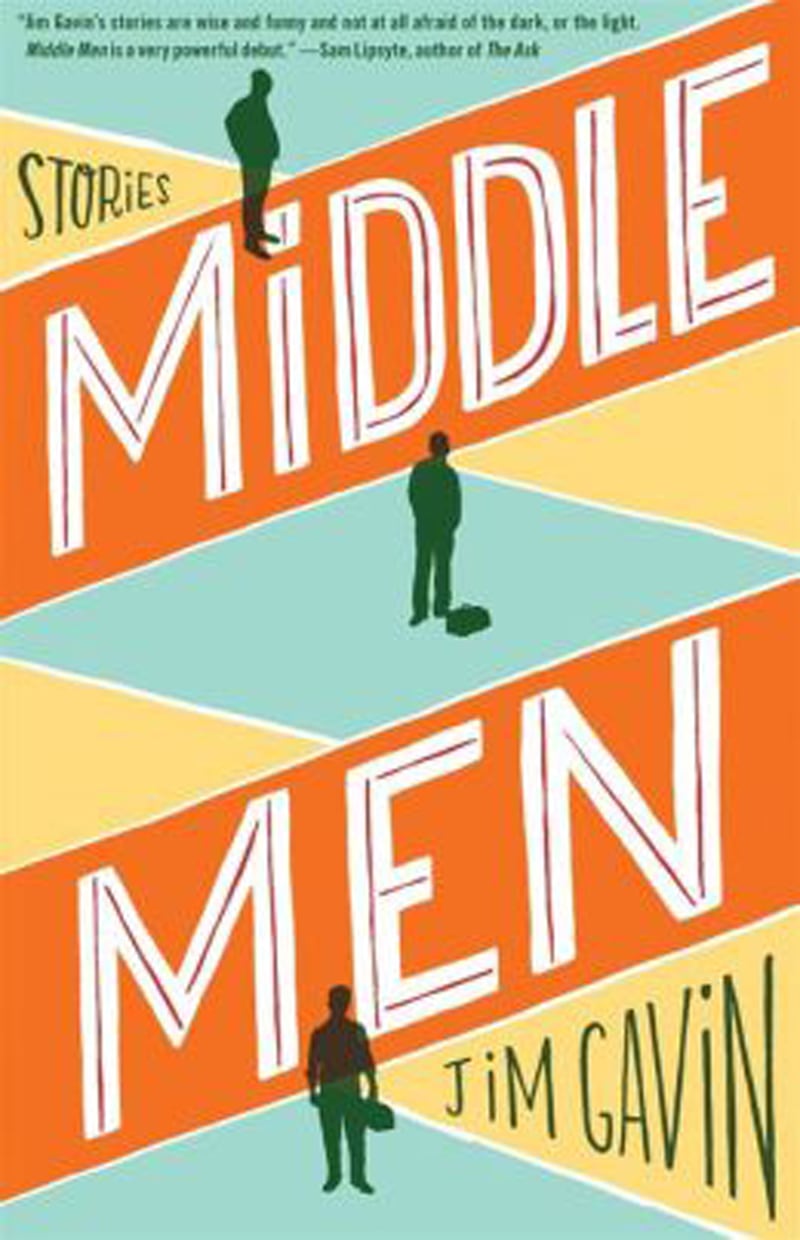
Crisscrossing along the highways of Southern California is a legion of men, mostly young, mostly lost. Middle Men, Jim Gavin’s soberly perceptive debut short-story collection, follows these men between jobs, relationships, and friends. There’s Berkeley dropout Bobby, skating from one mental breakdown to the next. There’s 23-year-old Brian, who spends all his money following a girlfriend 10 years his senior from Los Angeles to Bermuda. There’s Pat, the awkward high school kid who lives for basketball. And there’s Adam, the Yale-educated game-show production assistant waiting to land his big break in stand-up comedy. In Adam’s case, “despite all evidence to the contrary some part of himself—the most vital and destructive part of himself—believed that eventually his talent would be recognized as something pure and triumphant and somehow he would be granted dispensation from the degrading realities that made everyone else around him seem so shameless and corrupt.” If the other men in this volume suspect this about themselves, too, they never hint at it, least of all Marty Costello, the plumbing salesman featured in the collection’s final story, “Costello.” Marty, a character based off Gavin’s own father, has put years into his job, mortgage, and marriage, managing to maintain a quiet dignity even after none of those investments quite bear the returns he might have expected. In the year after his wife’s death from cancer, Marty’s children begin prodding him to take a new interest: “You need to get out there, you need to do something, go somewhere,” they say, misunderstanding, perhaps that there’s a contentment in his resignation. "Go where?" he thinks. "We’ve got the pool."
A Week in Winterby Maeve Binchy
An old Irish mansion gets a new life.

Before Maeve Binchy died in July of this year, she submitted to her publisher the manuscript for A Week in Winter, a hopeful, loving novel chronicling lives shaped by good deeds, small favors, and honest counsel along the rocky crags of the Irish coast. Fans of Binchy and newcomers to her work alike should consider themselves fortunate to have been left such a clear-eyed and open-hearted final gift. Central to the novel—which reads like a collection of short stories, with each chapter devoted to a new character—is hotel proprietress Chicky, whose tale opens the collection. While still in her 20s, Chicky runs away from her rural home in the town of Stoneybridge with a charming American named Walter, despite her parents’ deep disapproval. When the relationship falters after just a few months, Chicky takes a job as a maid and cook at a small boarding house, inventing a story about Walter’s death in a car crash to avoid confessing her humiliation to her family. Years of tireless work allow her to accumulate savings—and wisdom. When she finally returns home many years later to Ireland, it is with a measure of triumph. Her stint in New York has brought her the skills, savings, and confidence to take on the challenge of renovating the old Stoney House mansion into a boutique hotel. The biggest mistake of her life has borne new opportunities. That turnaround is a recurring motif in the subsequent stories describing the complicated lives of Chicky’s relatives, friends, and guests in Stoneybridge. People fail, in Binchy’s world: They disappoint their loved ones and themselves; they take foolish chances; they dissemble, stumble, and suffer gravely for their errors. But they help one another, too, and through hard work and humility, find new ways forward. The only character in A Week in Winter who fails to recognize this is sent packing from Stoney House. “What a wonderful fairy-tale world of platitudes you live in,” the joyless schoolteacher Miss Howe tells one of Binchy’s more good-natured characters. A cynical reader might say the same about A Week in Winter. They, like Miss Howe, would simply be missing out.
An Armenian Sketchbookby Vasily Grossman
The Soviet novelist’s mini-memoir written shortly before he was diagnosed with cancer.
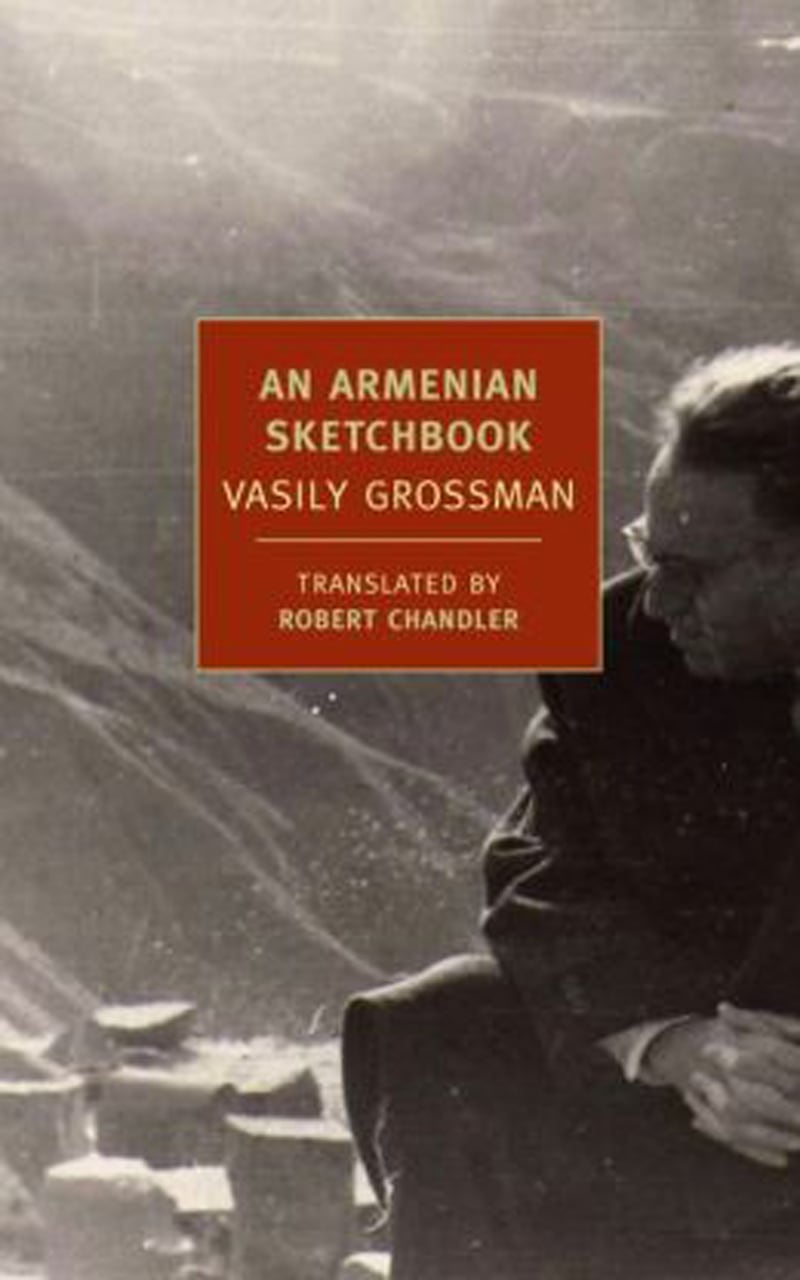
Written in the two months he spent in Armenia editing a translation of a novel called The Children of the Large House, this slim volume from Soviet journalist and novelist Vasily Grossman is equal parts travelogue, memoir, and religious meditation. As editor Robert Chandler notes, the context of this 1962 mini-memoir is significant: Grossman’s assignment in Armenia came soon after his two most important novels were stymied by censors and before he was diagnosed with cancer. As such, there is a vulnerability to the narration of An Armenian Sketchbook. Grossman writes not knowing what, if anything, his legacy as a writer will be—and suspecting that, as his health is failing him, he does not have much time left to secure that legacy. So while this “sketchbook” is largely about Armenian life and customs as observed by a literary-minded visitor, it’s also about Grossman himself. Chatty observations on his own shortcomings as a translator and the vagaries of his intestines segue seamlessly into somber meditations on the nature of life, religion, and work. Grossman weighs in on Armenian architecture, food and customs, but what truly holds his attention is the simple faith of the peasants he meets. Over dinner with an “old, semi-literate man in a dirty jacket and tarpaulin boots,” he is overcome with the work-weary man’s abiding love for humanity and faith in its goodness: “neither this heavy burden of labor, nor any other of life’s hardships had done anything to diminish his inner strength,” he notes. Grossman’s admiration for this piety and goodwill seems to be the real takeaway from his travels, as expressed in its original title, “Good to You” (a literal translation of an Armenian greeting) and in his final lines: “all I have said, clumsy or not, I have said with love.”
The Teleportation Accidentby Ned Beauman
A Berlin set designer obsessed with teleportation follows his heart to Los Angeles.

Nazism is taking hold in the declining Weimar Republic, but Egon Loeser, a sort-of successful set designer who runs with Berlin’s artistic set, has hardly noticed. He’s just broken up with his girlfriend Marlene and is too absorbed by sexual frustration and self-pity (and the search for cocaine with which to help mitigate either) to take note of any kind of larger political shifts. Loeser is a self-described New Expressionist, but his aesthetics are more about talk than practice. The only project he really cares about is Lavinci, a play about Renaissance designer Adriano Lavicini’s failed Teleportation Device. (The contraption is supposed to make scene changes seamless, but instead, it causes the structural collapse of theater where Lavinici debuts it.) The arrival on the Berlin scene of one young Adele Hitler (no relation to Adolf)—a girl with hair like “a drop of ink bursting in a glass of water” and “the most astonishingly baroque” big bright blue-green eyes, gives Loeser’s fragile mind a new fixation. He chases Adele all the way to Los Angeles, where he falls in with a set of German expats in Hollywood. In California, he also becomes entangled in a complex government scheme surrounding research on the teleportation device. The oversized, exuberant, and farcical plot of The Teleportation Device is more entertaining than any summary can convey. What really makes the book come to life, however, is Beauman’s wit. He has the knack for populating his tale with absurd secondary characters, spinning seemingly minor details into long-running jokes, and for placing his protagonist into precarious, comically rich scrapes. The result is rewarding; there are no such thing as pointless digressions in The Teleportation, just the rollicking tale of a hapless Loeser following his heart.
The Searchersby Glenn Frankel
The story of an American classic and the real-life kidnapping story that inspired it.
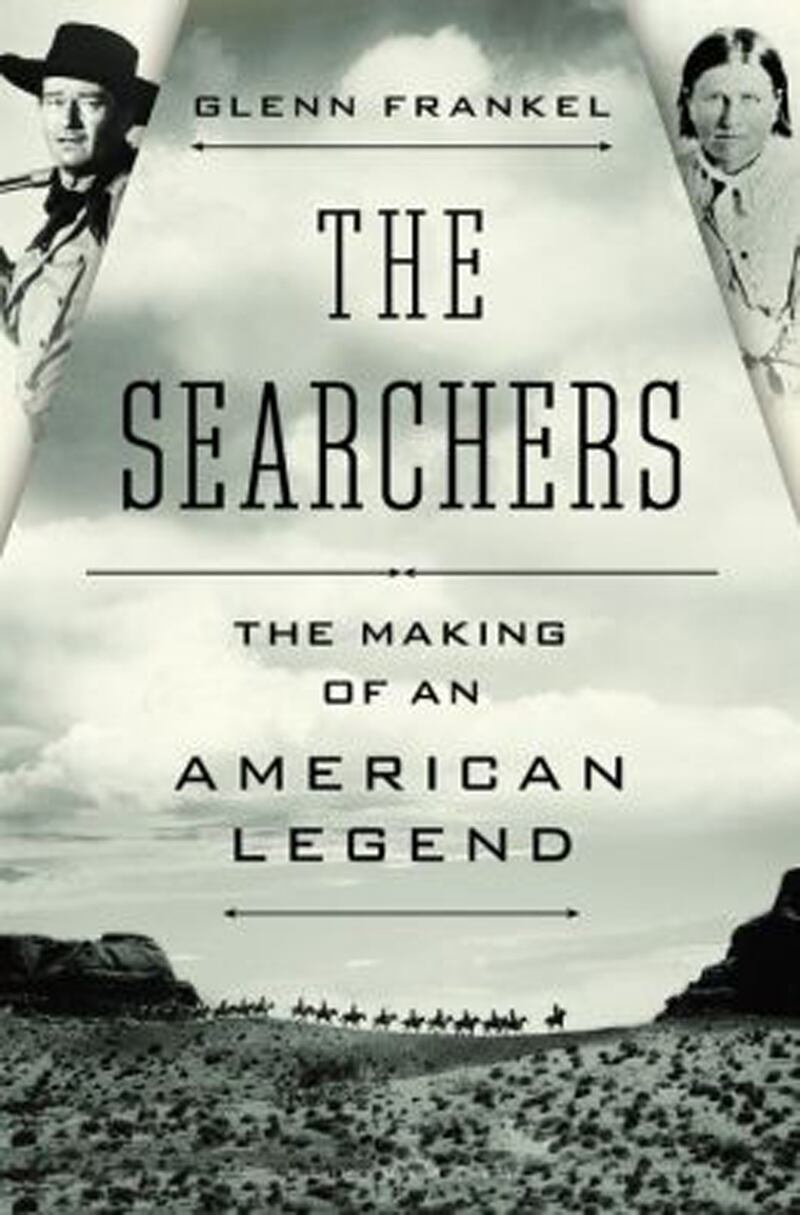
Pulitzer Prize-winning journalist Glenn Frankel spent many years covering the Arab-Israeli conflict, but for his latest book, he turns his attention to the American West—specifically to Texas, where, in 1836, a young 9-year-old girl named Cynthia Ann Parker was abducted in a raid by Comanche Indians. That raid, and Cynthia’s heavy-drinking, hot-headed uncle James Parker’s quest to find his kidnapped kin, is the subject of John Ford’s 1956 film The Searchers, “The Biggest, Roughest, Toughest … and Most Beautiful Picture Ever Made.” In its time, the film “came and went, embraced lightly … as another John Wayne Western,” Frankel notes, but it has since enjoyed a second life as a favorite of film students and academics. Frankel champions the film’s “relentless ambiguity”—the power with which it reflects the anxieties and deeply conflicting influences of the Western frontier. The most compelling story, here, however, is the one that played out offscreen for the real-life Cynthia Ann (called “Debbie” in the film). By the time she was finally captured back from the Comanches and reunited with her blood relatives more than a decade later, Cynthia Ann was hardly recognizable. Her weathered, darkened skin and bulky build advertised the separate life she had lived as a Comanche wife and mother. Reintegrating into white society was unimaginable for her. Heartbroken at being separated from her sons and old life, she died a captive to her rescuers: “the ultimate victim of the Texas-Comanche wars, abducted and traumatized by both sides.” It’s a story as deeply American as it is tragic.