
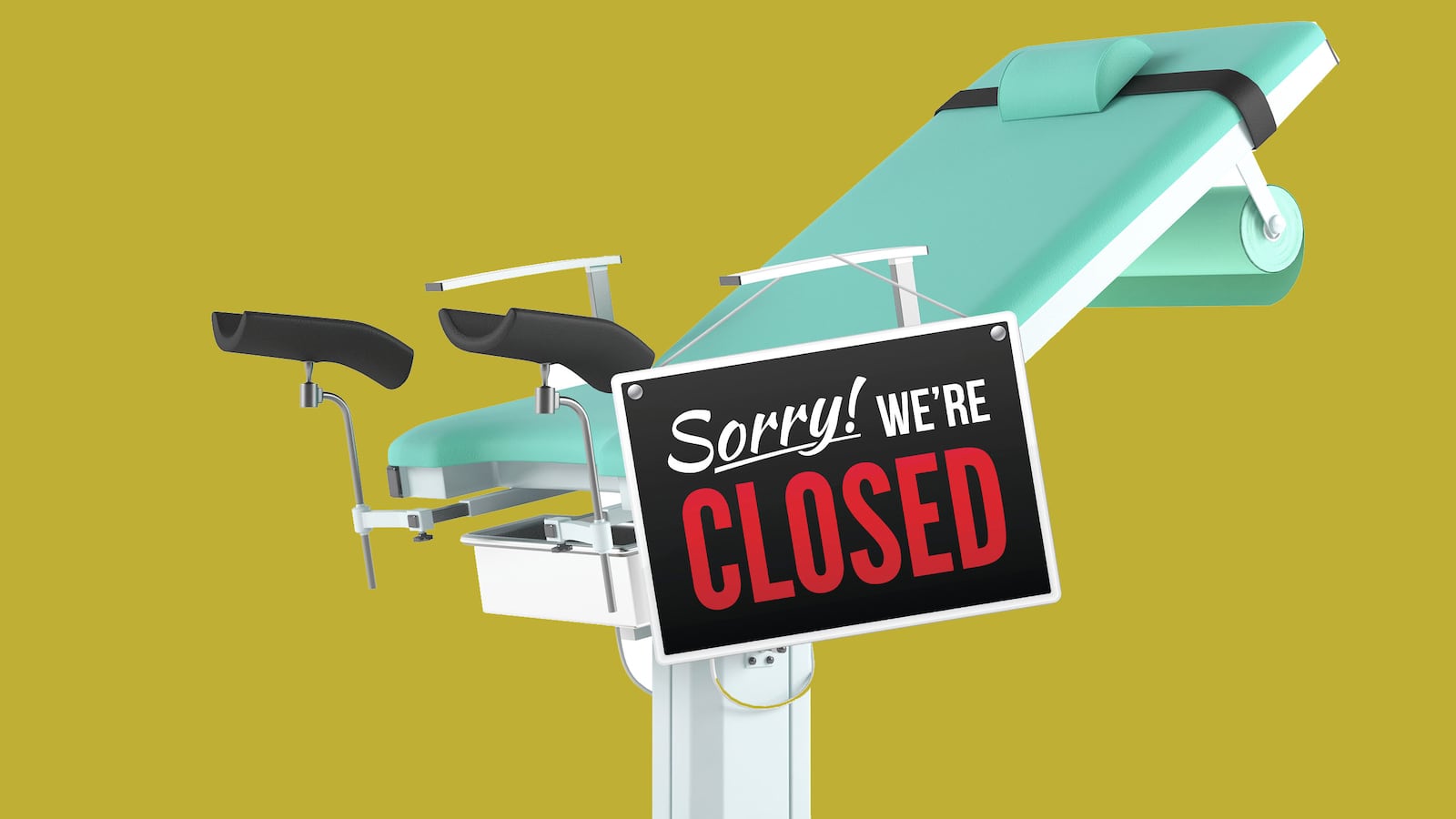
Since the confirmation of Justice Brett Kavanaugh in October, abortion rights advocates have worried the Supreme Court could overturn Roe v. Wade, the decision that legalized abortion nationwide. But new data shows abortion access is already quietly eroding, with the number of clinics across the country dropping once again in the last year.
Researchers at the University of California, San Francisco and University of California, Berkeley conducted a systematic online search for abortion facilities in 2017 and found a total of 780. This year, in previously unreported figures, the researchers found the number of clinics fell by 25, to 755 nationwide.
While some states have adopted abortion restrictions that limit when and how women can end their pregnancies, that’s not the only factor, UCSF Professor and Advancing New Standards in Reproductive Health researcher Ushma Upadhyay told The Daily Beast.
Upadhyay said some clinic closures could be the result of decreased demand because fewer women are having unintended pregnancies. Women who do choose to end their pregnancies are increasingly doing so at home, she added, through abortion-pill services like Aid Access.
Upadhyay also stressed the financial obstacles that clinic operators face. A disproportionate number of women seeking abortions are poor or low-income, so abortion providers strive to keep their prices low. At the same time, 11 states currently restrict private insurance coverage for abortion and 26 restrict coverage in plans offered through Obamacare. The vast majority of states also limit circumstances where abortion-seekers can be covered by Medicaid—the largest health insurance provider in the country.
“I think clinics are in a really tough position because already they charge so little, they’re not making any profits, [and] the staff works for meager wages because they believe in the service,” Upadhyay said. “It’s not a profitable financial model because providers are twisting themselves into pretzels to keep clinics open.”
Nikki Madsen, executive director of the Abortion Care Network, also pointed to the threat posed by anti-abortion groups like Operation Rescue. The radical organization is known for staging disruptive protests outside clinics, including one six-week blockade outside a Kansas facility that resulted in 1,500 arrests. In recent years, the group has also started buying up property leased to abortion clinics in order to shut them down.
"[This kind of] harassment and intimidation results in increasing costs for abortion clinics, like higher security costs than your average security at health clinics,” Madsen told The Daily Beast. “It also makes it harder to find physicians and other front-line clinic staff.”
“For many, those compounding laws, financial barriers, and extremism make it impossible to keep their doors open,” she added.
The new numbers mark the continuation of a trend previously documented by the Guttmacher Institute, which tracks abortion clinic closures over four-year periods. In 2014, Guttmacher found the number of providers in the U.S. had declined by 6 percent over the preceding four years, with some areas experiencing up to a 22 percent decline.
While Guttmacher is still completing its 2014-2017 census, lead researcher Rachel Jones said she did not anticipate a reversal.
“There's a lot of movement; it's sort of a moving target,” she told The Daily Beast, “but overall [the number of clinics] has probably continued to decline."
The effects of this decline are striking. As of 2014, nearly 40 percent of all U.S. women lived in counties without an abortion provider, according to Guttmacher. Upadhyay’s team identified 27 “abortion deserts” in 2017—areas in which women have to travel more than 100 miles to reach an abortion facility. Women living in Rapid City, South Dakota, had to travel more than 300 miles to reach the nearest provider, according to the researchers.
What’s more difficult to pin down is why the contraction is happening. Operation Rescue President Troy Newman Newman claimed in a blog post that more U.S. women were “rejecting abortion in favor of life.” That explanation seems unlikely, however, given that Americans’ opinions on abortion have remained largely unchanged for years.
Abortion rights advocates often argue that clinic closures are driven by targeted regulations on abortion providers, which make it more costly and cumbersome to run a clinic, and by restrictions on when and how women can access abortion. More than 400 of these restrictions have been adopted since 2011.
But according to Guttmacher, there was no significant correlation between the states with the most new abortion restrictions and the states with the most clinic closures between 2011 and 2014. In fact, a number of states that enacted no new abortion restrictions during that time still experienced a greater decline in abortion rates than the national average.
Operation Rescue, which tracks abortion providers in hopes of shutting them down, has also documented the closures. According to its annual survey released this week, the number of providers declined in 2018 for the sixth year in a row and has fallen by nearly 160 since 2012.
“Abortion facilities are closing faster than they can open, and that means there are fewer women and babies being put at risk,” Newman said in a blog post. “We expect that trend to continue until all of our nation is finally abortion-free.”
Overall, advocates say the decline in clinics means more women will have to travel farther to find a trusted abortion provider—meaning higher travel costs, more time off work, and more time away from home. After nearly half of Texas’s abortion clinics shut down in 2014, several women told researchers they were forced to wait until their second trimester to have an abortion, or never obtained the abortion at all.
Amy Hagstrom Miller, founder of Whole Woman’s Health clinics, saw several of her Texas clinics shut down in 2014. She said the lack of options not only prevented women from getting abortions, but contributed to the stigma they felt if they did.
“What women experience when they need to terminate a pregnancy and they need to find a [clinic,] is they then start to experience this kind of ‘othering,’” she told The Daily Beast. “Like, ‘Why can't I get an abortion in my community? Why do I have to travel this far? Why do I have to go to a different building?’”
“I think a lot of people are really surprised because in their friend group it’s kind of a normal thing someone might go though,” she added. “But when you try to obtain the service, you realize the stigma that’s been introduced.”