How the Rise of Farming Rotted Ancient Humans' Teeth
Scientists are studying ancient plaque samples to learn how the transition to agriculture did a number on our dental health.

Andrea Quagliariello
Dental plaque, what is it good for? Beside harboring millions of bacteria and contributing to tooth decay, the sticky saliva and food mixture can act as a porthole allowing biologists to peer into the distant past—at least for a team of Italian researchers interested in seeing how ancient plaque shifted after the agricultural revolution. According to their findings, farming changed much more about human physiology than just diet.
DNA and RNA, the genetic material that makes up all living organisms, degrades over time. Researchers in fields like paleogenomics (one of whom won the 2022 Nobel Prize in Physiology or Medicine) seek to recover and decode the fragmentary remains of this ancient genetic material—including the microscopic bacteria that makes up a part of the human microbiome. Typically, researchers reconstruct the ancient microbiome by using coprolites (calcified poop) or dental calculus (calcified plaque).
The new Italian study, published on Tuesday in the journal Nature Communications, analyzed calcified plaque from 76 human samples dating from 31,000 BC to 2,200 BC. Importantly, during this range encompassing the Paleolithic, Neolithic, and Copper Ages, humans transitioned from hunting and gathering to a farming lifestyle—meaning their diets and geographies changed considerably.
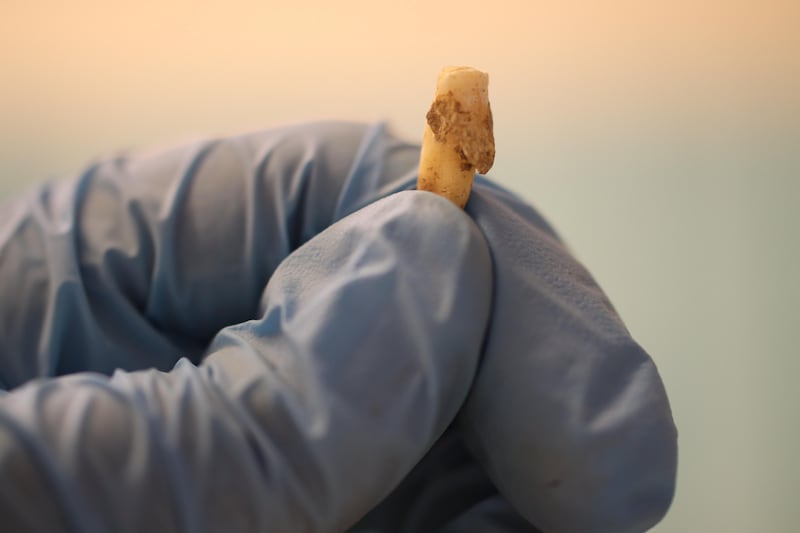
Example of anterior teeth with a huge dental calculus deposit from Copper Age Italy (~3.000 BC).
Andrea Quagliariello
In order to control for the location, which causes natural variety in humans’ microbiomes, the researchers limited their study to the Central-South Italian peninsula. Even so, the most common 49 bacterial species that had been preserved in the calcified dental plaques changed dramatically as humans transitioned to farming, which took place around 6,200 BC in Italy. Bacteria including species of Campylobacter and Capnocytophaga—some of which can clot together and can cause gum disease—were only weakly present in Paleolithic human samples, but became increasingly common throughout the Neolithic Period and peaked at the end of the Copper Age samples. In contrast, Streptococcus species—a major contributor to tooth decay and cavities in the presence of sugars—became less and less prevalent in the samples over time.
The researchers were even able to recover grains of food that the humans had eaten thousands of years ago. The Paleolithic humans had grains of wild plants—including wild wheat, wild slender oat, and yellow water lily—in their plaque. On the other hand, the Neolithic and Copper Age humans’ plaques contained structures called phytoliths, which are left behind from some plant tissues. According to the paper, the ones found constituted “direct evidence of cereal consumption.”
Get the best of The Beast delivered right to your inbox
By clicking “SUBSCRIBE” you agree to our Terms of Use and Privacy Policy.
Moreover, these ancient humans were getting bubbly with it: Researchers identified a number of fungal spores in their plaque, suggesting that they dined on fermented foods.

In the paper, the researchers argue that the trends identified in the samples’ microbiomes may be due to the major shifts in humans’ diet, as they moved away from consuming wild plants and toward farmed grains. Differing levels of proteins and carbohydrates in their saliva may have encouraged the growth of certain types of bacteria, while discouraging that of others.
And these microscopic changes may have had a surprisingly large impact: The researchers write that while Paleolithic samples tend to demonstrate signs of good oral health, Neolithic and Copper Age humans had higher rates of oral diseases like gum infections and cavities.
The next time you are reluctant to brush your teeth, ask yourself: Do you really want biologists thousands of years from now to discover that you are a frozen pizza for dinner?
See more of our coverage in your search results.

Got a tip? Send it to The Daily Beast here.
Register below to read this article for free or subscribe
to unlock unlimited access to The Daily Beast.
Monthly
$1
First month then $5.99/month
Annual
$35
First year then $59.99/year
Premium
$79
First year then $119.99/year
*Substack access provided by the next business day, using your subscription email. Choosing the Premium plan constitutes your permission to share your subscription email with Substack and your agreement to Substack’s Privacy Policy.
Already have an account? Sign In
Looks like you already have a subscription!
You're all set!
Thanks for subscribing.