Birdwatching Is Going High-Tech Thanks to This New Tool
Follow your favorite bird wherever they go.
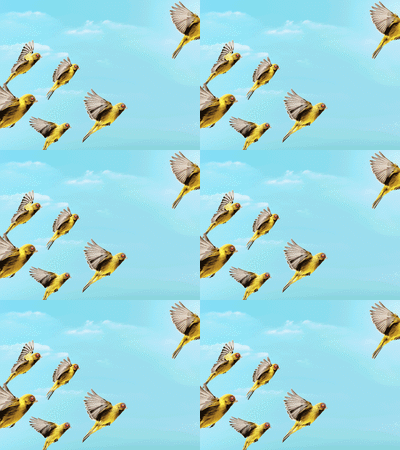
Photo Illustration by Kelly Caminero / The Daily Beast / Getty
Remember the Central Park ‘hot duck’? Over a course of several months in late 2018 and early 2019, a mandarin duck appeared in New York City. This was remarkable both because the duck is native to East Asia, and due to the male’s distinctive and colorful markings. There are great photos of it honking and nipping at a much dowdier mallard.
The duck drew huge crowds of amateur and seasoned birdwatchers to Central Park, and it even inspired at least one website to track its whereabouts. Spurred by a fruitless trip to spot the duck, the creator of the website wrote in Quartz that an effort was underway to use machine learning to identify pictures of the mandarin duck for even better tracking. Sightings of the bird ended around March 2019, but the underlying problem persisted: We had no good ways to predict where a bird would go next.
That is, until now. Using crowd-sourced data from eBird, a massive biodiversity project, researchers at the University of Massachusetts Amherst and Cornell University developed a tool that forecasts individual birds’ movements based on their past locations. This knowledge opens up new avenues for research and promises to be a useful tool for birdwatchers, the researchers say. A paper describing results from their new tool, called BirdFlow, was published on Feb. 1 in the journal Methods in Ecology and Evolution.

“There's a lot of wisdom out in the birdwatching community,” Dan Sheldon, a computer science researcher at the University of Massachusetts Amherst who led the research, told The Daily Beast. “In some ways, this is like extracting it in a quantitative way.”
Sheldon designed BirdFlow as an alternative to traditional bird-tracking methods that are time-intensive, costly, and finicky. Usually, recording a bird’s movement requires researchers to catch the bird and attach a sensor around its leg or as a backpack. Engineering a device to be small and lightweight enough, figuring out how data will be recorded and sent back, and eating the cost of enough devices for a large enough sample size are all issues associated with this method, Sheldon said.
Get the best of The Beast delivered right to your inbox
By clicking “SUBSCRIBE” you agree to our Terms of Use and Privacy Policy.
In contrast, BirdFlow bases its data off of the more than 200 million individually reported bird sightings that are collected and used by eBird. While the site can currently map the abundance of a bird species in a given region over time, it doesn’t predict where one bird or a whole flock will go next. BirdFlow generates simulated routes for a bird, forecasting where it will go based on where it’s been.

When Sheldon and his colleagues tested BirdFlow’s predictions for 11 species of North American birds, they found that it outperformed other models without relying on GPS tracking data. To Sheldon, the ability to predict a bird’s movement without tracking devices will open up doors for new research.
“We think the fact that we can have a model that has good predictive performance without having to collect any tracking data would be a major advance for scientists and conservation efforts,” he said.
For instance, infectious disease or agricultural specialists might one day use BirdFlow to track avian influenza to predict regions where chicken farmers should be concerned for their flocks. Sheldon says his team is adding one species at a time to the model, which will be available by summertime for researchers to download.
Eventually, Sheldon hopes to create visualizations like eBird’s maps that birdwatchers and the general public can use to see if their favorite bird will be hanging around nearby.
See more of our coverage in your search results.

Got a tip? Send it to The Daily Beast here.
Register below to read this article for free or subscribe
to unlock unlimited access to The Daily Beast.
Monthly
$1
First month then $5.99/month
Annual
$35
First year then $59.99/year
Premium
$79
First year then $119.99/year
*Substack access provided by the next business day, using your subscription email. Choosing the Premium plan constitutes your permission to share your subscription email with Substack and your agreement to Substack’s Privacy Policy.
Already have an account? Sign In
Looks like you already have a subscription!
You're all set!
Thanks for subscribing.