Court Deals Trump Humiliating Blow Over ‘Energy Emergency’
The judges found the Trump administration had overstepped in an attempt to keep a coal plant burning.

Evelyn Hockstein/REUTERS
President Donald Trump’s crusade to prop up the coal industry was dealt a serious blow Friday when a trio of judges ruled against his efforts to keep a coal-burning plant operating.
A Michigan utility had planned to shut down the J.H. Campbell power plant in May 2025, but just days before it was supposed to be shut down permanently, Energy Secretary Chris Wright stepped in.
He used an emergency federal power to order that the plant remain open, despite the utility having deemed it to be at the end of its lifespan.
The U.S. Court of Appeals for the District of Columbia Circuit found that Wright had failed to show that federal intervention over state authority was warranted.

U.S. Energy Secretary Chris Wright.
Leonardo Fernandez Viloria/REUTERS
The decision, written by Judge Cornelia Pillard, and joined by Chief Judge Sri Srinivasan and Judge Robert Wilkins, all Obama appointees, said the Department of Energy’s “sweeping conception” of its “emergency” authority had failed to persuade them.
Judge Pillard outlined that the plant had gone through a long and exhaustive planning process for its closure, with contingencies made to replace the energy generation lost with more efficient, cleaner, cheaper energy supplies.
Sign Up for The Swamp Newsletter
By clicking “SUBSCRIBE” you agree to our Terms of Use and Privacy Policy.
But at the last minute, the Department of Energy overruled the utility.

Judge Cornelia Pillard.
Ken Cedeno/Corbis via Getty Images
“The Department invoked a rarely used, short-term, federal emergency authority conferred in section 202(c) of the Federal Power Act to order the Campbell coal unit to stay open,” the decision stated.
She wrote that “the circumstances DOE identified in the challenged order do not warrant resort to section 202(c) as 7 correctly interpreted” and the court overturned the order.
The ruling is a big win for Michigan, Illinois, Minnesota and a swathe of environmental groups who had all opposed the emergency order.
It is also the first case of what could be many. There are currently three other petitions before the D.C. Circuit Court and more in other jurisdictions, dealing with emergency orders requiring six coal plants across the country to remain online.
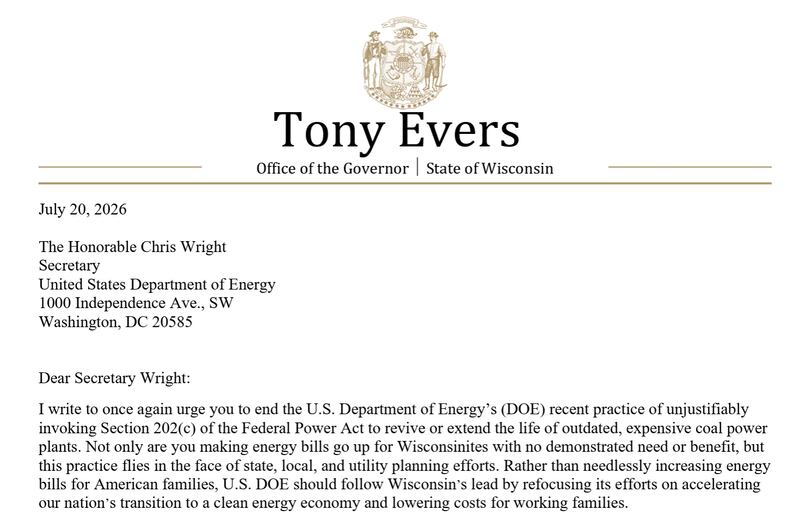
Gov. Tony Evers letter to Secretary Wright.
Gov. Tony Evers
In July, Wisconsin Gov. Tony Evers wrote to Wright warning that the administration’s orders keeping aging coal plants online could cost Wisconsin ratepayers an estimated $117 million over the next few years.
He urged the secretary to change course.
“Not only are you making energy bills go up for Wisconsinites with no demonstrated need or benefit, but this practice flies in the face of state, local, and utility planning efforts,” he wrote of the orders.
The orders, which are 90-day orders that keep being renewed, have been used by the Trump administration to prop up old coal fired plants in an attempt to help sustain the coal industry.
But the court said that wasn’t a genuine emergency.
“The court rebuked the Trump administration’s abuse of emergency powers,” Michael Lenoff, an Earthjustice attorney, said in a statement following the ruling.
“The DOE needs to stay in its lane and use its emergency powers only in actual emergencies. Preventing the market-driven retirements of coal plants to advance a coal-friendly agenda is not a proper use of emergency powers.”

The Department of Energy, the Department of Justice, and the White House did not immediately respond to a request for comment.
See more of our coverage in your search results.

Got a tip? Send it to The Daily Beast here.
Register below to read this article for free or subscribe
to unlock unlimited access to The Daily Beast.
Monthly
$1
First month then $5.99/month
Annual
$35
First year then $59.99/year
Premium
$79
First year then $119.99/year
*Substack access provided by the next business day, using your subscription email. Choosing the Premium plan constitutes your permission to share your subscription email with Substack and your agreement to Substack’s Privacy Policy.
Already have an account? Sign In
Looks like you already have a subscription!
You're all set!
Thanks for subscribing.
Sign in or create an account
Login dialog
Loading comments…