

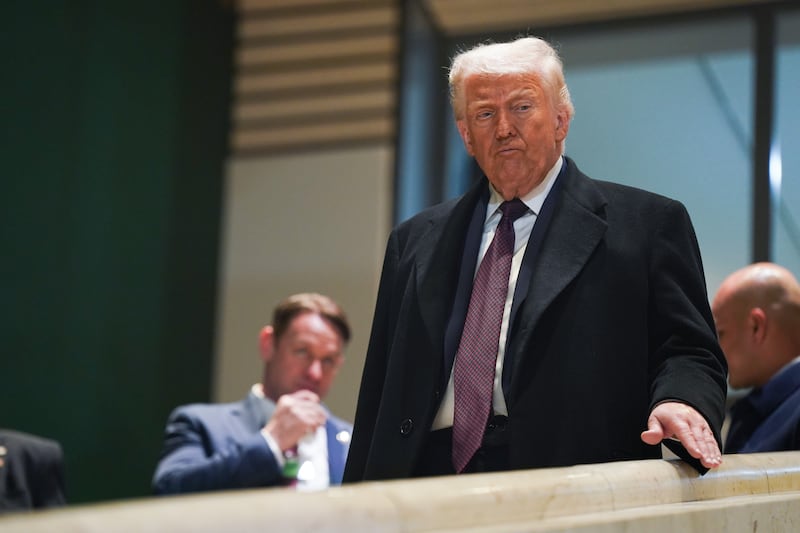
A damning new poll is rattling the Trump camp, showing the president facing steep public disapproval and putting Republican prospects in the midterms on shaky ground.
The latest NBC News poll, conducted between February 27-March 3 among 1,000 registered voters, shows that Democrats lead the Republicans by 6 points, with 50 percent to the GOP’s 44 percent, in the fight for control of Congress ahead of the 2026 midterms.
It comes as Trump is underwater on a range of key issues critical to midterm voters, including the economy and inflation, as well as immigration and the war in Iran.
According to the poll, on the economy, Trump faces his toughest ratings yet.
Sixty-two percent of voters disapprove of his handling of inflation and the cost of living, with only 36 percent approving. Nearly half of voters—48 percent—say his policies have hurt the economy, while 35 percent say they have helped, and 16 percent see little impact. Tariffs are particularly unpopular, with 55 percent saying they have hurt the economy and 33 percent saying they have helped.

Personal finances are a concern as well: 38 percent of voters report their situation is getting worse, 27 percent say it is improving, and 35 percent say it is holding steady.
The numbers are bad news for the Trump administration. With 48 percent of voters considering inflation and cost of living as the most important issues facing the country, the Trump administration has sought to control the narrative on the economy.
During his record 108-minute State of the Union address last month, Trump praised his own “roaring economy,” which was “roaring like never before,” claiming that the nation is “back bigger, better, richer and stronger than ever before.”
Trump has also lifted tariffs on a range of food items, introduced measures to lower certain prescription drug prices, and put forward proposals for retirement accounts for workers without employer-sponsored plans, all intended to help Americans manage rising living costs.
Still, the NBC poll shows no signs that the GOP is the trusted party on the cost of living.
Democrats have now tied Republicans, 40 percent to 40 percent, on which party would handle the economy better—the GOP’s worst showing on this question in NBC News polling since December 2017.
Trump’s ratings are also slipping on immigration, previously a critical issue in his campaign.
While 53 percent of voters approve of Trump’s handling of border security, 54 percent disapprove of his handling of immigration after his administration sent federal agents into major American cities and Minnesota immigration officers fatally shot two U.S. citizens in January.
Meanwhile, voters still trust Republicans more than Democrats on immigration and border security, but the GOP’s advantages are slipping.
Their lead on border security has dropped from 31 points in late October to 27 points, and their edge on immigration has fallen from 18 points to 12 points.
Trump faces criticism on foreign policy as well after the U.S. and Israel launched unprovoked airstrikes on Iran last weekend. At least seven U.S. service members have been killed in retaliatory strikes since.

According to the poll, 54 percent of voters disapprove of his handling of the situation in Iran, while 41 percent approve.
Overall, Trump’s approval rating stands at 44 percent, and a majority (56 percent) of voters say the president is either bringing the wrong kind of change or not bringing change at all.
Dozens of recent polls have put the president’s approval rating deep underwater, and his ratings on key issues have also been falling.
Polls have also shown Trump losing support from key voter groups that propelled him to the White House in 2024, including non-college-educated voters, young men and Hispanics.
A man casts his vote into a mock ballot box at an election event hosted at the U.S. ambassador's residence in Kathmandu, Nepal November 9, 2016. REUTERS/Navesh Chitrakar
REUTERS/Navesh ChitrakarAt the same time, in 20 state legislative special elections so far this year, Democrats have outpaced Trump’s 2024 performance by 10 to 14 points in areas including northern and central Virginia, New York City, east-central Minnesota, and southeastern Connecticut.
The results have raised concerns among Republicans that Trump’s backing may no longer guarantee victories in the midterms in districts once considered safe.
Even in reliably Republican areas, candidates are struggling to replicate his margins. For example, in a north-central Oklahoma state House race on February 10, a GOP candidate won by 28 points—far below the 58-point margin Trump had achieved in the same district two years earlier.
In a stunning upset in Tarrant County, a traditional Republican bastion in the Texas state Senate, Democrat Taylor Rehmet won over a Trump-endorsed GOP candidate in January, securing more than 57 percent of the vote.
Two Republican strategists told Axios last month that retaining a Senate majority could be a serious challenge for the party in the November midterms.
“A year ago, I would have told you we were almost guaranteed to win the Senate,” one of the GOP operatives said. “Today, I would have to tell you it’s far less certain.”