
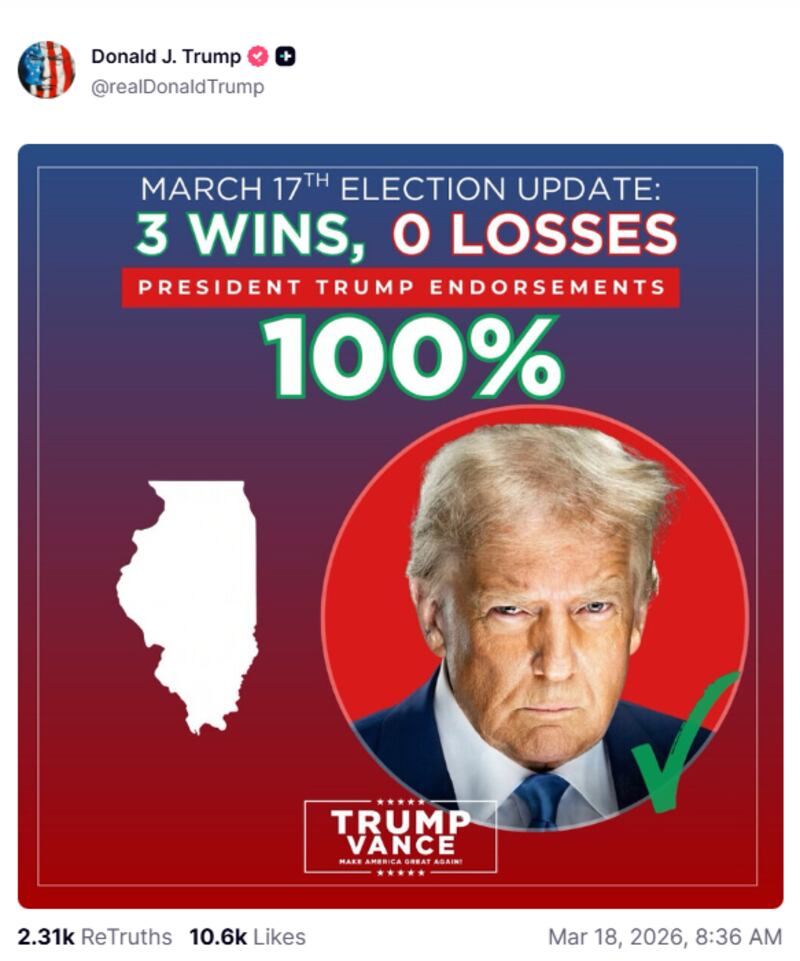
The president is once again bragging about his “perfect” endorsement record—but a closer look shows many of those wins were never in doubt to begin with.
President Donald Trump, 79, took to Truth Social on Wednesday to tout a “100%” endorsement streak, flooding his feed with glossy victory graphics after a series of Republican primary results. The posts, splashed with his headshot and bold, colorful lettering, claimed multiple wins and zero losses.
There’s just one catch: some of those “wins” came in races where there was no opponent at all.
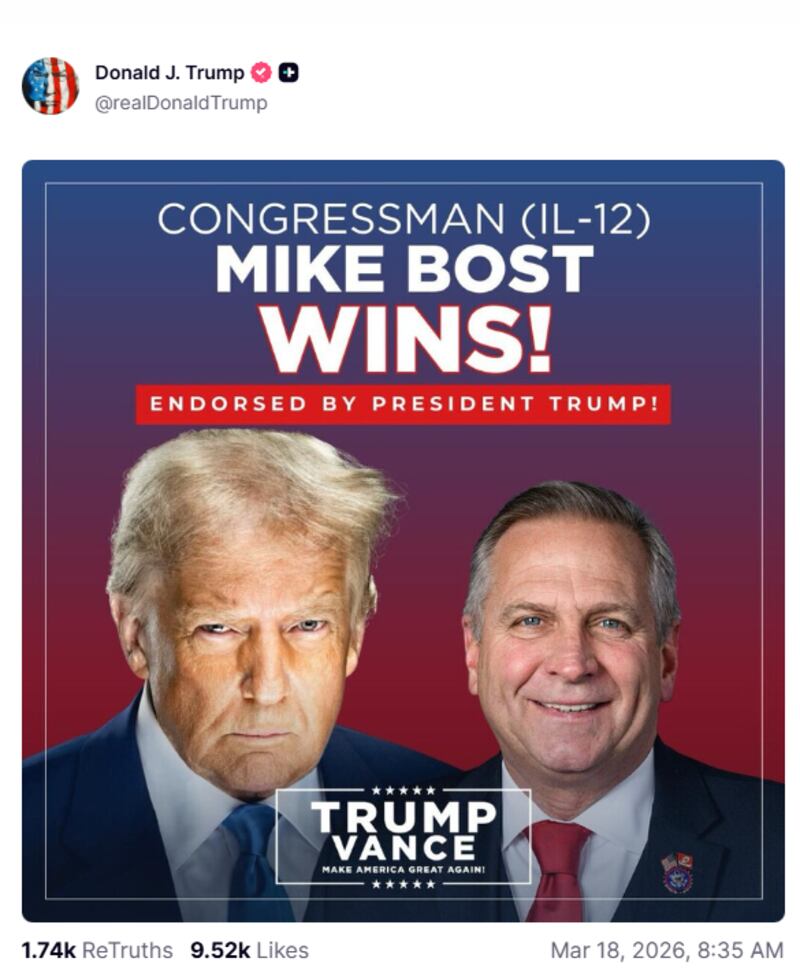
In Illinois, Trump kicked off his latest victory lap by touting Rep. Mike Bost’s, 65, win in the state’s 12th Congressional District. But Bost—who chairs the House Veterans’ Affairs Committee and has been a reliable Trump ally—didn’t actually have a primary challenger.
His “win” simply locks him in for the looming November elections, where he’s expected to face a Democrat in a district that leans comfortably Republican.
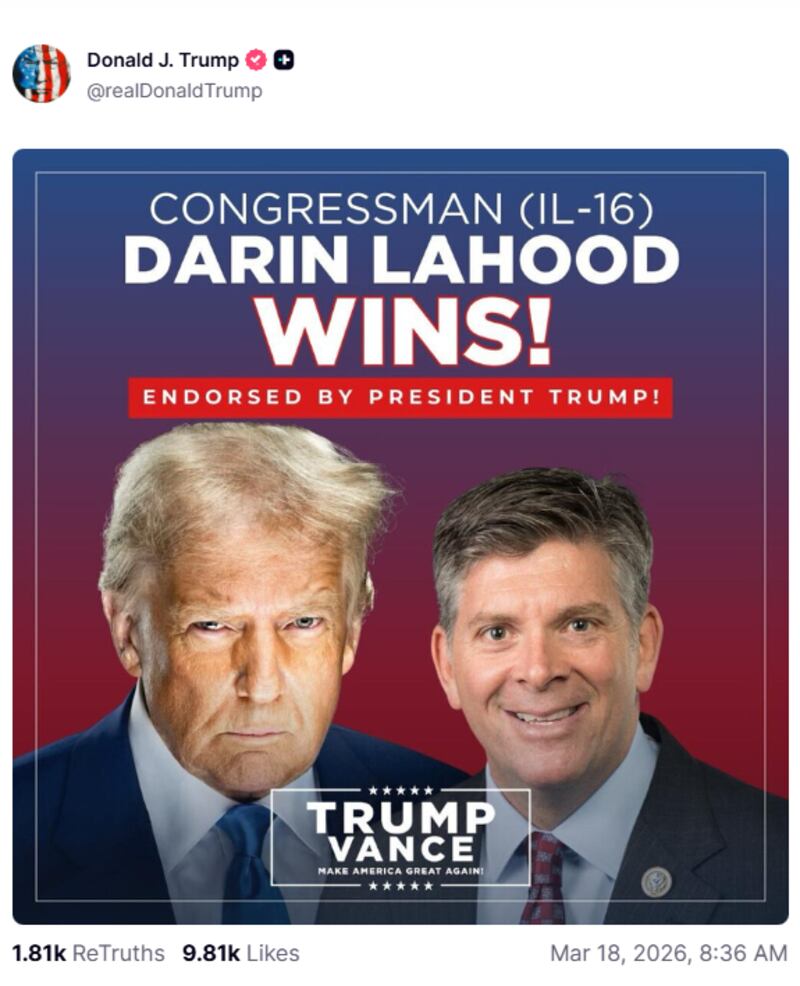
Rep. Darin LaHood’s race followed a similar script. The Illinois Republican, who represents the state’s 16th District, also ran unopposed in his primary after securing Trump’s endorsement. Like Bost, LaHood, 57, now advances to the general election without having had to prove Trump’s influence at the ballot box.
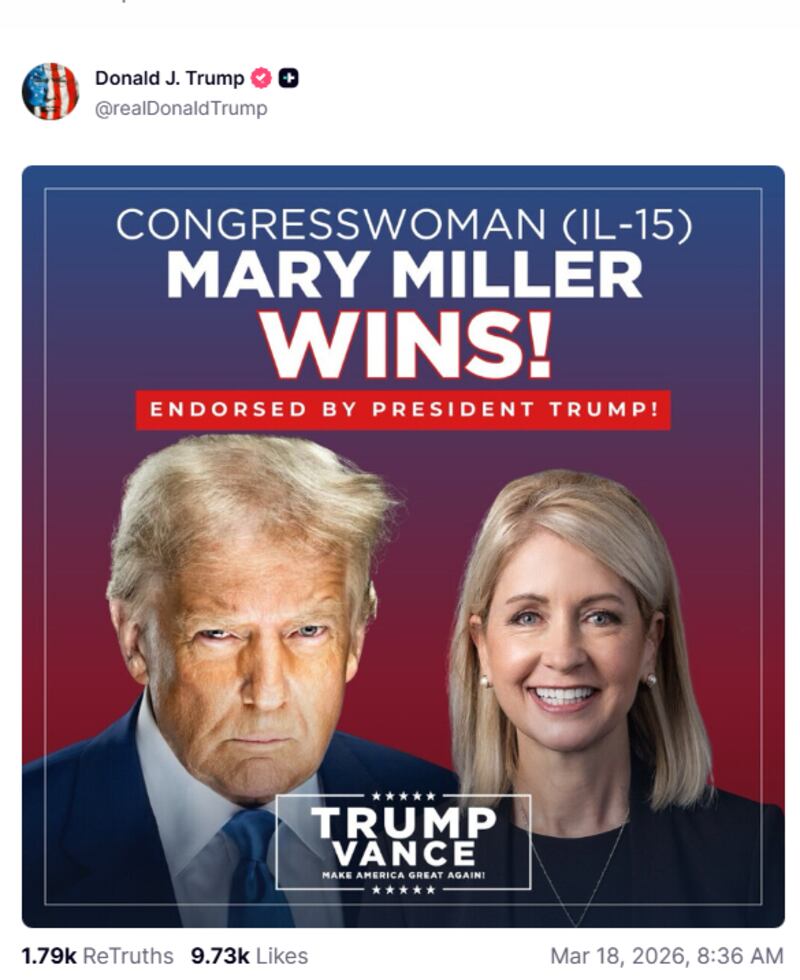
The only race that actually tested Trump’s political clout was 66-year-old Rep. Mary Miller’s. Her victory against Ryan D. Tebrugge and Judy Bowlby gave Trump a legitimate notch in the win column.
Still, even with an actual victory to point to, the president hasn’t bothered to distinguish his actual wins from unchallenged candidates.
Speaking earlier this month at his “Shield of the Americas” summit, Trump joked that candidates “beg” for his endorsement and then “win by 30 points,” quipping that he should be getting paid for it.
The crowd laughed—but the numbers tell a more selective story.
Earlier this month, Trump pulled the same move when claiming victory in 14 races in Texas, Arkansas, and North Carolina. All were candidates who won their races this month without any opponents or had their primaries cancelled altogether.

The unopposed strategy marks a noticeable shift for a president whose endorsement record has been far more uneven in competitive races.
Trump-backed candidates have suffered high-profile losses during election cycles, undercutting his claims of a perfect record. In New York, former Rep. Anthony D’Esposito—whom Trump endorsed—lost his seat in 2024 to Democrat Laura Gillen.
Elsewhere, Trump’s handpicked candidates have also struggled in swing territory. In Arizona, Trump-backed Senate hopeful Kari Lake lost her 2024 bid to Democrat Ruben Gallego after a bruising race. And in Georgia, Trump-endorsed Senate candidate Herschel Walker fell short in his 2022 runoff against Sen. Raphael Warnock.
Trump has held off on endorsing in several high-stakes contests, including Virginia’s gubernatorial race in November 2025. Republican Winsome Earle-Sears did not receive Trump’s endorsement and lost to Democrat Abigail Spanberger.
A similar dynamic is playing out in Texas, where Trump has so far declined to endorse in a looming GOP Senate showdown between Sen. John Cornyn and Attorney General Ken Paxton. The president previously hinted he might weigh in—and even suggested that one candidate should drop out—but has yet to make a move as the deadline to withdraw passed.
After a Texas special election in February in which Trump endorsed the Republican candidate Leigh Wamsganss, who lost, the president pleaded ignorance about the whole election when asked by reporters.
“In Texas, a Democrat won a special election in an area that you had won by 17 points. What is your reaction to that?” a reporter asked Trump last month.
“I don’t know. I didn’t hear about it. Somebody ran—where?”