Jeffrey Epstein had a years-long relationship with an FSB-trained Russian official who sought his help connecting with a well-known hacker in 2016.
The late sex trafficker’s correspondence with Sergei Belyakov is among the strangest revelations in the millions of case files released by the Justice Department last month.
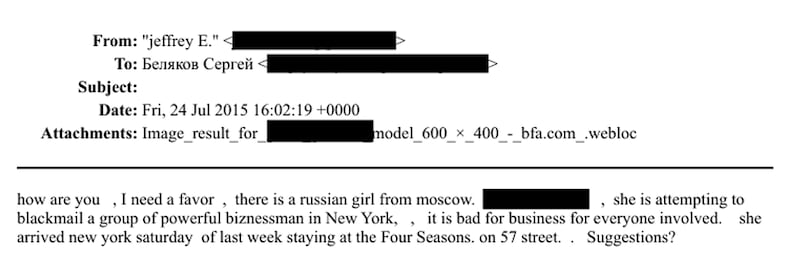
Belyakov, a former deputy economic minister, helped Epstein secure visas to visit Russia, provided him with a dossier on a Russian woman Epstein had complained was trying to blackmail “a group of powerful businessmen,” and reported to Epstein about his work for the Russian government.
Epstein’s frequent bids to meet with Russian President Vladimir Putin and Russian Foreign Minister Sergei Lavrov feature heavily in the newly released files—his assistant reminds him in one September 2011 email that he’d told his bodyguard he “had an appointment with Putin” coming up—but he appears to have had Belyakov at his beck and call.
In one January 2016 email under the subject, “My new position,” Belyakov told Epstein he’d started working at the Russian Direct Investment Fund–now led by Kirill Dmitriev, one of Vladimir Putin’s most trusted envoys, and a key player in ongoing peace talks with the Trump administration to end Russia’s war against Ukraine.

Much of their correspondence focused on investment opportunities and potential investors, though it’s unclear to what extent Belyakov involved Epstein in his work beyond the emails documented in the latest files.
The pair met several times in person over the years. In numerous email exchanges from 2014 through 2018, they reference personal meetings they had together, along with sporadic phone calls.
Epstein described Belyakov as a “very good friend” in a 2015 email to billionaire venture capitalist Peter Thiel as he tried to arrange for the pair to meet. Belyakov also apparently put Epstein in touch with other Russian officials, with emails showing he helped Epstein apply for a Russian visa in 2014 to meet with then-Deputy Finance Minister Sergei Storchak and Alexei Simanovsky, the deputy head of Russia’s Central Bank at the time.
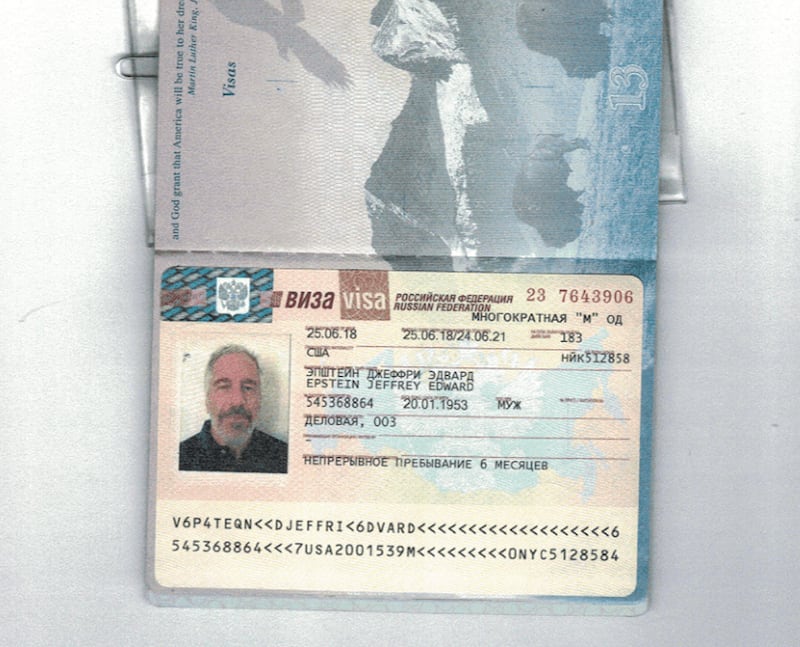
The FSB Academy graduate also repeatedly went out of his way to facilitate Russian visas for the notorious sex trafficker. Belyakov provided an invitation letter from the “Association of Nongovernmental Pension Funds” for Epstein’s 2018 visa application, asking for a three-year visa that would allow him to come and go as he pleased for “international seminars and forums.” In a 2015 visa application, Epstein listed Belyakov’s employer, the St. Petersburg Economic Forum Foundation, as the organization inviting him to visit.
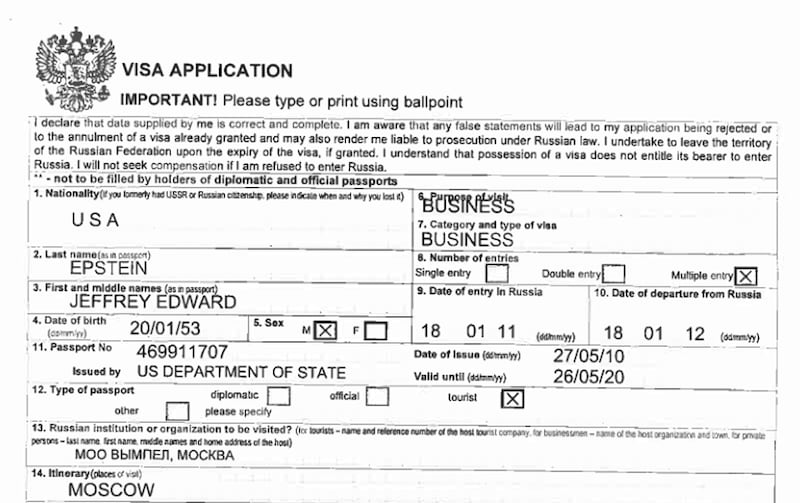
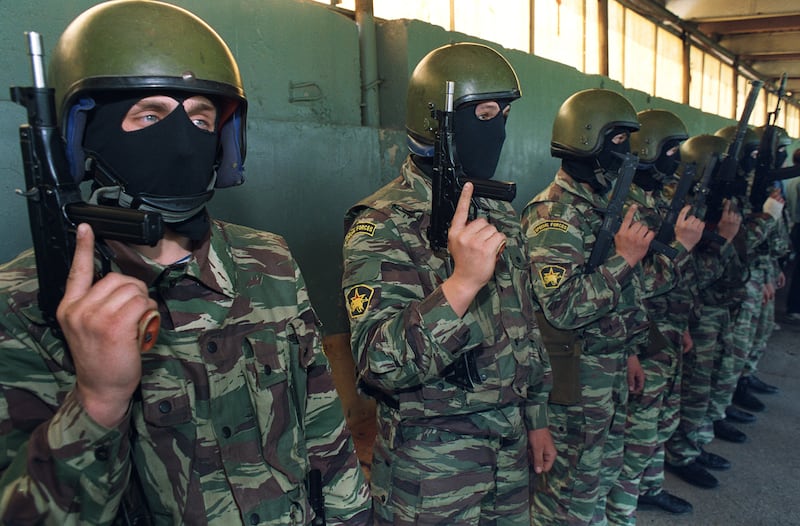
Russian visas typically require a letter of invitation from an organization or individual willing to vouch for a visiting foreigner during their stay—and in 2011, Epstein listed as his “host organization” the Moscow-based NGO “Vympel,” a veterans’ group for the secretive Vympel unit of the FSB, led at that time by an FSB veteran and KGB colonel. The group appears to no longer be active.
Belyakov and Epstein appear to have been largely cautious about how much information they included in their messages to one another, usually keeping them short.
In February 2016, Belyakov asked Epstein to set up a meeting with Vincenzo Iozzo, a renowned hacker with whom Epstein appeared to have been in close touch over the years. The purpose of the meeting was unclear, but earlier in the same conversation, Epstein had told his Russian friend, “I will do anything that is helpful to you.”
Belyakov clearly felt the same way. In July 2015, according to his own emails to Epstein, he arranged a meeting with unknown sources to compile a dossier of sorts on a woman said to be giving Epstein’s friends trouble.
“There is a russian girl from moscow… she is attempting to blackmail a group of powerful biznessman in New York,” Epstein wrote, asking for “suggestions” on how to deal with her.
“Give me a few days to get information about her,” Belaykov wrote back, later informing Epstein of a meeting “with a guy” who was believed to have information about the woman. A few days later, he updated Epstein with what he’d learned, saying the woman had “nobody behind her,” or in other words, no powerful connections among Russia’s elite.
A separate document showing an email Epstein had apparently sent to himself days earlier—presumably a draft of what he planned to tell the woman—suggests he threatened her with punishment from the FSB.
He claimed to have consulted “some friends in FSB” who said she would be considered an “enemy of the people” and “dealt with extremely harshly” if she continued to threaten U.S. businessmen and jeopardize potential investment in Russia’s economy.
Belyakov, who now works for a private technology company, appeared to be a rising star in Moscow during much of the time he was corresponding with Epstein. He graduated from the FSB Academy, which churns out Russian intelligence officers, in 1998. He spent a year serving as an FSB border guard before moving to a series of positions within the government focused on the economy, getting promoted to deputy economic minister in 2012. He went on to serve as the head of the St. Petersburg Economic Forum Foundation from 2014-2015. A year later, he began working as an adviser at the Russian Direct Investment Fund, according to independent Russian media outlets.
After Donald Trump won the 2016 presidential election, Belyakov sent Epstein an empty email with the subject line reading, “Congrats with your President).”