
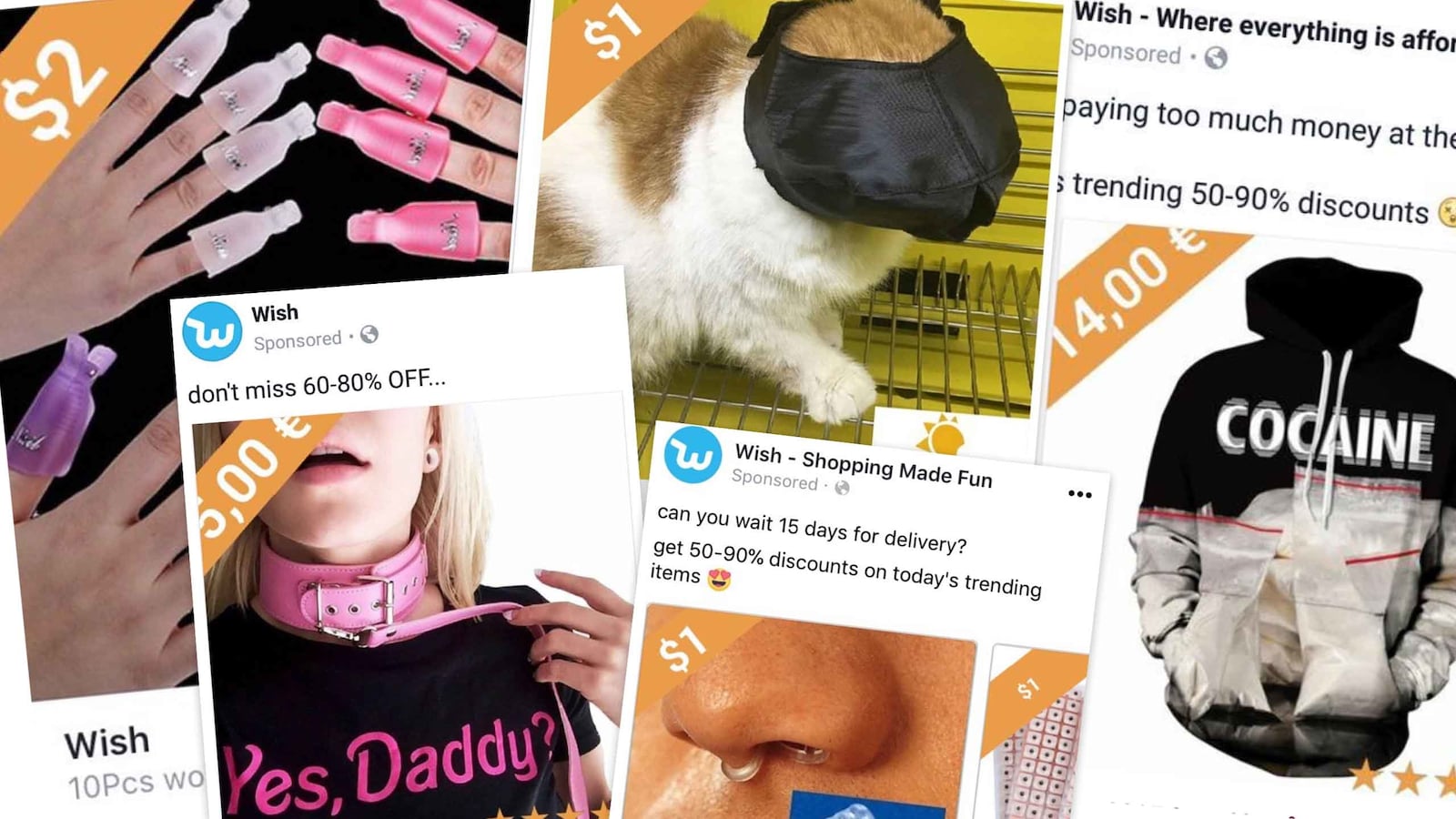
Over the past few months, Wish ads have dominated Facebook by hawking bizarre items like hamster leashes, giant human-sized balls of yarn, toenail extenders, mysterious car goo, and a myriad of other strange things for extremely low prices.
Thousands of these ads are displayed daily, not only on Facebook itself, but in a plethora of other apps that pull in Facebook ad inventory.
Wish ads are so unusual that they’ve developed a cult following. For Wish ad connoisseurs, guessing what the products actually do has become a competitive game and a Twitter account called @WeirdWishAds documents some of the most surreal items.
Wish is an $8 billion e-commerce company similar to Amazon or Alibaba that “hopes to become the next Walmart.” Its competitive advantage is it offers much lower prices than its competitors by shipping direct from Chinese manufacturers. The only downside is that most items take around 14 days to arrive.
Many people have assumed that Wish’s insane ads must be some type of viral marketing stunt.
“edens got a conspiracy theory that the Wish app advertises weird shit so ppl will share the screenshot and alert people to Wish nd u know what i think she’s right,” one user tweeted in November.
But to those businesses who rely on Facebook ad inventory, Wish ads are no laughing matter.
Matt Raoul, CEO of the app Timehop, an app for viewing old photos and memories, said that his users began reporting the ads for offensive content sometime in November of this year.
“Timehop is a very family friendly app,” Raoul said. “We have controls we set on the ads we display saying, no alcohol, no adult content, et cetera. But then we started seeing reports for these ads from this company called Wish and the ads were crazy! We couldn’t believe it.”
Some of Wish’s more problematic ads promote products such as a penis sleeve extender, triple dildo strap-on underwear, a dog collar with a leash for women, an “anall” speculum, and a sweatshirt featuring the word “cocaine” and giant bags of the drug.
“It was really embarrassing for us,” Raoul said. “We spend so much time worrying about what ads we’re showing our users and we do so much to limit them, but somehow these crazy ads got through to our users. We don’t want to say no ads from Wish. It’s just these particularly weird products we want to stop showing up.”
But why would a seemingly straightforward e-commerce company promote such creepy and strange products? Like most things on the internet, it all boils down to the Facebook algorithm.
In February 2015 Facebook launched a new type of ad product. Unlike previous “static” ads, where the advertiser would have to hand select images that would be shown to users, the social network’s new “dynamic” ads allowed companies to simply upload their entire product catalog to the platform. From there, Facebook’s algorithm would choose which product to show which consumer.
You’ve probably already noticed these new types of ads in your feed. The carousels are popular with big retailers like Macy’s and Wayfair that want to show off many products at once.
The theory goes that Facebook, with its massive mine of user data, could far more effectively target products to consumers in real time and save companies time by not forcing them to upload each image separately as a new ad. Since its launch, Facebook has used this ad format to help businesses showcase products like hotel rooms, flight options, real estate listings, cars, and more.
Wish has long been a large and dedicated advertiser on Facebook, quickly embracing new ad formats as fast as Facebook can release them.
“Facebook’s ad team has been blown away by how much more sophisticated Wish is as an advertiser than literally any other company, according to multiple sources,” Jason Del Rey wrote in ReCode.
In 2015 alone, Wish spent around $100 million on Facebook ads and was the No. 1 advertiser on both Facebook and Instagram during the 2015 holiday season, according to app data startup Sensor Tower.
So when Wish decided to adopt Facebook’s new dynamic ads this year, the company, unsurprisingly, went all in.
While Wish’s competitors like Amazon or Alibaba might balk at handing massive amounts of data—let alone its full product catalog—to Facebook, that’s exactly what Wish did.
Wish currently has over 170 million unique products for sale, with over 9 million new products uploaded every week. When it made the transition to dynamic Facebook ads it gave Facebook access to every last one of them.
Theoretically, Facebook should have plucked out shoes on Wish and served them to shoe lovers, or pushed perfume on perfume lovers. But since Wish’s catalog is so massive and Facebook’s audience is so broad, some strange products bubbled their way to the surface.
Unlike the shoe or perfume ads, curious users actually clicked Wish’s ads for things like plastic nostril holders or profane cuff links. According to Wish, Facebook registered this click as a positive metric and, in turn, showed the bizarre ads to more users, who were shocked, clicked and, in rare cases, actually bought them.
It was only a matter of months before things spiralled out of control. By late November, Wish had become the leading purveyor of advertising clickbait.
“It’s funny,” Peter Szulczewski, CEO and founder of Wish, said about the ads, “but it’s actually suboptimal for us.
“If you’re optimizing for clicks, people will click on these items, but it’s a curiosity-driven click,” he said. “People are just clicking on things because they’re crazy. No consumers are actually purchasing these products.”
He said that he personally reviews Wish’s top-selling items every day and he’s never seen any of the strange products advertised on Facebook breach that group.
“No one is going to buy a plastic tongue thing,” he said.
“It’s a consequence of Facebook’s ad system. It’s basically rewarding high shock value items that people will click on. If we just show a garden hose or jacket, the CTR wouldn’t be as high,” he added.
Facebook doesn’t particularly want to show these strange items either though, because ultimately they aren’t driving sales and some items even violate the company’s guidelines.
Joe Osborne, a Facebook spokesperson said, “We review ads before they appear on Facebook to ensure they adhere to our policies. Upon further review we realized that some of the ads presented did not, so we’ve removed them.”
Thankfully for Facebook, this issue hadn’t arisen previously, because most businesses that use dynamic ads offer pretty mainstream products. Even the oddest coffee table on Wayfair is unlikely to shock a user into clicking.
Szulczewski said Wish is in the process of creating a more restricted product list to serve specifically to Facebook. He’s also been reassured by his conversations with Facebook ad executives, who he says are working on a solution to the Weird Tongue Thing problem.
Normally, when Wish chooses to serve ads for specific products, Szulczewski said, the company takes into account over a dozen metrics, including buy rate, refund rate, reviews, ratings, and more. Facebook’s algorithm is simply emphasising clicks far too much.
Szulczewski said that he communicated this to Facebook and the company assured him that it is in the process of “de-ranking” clicks as a metric when it comes to the company’s dynamic ads.
Wish ads, however, are simply the latest battlefield in Facebook’s broader war against clickbait. The company has publicly struggled for years to tamp down on clickbaity editorial content in News Feed. Without restrictions, ads on the platform could eventually devolve into the type of internet chum that has clogged the broader web for years.
Because Szulczewski still does a lot of business through Facebook and credits the platform with facilitating a portion of Wish’s growth, he stressed that he has no plans to abandon the world’s most visited social network, or dynamic ads, any time soon.
He also feels that, from a branding perspective, the damage done from the Weird Tongue Things will be reversible over time.
“We’re going to start showing things people are actually buying and people will see,” he said.
“We’ve been around 5 years, we sell 3 million items a day, and very few of those are weird severed tongue devices or cat blinders.”