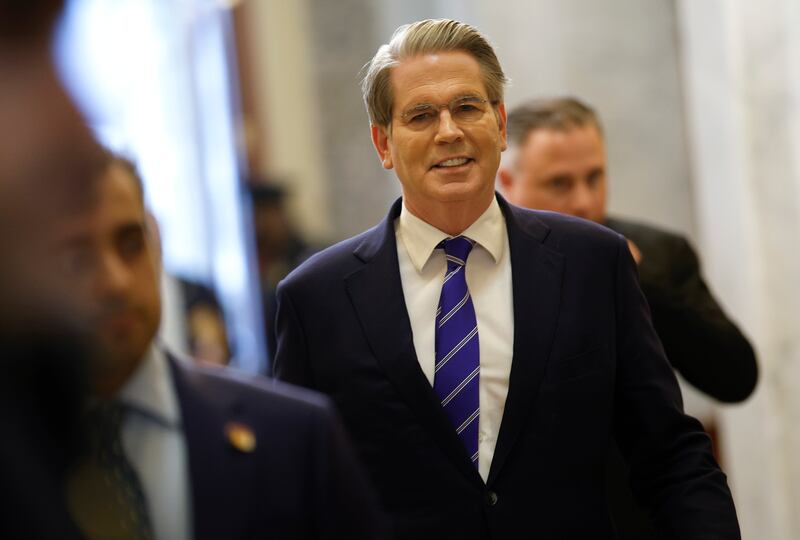
Fox Business host Larry Kudlow patiently explained trade deficits to Treasury Secretary Scott Bessent during an interview Monday, an eyebrow-raising incident that occurred as the Trump administration continues to falter on its tariff messaging.
“I don’t know if you heard [Arthur] Laffer in the prior interview, but Art doesn’t believe that the trade deficit should be a metric. I don’t really either,” Kudlow began, referring to the Trump administration’s reliance on trade deficits to calculate the sweeping “reciprocal tariffs” it imposed on global trade partners last week.
“Mr. Secretary, if you get the tax cuts—and I guess you’re well on the way—you get your deregulation, these are all huge pro-growth items,” Kudlow continued. “The United States will grow faster than Japan. We will grow faster than almost anybody. Therefore, almost by definition, by growing faster than the rest of the world, we’re always going to have a trade deficit.
“So I don’t know why you’d want to use the trade deficit in a calculation for a reciprocal charge,” he added.
A trade deficit occurs when one country imports (or buys) more goods and services from another country than it exports (or sells) them. President Donald Trump has repeatedly reiterated that trade imbalances pose a threat to the U.S. and hinder its global economic position—a position at odds with most mainstream economists.
When calculating what the White House has pitched as reciprocal tariffs to be imposed on other countries, the Trump administration relied on the trade deficit as the central value in its formula, which saw a country’s deficit with the U.S. being divided by its exports, divided by two—a formula economists and think tanks on both sides of the aisle have since criticized.
“To apply this to the whole world on the basis of trade deficits, is that really the best, in your judgment?” Kudlow continued. “You’ve been around a long time, you’ve looked at these, you’ve done analysis. Is that really where we should be at?”
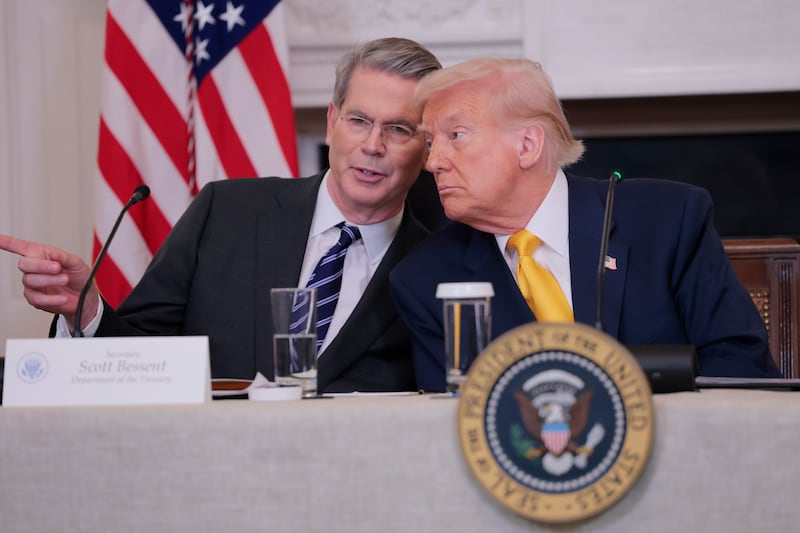
In response, Bessent—a former investor and hedge fund manager—said a trade deficit is the result of three things: The “terms of trades,” the “budget deficit,” and the “level of the dollar.”
“We want a strong dollar. We are getting our budget deficit under control, which I actually think will help with the trade deficit, and then the third part is the trade barriers which we’re seeing,” Bessent said.
“The real problem has been these barriers because what we are going to create in the U.S. through lower taxes, energy dominance, and our deregulation, our rule of law is going to be we are the best place in the world to do business,” he continued, adding that he hopes to have “very, very productive negotiations.”
“And we will continue to attract more and more industry here when these barriers come down. I am highly confident of that,” he concluded.
While Bessent spoke of negotiating Trump’s tariffs with the goal of eliminating them, Trump has contradicted himself on the issue—telling a reporter during an Oval Office press conference Monday that both negotiations and permanent tariffs are on the table.
“They could both be true,” Trump said when asked about his administration’s “mixed messages” on the tariffs’ shelf life.
“There could be permanent tariffs and there could also be negotiations, because there are things that we need beyond tariffs,” the president continued. “Tariffs are very important, but there are a lot of things like opening up countries that are totally closed.”
“We’re gonna get fair deals and good deals with every country, and if we don’t, we’re gonna have nothing to do with them and they’re not gonna be allowed to participate in the United States.”