Great Reviews of Some Sketchy Hotels
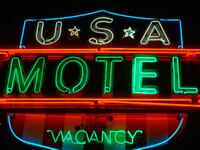
The mysterious Reginald Edward Morse is a hotel reviewer in Rick Moody’s latest novel. Here Morse rates the hotels where Moody stayed on his book tour.
Visions of America/Getty
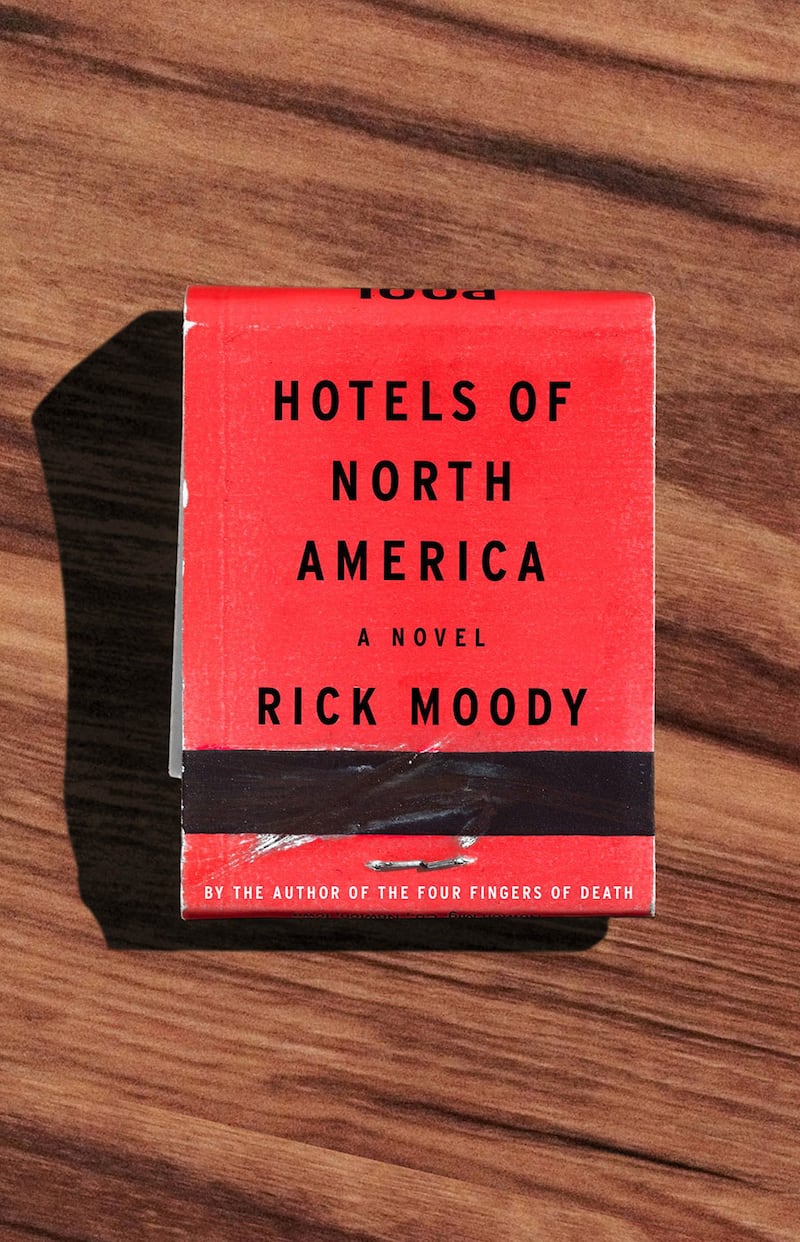
’s Reginald Edward Morse is the protagonist and narrator of Hotels of North America, Rick Moody’s latest novel. A reviewer for RateYourLodgings.com, he is also missing in action, when the book begins. All we have of him—and it’s the bulk of the book—are his reviews, his asides, his ruminations about life. But when Moody went on tour to promote the novel, somehow Morse re-emerged! The entries below, as written by Morse and conveyed to us by Moody, are reviews of all the hotels where Moody stayed on his book tour. Hotels of North America, by the way, is now out in paperback.
Reginald Edward Morse, The Lost Episodes, Part Three
Marriott Biscayne Bay, 1633 N. Bayshore Drive, Miami, FL, November 20-22, 2015
I was here for a convention of mortuary directors, where I was booked to serve on a panel about “Listening Compassionately.” I’m not a mortuary director, but I have a high regard for the profession. In an economic downturn, mortuary work is one of the few reliable professions. The demand for these services is inelastic! Naturally, it happened that everyone in the conventional hall for the ASMP conference was a professional griever. They all had a stillness that I admired, a sense of proportion, even if simulated. They wore clothes in muted colors. The others scheduled to serve on the panel with me were people of gravity and seriousness. Someone would undoubtedly mention traditions of grief. There would be no jokes. And yet it is normally my tendency, when faced with a panel discussion of any kind, to want to take beta blockers or anti-anxiety meds, or maybe even a little antipsychotic medication. Now and again, because I don’t follow the directions as carefully as I ought, I have fallen asleep for a day or two, slept right through my panel, only to be roused by a hotel chambermaid. Frankly, the idea that there were all these mortuary directors walking around the Marriott Biscayne Bay unnerved me. It was like they were sizing people up, professionally, measuring the casket. And so right after the dinner on the first night, I repaired to my room on the 15th floor, to ensconce myself watching Sharknado (and various sequels).
Look, I know that shark week is a phenomenon, that certain young men between the ages of ten and thirteen take shark week very seriously, and that various adults like to simulate an interest in shark week, but I personally have always found myself too busy to bear down on the subject with any real avidity. I was as interested in sharks as the next boy, back when I was a boy. In fact, when I was a boy, there was that film about a great white shark harrowing the coast of Long Island, and I especially remember reading the novel on which the film was based wherein, in chapter one, some drunken reveler reaches down, in the surf, after getting attacked only to feel that her foot is missing! I remember it well, the torn flesh, etc. But despite this lasting memory, I did not keep up with shark-related cultural developments of the ensuing decades. I would occasionally note that there were some attacks in the Carolinas, or in New Jersey, but always with the sense that I was far more endangered by young adults of the variety road rage than I was by sharks.
Get the best of The Beast delivered right to your inbox
By clicking “SUBSCRIBE” you agree to our Terms of Use and Privacy Policy.
When Sharknado was first released, I must have been busy with my motivational speaking business. What a mistake. Sharknado represents an acme of American movie-making. I just don’t know where to start. You know and I know that any kind of discussion of the digital effects in a contemporary film is where critics start who have nothing to say about the human. Therefore, let me say with satisfaction that the digital effects in Sharknado are among the very worst in recent filmic memory. Indeed, the idea of the film—there are these waterspouts over the ocean and the sharks get sucked up into them and then they get deposited over Beverly Hills!—must have called forth the kindergarten animation (little cartoon sharks in a cartoon tornado in the rear of the shot) from the outset. Unless the Sharknado creators were entirely delusional about the scale of the product (it was produced for shark week, after all, on a television film budget), the very concept of a sharknado was either going to cost hundreds of millions of dollars, or look and feel very bad. I believe that those involved understood that the latter was the virtuous course of things. The sharknado animation looks like steel wool with lice writhing in it.
Then there is the matter of the cast. Apparently Ian Ziering, the male lead, badly needed health insurance, and though he was tempted to pass on Sharknado, the appeal of health insurance for his family led him in another direction. And now he’s done three of these films! His family is well looked after! Their pre-existing conditions are not a problem! Maybe there needs to be some governmental program for down-and-out television actors wherein campy horror films can generate health insurance on an annual basis, through four or five sequels. Surely someone can breathe some more life into a Snakes on a Plane sequel, for the family of Samuel L. Jackson, et al.
Tara Reid, not known for her acting, generally speaking, finds a new purpose in Sharknado. The gauzy close-ups and I’m-so-bored line readings lend her a paradoxical grace under pressure, an elder stateswoman gravitas. It’s hard to believe that anyone had to act in this film, and yet phoning in the performance somehow makes them all seem that much more wise and knowing, like true professionals. Let us not forego to mention, e.g., John Heard, who gets killed off quickly but who really goes all-in with the scenery chewing in his brief pre-mortem beer-guzzling appearance.
Brief plot summary graph: They have to kill the sharks with swords and projectiles, when they fall out of the sky, and then someone flies a plane into the sharknado and detonates some kind of bomb that unfunnels the sharknado, and then there are shark innards everywhere, etc.
The only thing that could destroy the Sharknado franchise is the very thing that came to pass, namely that Sharknado became successful. As soon as the Sharknado creators realized that they had shark week gold on their hands, they seemed to have attempted to improve their work, getting heavily ironic in the process, adding tongue-in-cheek guest appearances (the Subway pitch guy, Jared Foegle, not yet a convicted pedophile, turns up in Sharknado 2), all of it leading in the direction of a sort of hipster vaudeville event.
This disgusts me. When you are in a Marriott in Miami, trying to avoid a tornado of undertakers, an undernado, the last thing you want to watch is some campy, ironic Sharknado, a Sharknado that jumps the shark. You want the dramatic underperformance of American popular culture. You want the desperation. You want the has-beens, the poor special effects, you want the total absence of believable character motivation, you want the hero, covered with shark intestines, hugging his estranged wife at the film’s close. You want to believe in the myth, namely the myth that someone actually pitched a studio on this project, and the film studio said yes! You want to believe in the 25-year-old learning disabled MDMA-addict who took that meeting and who thought Sharknado was a good idea! You want to imagine him going out to hear Skrillex play that night, and in the middle of some breakbeat passage during the Skrillex show, this 25-year-old studio executive who still chronically wets his bed was actually seeing a sharknado and texting the relevant agents right there, from the Skrillex show, to say that he knew Sharknado was going to be really big.
You want to believe in the toy manufacturers getting into Sharknado, getting their shark week gear ready. You want to believe in the cable networks, once devoted to fact-based media, just giving up on all of it, and going for Sharknado instead, and the twenty-four-hour broadcast day of dramatic recreations that fall on either side of Sharknado throughout shark week. That’s the myth you want to believe in. The myth of total American shamelessness.
You want to believe in American marketing, American ingenuity, American know-how. You want to know that when people are holed up in a Marriott in Miami, having taken something north of the correct dosage level of Seroquel, so that they can sit back, relax, and engorge (or disgorge) themselves on Sharknado, such that they will have an indisputable American entertainment experience, one that will stun them into a vegetative state so significant that they will fail to turn up for their panel discussion, and will slink off to the airport having done nothing that they were meant to do in order to be remunerated, still unconsciously wearing a lanyard that says: Reginald Edward Morse, Independent Contractor.
I’d tell you more about Sharknado 2 or Sharknado 3, but I can’t remember having seen them. ★★
Hotel Angeleno, 170 North Church Lane, Los Angeles, CA, November 19-20, 2015
Shaped like an architectural replica of the salt cellar design well-known to the American diner, and, therefore, circular, so that the rooms are, kinda, pie slices. I am told that it was first a Holiday Inn. The restoration/rehabilitation that would have been required to make the full-scale transformation from Holiday Inn to four-star glammed up LA power hotel apparently stalled before completion. Did I say that it’s right on the 405? As they say in LA: the 405! The 405 is right outside the Hotel Angeleno, and the near-constant clog on that infarction-to-be is your never-ending experimental music drone in the Hotel Angeleno. My room was brown. The wifi never worked, despite my complaining. There were, it is true, an abundance of attractive young Angelenos coming in and out of the very, very slow elevators, bound for some bar or club secreted away inside whose musical emanations I could just make out in my own room. Two of these attractive Angelenos, in the elevator with yours truly, had an attenuated exchange about merlot and how much they like merlot. Throughout, I wanted to be anywhere else. On the plus side: the Hotel Angeleno is not far from the airport at all, and everyone I talked to on the staff was gentle and kind. Elapsed time in residence, thirteen hours. ★★★
The Benson, 309 SW Broadway, Portland, OR, November 18-19, 2015
There wasn’t enough furniture in the room, it was decorated in a succession of beiges, the shower curtain was unspeakable with mildew, they employ those pumps of shower gel and shampoo in the shower, the drain in the sink didn’t drain, the wallpaper in the bathroom was just getting ready for its big peel-off, the shower head was bad, the curtains were excessive (verging on something we might refer to as bunting) the hallways had the slightly spooky 19th or early 20th century vibe ambience you associate with salesmen of fraudulent medical syrups, the keep-the-riff-raff off the upper floors key check in the elevator didn’t work and therefore only prevented the hoi polloi from getting to its upper floors, and the main floor at the time of check-in was heavily peopled with roughhewn Portland hipsters doing some kind of meet and greet. You kind of wanted to say: Take it outside to the food trucks, guys! You won’t bother anyone.
The Benson is named in honor of an important local citizen who tried to encourage the regional lumberjacks to drink less by installing water fountains in downtown Portland, or that is how the situation was recounted for me. But the piece de la resistance at the Benson, in my underdecorated room, was the situation with the toilet paper. The whole toilet-paper-roll-origami trend has just gone too far. For each new customer, they enfold a little origami hospital corner fold on the uppermost square as if to indicate the specialness of arrival, as no one else has ever required that particular roll of toilet paper. Once the innovation was introduced, it could not be stopped, it was nationwide; on and on the hotels went, with their hospital corner enfoldments. In my travels, I have seen that a surfeit of generous new origami styles have taken hold in the bathroom, or are beginning to take hold as I write these lines, and The Benson, I must note, has taken the whole trend to an entirely new level. They are really innovating. At the Benson, the person charged with turning over the room tore off a sheet, and then virtuoso’d this sundered piece into a sort of a farfalle shape, a bowtie pasta, and then re-affixed it to the roll. A highly ornamental punctuation mark. I wonder how much of an imposition this whole tendency is for the chambermaids who work at The Benson and who are therefore charged with making this origami bowtie in each and every Benson room. And: was a Japanese artist or a student thereof employed to teach all the chambermaids? Is such a person on hand for the new chambermaids in what is surely a high-turnover profession? Is the toilet tissue origami a commentary on the importance of Japanese culture, and Japanese-American culture, in Portland as a whole? (They do have a really great Japanese garden in the park here.) Or was it simply an amenity designed to direct your attention away from the other slightly dank and sinister early 20th century joylessness of The Benson as a whole? I spent less then 12 hours there, really more like 9½ hours, and I was asleep for most of these hours. If the origami was to get my attention, it most certainly did. But so did the rest of the joint. ★★★
Hotel Nikko, 222 Mason Street, San Francisco, CA, November 17-18, 2015
I had to play the hotel reviewer card yesterday morning, upon arriving. It went like this, I got up at 4 a.m. in Seattle, fresh from a conference on motivational speaking in educational settings, wrung out, suffused with feelings of failure—as though failure were some slightly garish perfume, like, e.g., Old Spice, that I had once used but was unable to rinse off—in order to high tail it, down to the San Francisco Bay Area, home to America’s vaunted high tech business sector, in order to consult on workplace design for a start-up that allows people to use their free time as independent contractors-for-hire to pizza delivery business. If the consulting went badly, I could always just deliver some pizza. Anyway, upon arriving at the Hotel Nikko, promptly at 9 a.m., I found, alas, that the Hotel Nikko was unprepared for me and my personal belongings. That is, they were not ready for me to check in. They were not ready for me, Reginald Edward Morse, to check in to their fine Japanese-themed establishment.
I’m going to say, right up front here, that the receptionist yesterday was named Manuel, and he was in his forties, and exceedingly polite, and had facial hair that was tasteful, not one of those Moonshiner beards that are so popular in this day and age. Nevertheless, I viewed Manuel as my adversary! Manuel did not know that he needed to give me this room, and he didn’t not know that he was going to give me this room, because I am an internationally recognized hotel reviewer on this the internationally recognized RateYourLodging.com web site. (Which has an IPO coming up soon! And offices in the nearby San Bruno area!) At any rate, Manuel, though I had called from Seattle to insure that I might be granted early check in, made clear that there was no real early check-in at 9 a.m., not at all, and that he would be happy to check my bags, and take my phone number so that he could contact me as soon as a room became available, probably at about 2:59 p.m.. It was at this point that I said to Manuel: Look, make of this what you will, Manuel. But I am, in fact, an internationally recognized hotel reviewer, and I am going to be reviewing this hotel later, and should there be a room available to me now it is a foregone conclusion that this customer service event will register in any review that I write. (And you can see, because you are reading these lines, that I was telling the truth.) Manuel looked thoughtful for a moment, and then he said, Mr. Morse, sir, we treat all of our guests equally in the matter of courtesy here at the Hotel Nikko, and I will be happy to check your baggage for you.
This did not represent a new rhetorical turn in our colloquy, however, and therefore I needed some new way to bring Manuel to the light. I needed to close the deal. Like the guys in those how to pick up women books who need just one more way to speak to the ladies. However, Manuel, in a graceful slow motion, seemed to be rounding the corner just as I was thinking these thoughts, just as I was giving into the hard, unforgiving mattress of despair, because after an interval of silence, Manuel said: How would you like a premium suite? To which I said, Manuel, what is the price differential, and can I stick it on the credit card of a Pizza Delivery start up, who are underwriting my travel today? To which Manuel replied: You can definitely stick it on the card, and we’re talking about a difference of $40, Mr. Morse. I said: Manuel sign me up! Thinking to myself, that is, that I would have to somehow finesse it with the pizza delivery people. But that would come later! The key was produced, the deal was closed, and I had access to the Imperial Club, at least I think that was the name, the Imperial Club, a fancy floor at the top of the Hotel Nikko with its own breakfast lounge, and breathtaking views of the greater San Francisco Bay, from which I watched both sunset and dawn, between which I went to go talk about pizza delivery, and even to make a couple of delivery calls myself, including one in which, upon delivering the pizza, I spoke of the awesome power of music to speak in a language of the heart that no word will suffice to do! Two pies, one with extra cheese! Galileo! Galileo! The breakfast lounge is incredible, with a really nice guy working there who gets to spend every morning watching boats heading to the docks in Oakland, my room is exceedingly quiet, and the view is to die for, and the Christmas lights are already flickering on the Macy’s below me. If only I could rinse off the Old Spice! ★★★★★
Hotel 1000, 1000 First Avenue, Seattle, WA, November 15-17, 2015
With the designed hotels, the question to ask is whether the design holds up under scrutiny. Does the fact that the knob on the drawer that is not an actual drawer but just a drawer facsimile begin to irritate you after a while? Here at the Hotel 1000, for example, which is very much a designed hotel, how are you going to feel about the gigantic bathtub that you can ogle through a window by the bed (unless you lower the electric privacy screen) when you actually go to use it, assuming you are going to use it at all? Back in the immemorial days when I was up to no good in hotels, I would have assumed there was some important prurient use for this bathtub simply because it was so spectacularly designed. But now in my dotage I sort of want to feel that the bathtub has surplus value, is not simply glamorous in the style sense, in the way that Priscilla, the receptionist last night was glamorous with her excellent Russian accent, Now, Mr. Morse, have you stayed with us before? No? Then I just have two informations for you, Mr. Morse, and one of these concerns the Wifi, which is a complimentary Wifi, and the second of these informations concerns the wine-tasting, which we are having in the lobby this evening, and to which you are most welcome.
Imagine my surprise then (and please see the accompanying video) when I looked around in the bathroom for the water source, through which the incredibly large bathtub might be filled, mystified as to the way this would happen (imagining poor, reluctant staffers who might have to carry in pitchers of water for my bath), until I seized the unmarked plumbing on the side wall by the edge of the bathtub, cranked it all the way to the right, and found that the water that filled the tub came out of the ceiling! That’s right, the water in the bathtub in room #513 at the Hotel 1000 came out of the ceiling! Doesn’t that basically guarantee plumbing hazards in the ceiling of this room to come at some future date? Having the tub fill from the ceiling is incredibly catchy, it’s a wow factory as far as design goes, but what are the real world ramifications of this tub and its design? For example, you cannot effectively do anything in the tub while it’s filling, because there’s a de facto waterfall falling into the tub while it’s filling, right in the middle. A waterfall with a significant spill radius. Mostly you just want to be free and clear of the waterfall while it’s filling, especially if it’s not yet warm, which mine assuredly was not for easily ten or fifteen minutes. I had to fill the tub by half, and then empty it and start over before there was enough hot water to support an actual bath.
Next we need to point out that the Hotel 1000 favors those Moulton Brown soap dispensers, which are affixed to the wall in the shower and by the sink basin, but which are nowhere near the tub so that, drum roll please, it is in fact impossible to bathe in the gigantic, exposed, waterfall-inflected tub, unless you provide your own (removable) soap. And: if you want to let some of the water out and refill a bit because the tub has cooled some? Forget about it. The stainless steel fixture that controls the temperature and severity of the fill is on the wall beyond the tub and you cannot reach it from the tub, so you will have to get out of the tub to manipulate this fixture. Which means? You guessed it, the tub looks great, but no engineer has actually tried to use it. He was probably a shower guy. There are design elements like this (wood paneled ice dispenser out by the elevator) throughout the Hotel 1000, which design elements create radical interventions in the expectation field of hotel life, but in many cases the solutions are more glitzy than practical.
Look, you know all of this. So let me be positive! I loved the restaurant, where I had a really great veggie burger, and the guys out at valet parking were very kind to me, when I didn’t know where the hell I was going, which is a frequent situation in my case. So the service was good! It had better be good, however, because The Standard is putting in a Seattle Standard right next door. I saw the contractors going in and out. Before you know it, Hotel 1000, it’s not going to be just the Alexis across the street. Soon you, with your barely usable tubs, will be competing against The Standard, and a battalion of bored-looking models in cages in the lobby, etc. Get some soap for that tub now, quickly! ★★★★
Hotel Marlowe Kimpton, 24 Edwin H. Land Blvd, Cambridge, MA, November 13-14, 2015
How many times must I speak ill of the foam pillow before you will listen! How many times must I stay in a ★★★★ hotel, one in which the most elegant of dogs is liable to get onto the elevator with you (pet friendly!), only to find that even in this superior lodging environment the pillows are those foam monoliths, which are very much like putting your head down on a molded polyurethane flotation device (with barnacles)—such as you might use when shipwrecked and floating alone in the Pacific, 1,100 nautical miles southwest of New Caledonia, to an uncertain fate! Why are the pillows like that, why are they exactly like drifting in the Pacific when you think at any moment that some immemorial sea creature, C. Megalodon, for example, might bear down on you, in your solitary misfortune, to bisect you and then use your severed femur to clean out a few particles at its gum line, periodontal-style, before going off in search of fodder elsewhere.
Foam pillows give me that sort of repose. I don’t care if they are those extra long foam pillows, and I don’t care if there is a bolster in front of them, in crimson brocade, which brocade means to suggest the fine taste of the Hotel Marlowe, if the pillows are those foam pillows then your taste is revealed as taste of a superficial variety. And fuck your indie rock station playing at the valet parking station, which was audible in our room (eighth floor), and in the great majority of rooms at the Hotel Marlowe. It probably caused havoc for all the dogs attempting to sleep here last night. That said, my sleeplessness was less because of your indie rock and your remarkably awful pillows, and more about Paris. Oh, City of Lights! ★★★
Embassy Suites, 222 St. Paul Place, Baltimore, MD, November 12-13, 2015
If you’re in the hotel reviewing business long enough, you will come to experience every conceivable hotel anomaly. Eventually you will have trouble in your room with the presence of a trapeze artist on Ritalin who won’t stop talking about Fabio dust jackets from the ’80s. That was not our problem in Baltimore. Our problem in Baltimore was perfume. For the connoisseur of perfumes, the Embassy Suites must be a long-sought-after destination, because our room, at least, was noteworthy for the presence of one of those perfumes that is essential for concealing the presence of a dead body, or perhaps the total absence of showering by, e.g., a trapeze artist on Ritalin, over the course of several weeks. The perfume seemed, Vegas-style, to have been piped in, because we did open the windows in order to try to mix it up with some Baltimore city traffic fumes, without perfect success! The perfume, I would say, had overtones of grandmotherly lavender, and urinal cake, and perhaps a whiff of vanilla (of the Madagascar variety), but all at a strength that could have been used during the trench warfare of WWI on the German side. K., who has very particular feelings about smells, namely that there should be no smells, was a wraith during the overnight, perched by the open window at various intervals whispering, “Reg, Reg, Reg, it smells like a dead body.” Another analogy, perhaps, would be the redolence of the corpse flower, or amorphophallus titanum, about which you probably know something already.
The horrible part, on the overnight, is as follows: because the windows were open, we were able to hear, even up here on the 35th floor, the cries of some romantic coupling at street level, which could not be reliably called consensual with certainty, possibly human, which was then broken up with Hey, break it up there! emerging from our own lobby, it must be assumed. We would have shouted Go get a room!, ourselves, excepting that the couple in question would have had trouble getting to the completion stage in a room such as ours that smelled a little bit like amorphophallus titanum. (Also: shower ice cold.) ★
Downtown Des Moines Embassy Suites, Des Moines, IA, August 30-September 4, 2009
The following are the major tributaries of the Mississippi River: the Des Moines River, the Illinois River, the Kishwaukee River, the Minnesota River, the Missouri River, the Ohio River, the Red River, the Arkansas River, the Upper Iowa River, the White River. The following are the major tributaries of the Des Moines River: Beaver Creek, Competine Creek, Raccoon River, White Breast Creek. The Beaver Creek is approximately 77 miles long and joins the Des Moines River in Polk County. The Beaver, which is approximately 18 feet above normal as I write these lines, or nearing flood stage, has tributaries including Middle Beaver Creek, East Beaver Creek, West Beaver Creek, Slough Creek, Beaver Branch, Jim Creek, and not one but two Little Beaver Creeks.
“Beaver Creek” is a translation of a Native American name. There were, in fact, beavers on Beaver Creek until they were driven out, no doubt by westward expansion of European immigrants in the 19th century. The Competine Creek is only 9.8 miles and joins the Des Moines River at Lake Red Rock. The Raccoon River is 30.8 miles, or more if you include some of its forks, and it joins the Des Moines River right in town here. Right by the baseball stadium, in fact, the stadium that houses the AAA Pacific Coast League Iowa Cubs. The road to the stadium is called Line Drive, and they have a lovely little gift shop where there was, yesterday morning, a young saleswoman called Lisa selling caps and t-shirts at 25 percent off, because the Iowa Cubs had just played their last home game of the season. She had no one to dog sit her little black pup yesterday, and so he was in the shop, getting underfoot. The breed, according to Lisa, was the chu-WEE-wee, and she found this particular chu-WEE-wee in a ditch with its brownish and tannish litter mates, all ultimately adopted elsewhere. Perhaps the ditch in question was adjacent to the Raccoon River.
The dog, it should be noted, has been named by Lisa after a serial killer from a popular television show. When asked why she had named the dog after a serial killer, Lisa replied that the television serial killer was a very “good-natured” serial killer.
And now some more history: in 1903, the Iowa Western League baseball team called the Iowa Midgets was renamed the Iowa Undertakers for one season, until the nascent insurance industry in the town scotched the experiment and lobbied for the name the Iowa Prohibitionists. Howsoever they were named, they had a losing season in each of these years. The Midgets were too slow on the base paths, the Undertakers were high from the formaldehyde and had a tendency to stiffen up at the plate, and the Prohibitionists were sanctimonious and uptight. You could purchase, at the gift shop in Principal Park, an Iowa Undertakers t-shirt, though as with many of the t-shirts for sale there, the sizes ran large.
The Raccoon River reached the flood stage in 1993, and overwhelmed the drinking water supply in Des Moines, which takes water out of the river at a purification plant just outside of town. The tributaries of the Raccoon River are simply called North, Middle, and South Raccoon, and according to the Beaver Creek naming theory, it is likely that there were or still are raccoons in the area of the Raccoon River. The Raccoon River is heavily polluted with nitrates, enough so that pregnant women have been urged to avoid drinking from it recently. The White Breast Creek is 91.3 miles long and it joins the Des Moines River at Lake Red Rock. All the tributaries thereof have charming names like South White Breast, and Little White Breast. I wonder which farm wife was so memorialized, and was it the same farm wife memorialized with the tributary called Flank Creek. There are also tributaries of the White Breast called Indian Creek, Cotton Creek, and Hawk Run. A list of other picturesque rivers of Iowa would include the Fabius River, the Chariton River, the Grand River, the Little River, the Little Fox River, the Platte, the East Fork East Nodaway River, the West Fork Middle Nodaway, the Rutt Branch, the East Nishnabotna, the Pea Creek, the Boone River, the Lizard Creek, the East Fork East Nishnabotna, the Keg Creek, the no doubt accurately-named Mosquito Creek, the Thunder Creek, the Squaw Creek, the Little Sioux, the Cedar (which has the rapids), the Winnebago, the Ocheyedan, the English, the North English, the Middle English (where they use words like “eek” and “thilke”), the Little Wapsipinicon, Catfish Creek, the Turkey Branch, the Volga, the Little Turkey, and of course the Blue Earth River, and its tributary the Middle Branch Blue Earth River.
This constitutes the better part of my researches on rivers of Iowa, some of which I could see from the window of my room at the Downtown Des Moines Embassy Suites. When a hotel is far, far better than you have any reason to expect it to be, there is no choice but to concentrate your writerly attentions in other directions. From my window in the Embassy Suites I could look down directly upon the Des Moines River, and in the middle distance I could see where the Raccoon River emptied into it. A light-up arch rose above the Des Moines River, here below my window, a sort of a juvenile version of the Gateway Arch of St. Louis, and at night this arch was very dramatic. It framed, more or less, the World Food Prize Hall of Laureates, across the Des Moines River from the hotel. The World Food Prize Hall of Laureates sort of resembles a Florentine mansion. It once housed the Central Library for Des Moines. The guy who started the World Food Prize saved a billion lives with his formula for hybrid grains. Likewise, this year the World Food Prize was awarded to a guy who developed sorghum hybrids resistant to witchweed.
The roiling waters of the Des Moines from my window, the swift current running down toward the Raccoon would appear to make the river treacherous in the extreme for swimmers. And yet adjacent to the lesser arch there are classically perfect almost Parisian steps leading down and into the watery substratum of death. Likewise there is a ramp on the far side by the World Food Prize, where you might climb from the violent waters of the Des Moines River, having bathed in the agricultural nitrates. It is hard, from the sixth floor of the Downtown Des Moines Embassy Suites, to part with the idea of plunging into the arterial waters of planet earth, the Raccoon leading to the Des Moines, leading to the Mississippi, leading to the Gulf of Mexico, leading to the Atlantic Ocean, leading to the Gulf Stream, leading to the Arctic. The restless and unquiet surface of the Des Moines River looks so pictorially like the surface of human consciousness, dangerous, turbulent, uncertain, but also majestic, graceful, deep, even if to plunge in is to risk being carried off to your demise. As the downtown of Des Moines is mostly free of pedestrians, it is hard imagine that you would be quickly rescued. And yet the arch seems to call. ★★★★
Rick Moody is the author of four previous novels: The Four Fingers of Death, Purple America, The Ice Storm, and Garden State, as well as an award-winning memoir and multiple collections of short fiction. He is the recipient of a Guggenheim fellowship, and his work has been anthologized in Best American Stories, Best American Essays, and the Pushcart Prize anthology. He lives in Brooklyn, New York.
See more of our coverage in your search results.

Got a tip? Send it to The Daily Beast here.
Register below to read this article for free or subscribe
to unlock unlimited access to The Daily Beast.
Monthly
$1
First month then $5.99/month
Annual
$35
First year then $59.99/year
Premium
$79
First year then $119.99/year
*Substack access provided by the next business day, using your subscription email. Choosing the Premium plan constitutes your permission to share your subscription email with Substack and your agreement to Substack’s Privacy Policy.
Already have an account? Sign In
Looks like you already have a subscription!
You're all set!
Thanks for subscribing.