Hapless FEC Lets Conservative Group Get Away With Breaking the Law
The FEC spent five years investigating a now-defunct ‘dark money’ group with links to several prominent Republicans. And even though it found wrongdoing, it’s not going to do anything about it.
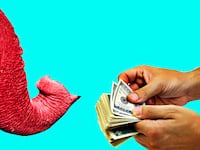
Photo Illustration by Emil Lendof/The Daily Beast
By Cady Zuvich, Center for Public Integrity
Three notable conservatives—including a top fundraiser for Republican presidential candidate Marco Rubio—are linked to a now-defunct “dark money” nonprofit group that failed to disclose several million dollars spent on candidate-related TV ads, according to documents released Friday by the Federal Election Commission.
Those involved with the Commission for the Hope, Growth and Opportunity group include William Canfield, general counsel for pro-Carly Fiorina super PAC CARLY for America; Scott Reed, senior political strategist for the U.S. Chamber of Commerce, and Wayne Berman, a senior adviser at Blackstone who serves as presidential candidate Marco Rubio’s national finance chairman.
Within 227 pages of FEC legal documents released after a five-year investigation, the three men are characterized as being a part of the decision-making core behind the law-breaking nonprofit’s decidedly political activities.
But the trio, as well as the group itself, will likely dodge punishment.
Sign Up for The Swamp Newsletter
By clicking “SUBSCRIBE” you agree to our Terms of Use and Privacy Policy.
Habitually gridlocked FEC commissioners—three are Republican appointees, three Democratic appointees—could only agree that the Commission for Hope, Growth and Opportunity violated federal law by failing to properly report details about its ads. In doing so, the commission voted (PDF) to “take no action at this time” on the violation.
The commissioners then deadlocked 3-3 (PDF) over whether the Commission for Hope, Growth and Opportunity broke the law by failing to “organize, register and report as a political committee.” The three Democratic commissioners voted to find the group in violation while the three Republican commissioners dissented.
“This is one of the most outrageous decisions that I have ever seen come out of the commission,” Ann Ravel, the FEC’s Democratic chairwoman, told the Center for Public Integrity (PDF).
In a joint statement, the commission’s Republicans—Matthew Petersen, Caroline Hunter, and Lee Goodman—said no action against the group is merited because the group has disbanded. “Any conciliation effort would be futile … the most prudent course was to close the file,” they wrote (PDF).
The lack of enforcement follows damning conclusions (PDF) (PDF) from the FEC’s own lawyers, who contended that the Commission for Hope, Growth and Opportunity was blatantly and primarily political. Federal rules stipulate that the primary purpose of a 501(c)(4) “social welfare” nonprofit can’t be politics.
While acknowledging difficulties in punishing the Commission for Hope, Growth and Opportunity, FEC lawyers nevertheless recommended (PDF) pursuing enforcement actions.
Through 2010, the Commission for Hope, Growth and Opportunity received $4 million from one undisclosed donor—an amount that made up most of its $4.8 million fundraising total.
The nonprofit then directed an estimated 85 percent of that $4.8 million toward a large-scale ad blitz in key 2010 House races without disclosing any of it to the FEC, agency lawyers wrote.
Of its spending, an estimated 61 percent went to “express advocacy”—or outright calling for the election or defeat of a candidate, FEC lawyers said.
Michael Mihalke, a principal from political consulting firm Meridian Strategies LLC, told FEC lawyers that “Canfield and Reed approved the content, production, and placement of all CHGO-related television ads” while Berman received a “fundraising commission” from the group’s coffers after the 2010 election.
The three men told FEC lawyers that they had limited involvement with the group. Berman told investigators that he offered advice on a “voluntary basis.” After being pressed by lawyers, Reed said that he had been “involved in discussions on the strategic placements of television ads for CHGO but could recall no details of these discussions.”
Reed and Berman declined to comment while Canfield could not be reached for comment.
In a November 2010 letter to the FEC, Canfield asked the agency (PDF) to dismiss the complaints against the Commission for Hope, Growth and Opportunity. He argued that the FEC had failed to follow “statutory and regulatory-mandated timely notice requirements,” and Commission for Hope, Growth and Opportunity was therefore “denied procedural fundamental fairness by the Commission.”
Commission for Hope, Growth and Opportunity serves as an example of a nonprofit group that enjoys a preferred tax status because it purports to be focused on “social welfare.”
Often referred to as “dark money” groups, these nonprofits are not required to disclose donors and are barred from engaging in politics as their primary activity. Some groups have been criticized for pushing the boundary on how much they participate politically.
Commission for Hope, Growth and Opportunity’s public activities began soon after its organizers checked a box on an IRS form, indicating in 2010 that they did not plan on spending money to influence elections.
The group’s mission, according to IRS documents, was to “implement statutes, rules and regulations that are consistent with free-market principles and that adhere [to] economic growth and expansion.”
That same year, the nonprofit directed an estimated $4.7 million on TV advertisements that criticized House Democrats such as former Rep. John Spratt (D-SC), former Rep. John Salazar (D-CO), and former Rep. Suzanne Kosmas (D-FL), all of whom were unseated during the 2010 electiona.
In one ad that targeted Spratt, a voice calls for voters to “pull the plug on this song-and-dance once and for all” on Spratt, “who approved billions in deficit spending without missing a beat.”
The ad then goes on to boost Mick Mulvaney, a Republican who defeated Spratt for his seat in 2010.
Two organizations filed FEC complaints following the ad flurry: watchdog group Citizens for Responsibility and Ethics in Washington and the Democratic Congressional Campaign Committee. In a 2012 report, Citizens for Responsibility and Ethics in Washington named Commission for Hope, Growth and Opportunity as the “worst” of the shadow groups pumping money into the election.
Noah Bookbinder, executive director of Citizens for Responsibility and Ethics in Washington, called the FEC’s deadlocked vote “outrageous and profoundly disturbing.”
“The fact that three Commissioners nonetheless prevented any action on the matter is powerful evidence of the dysfunction currently incapacitating the FEC,” Bookbinder said in a statement. “CREW is working to determine what further legal steps can be taken to attempt to ensure accountability for serious abuses of the laws governing political organizations.”
Ravel said the recent decision sends a message to other outside groups that the FEC sends continuously: that the FEC is unwilling to enforce the law.
“When people see that, they tend to act with impunity,” Ravel said.
See more of our coverage in your search results.

Got a tip? Send it to The Daily Beast here.
Register below to read this article for free or subscribe
to unlock unlimited access to The Daily Beast.
Monthly
$1
First month then $5.99/month
Annual
$35
First year then $59.99/year
Premium
$79
First year then $119.99/year
*Substack access provided by the next business day, using your subscription email. Choosing the Premium plan constitutes your permission to share your subscription email with Substack and your agreement to Substack’s Privacy Policy.
Already have an account? Sign In
Looks like you already have a subscription!
You're all set!
Thanks for subscribing.