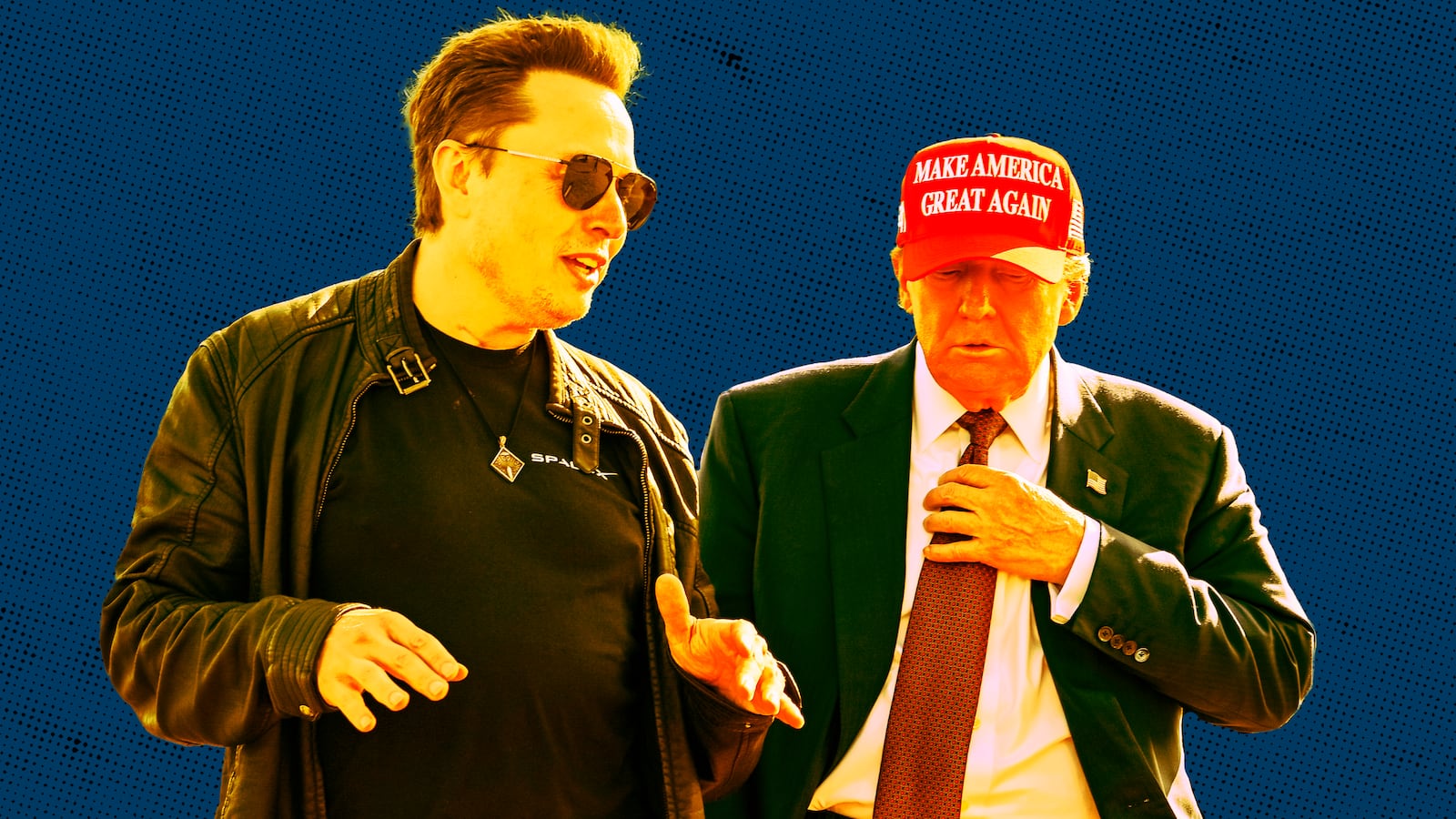
President Trump has welcomed Elon Musk back into his inner circle despite the world’s richest man embracing white supremacist talking points.
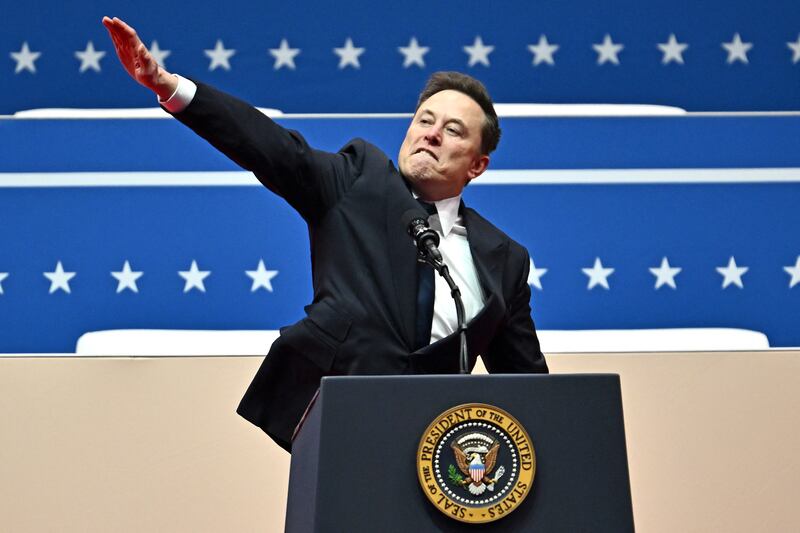
The Musk-Trump story is a drama in three parts. Act one saw the Tesla CEO shielded by the new-look White House after he made a gesture at a Trump rally in January last year that historians said looked a lot like a Nazi salute.
That didn’t get him nixed; in fact, after Trump gained control of the Executive Branch, Musk was brought on to run the Department of Government Efficiency, an ultimately ill-fated effort to slash wasteful government spending.

Act two began with an extraordinary falling-out between the two men. It started when Musk unleashed a broadside against Trump’s signature budget bill, leading to a nasty war of words which culminated in the billionaire declaring that the president was all over the Epstein files. “@realDonaldTrump is in the Epstein files. That is the real reason they have not been made public,” he said in June.
“Mark this post for the future. The truth will come out.” He later deleted the post and walked back, but the relationship looked dead.
“Elon and I had a great relationship. I don’t know if we will anymore,” Trump said of the man who spent $277 million supporting the president and allied Republicans.
The divorce got so bad that Musk even threatened to start his own political party, the America Party, before relenting.
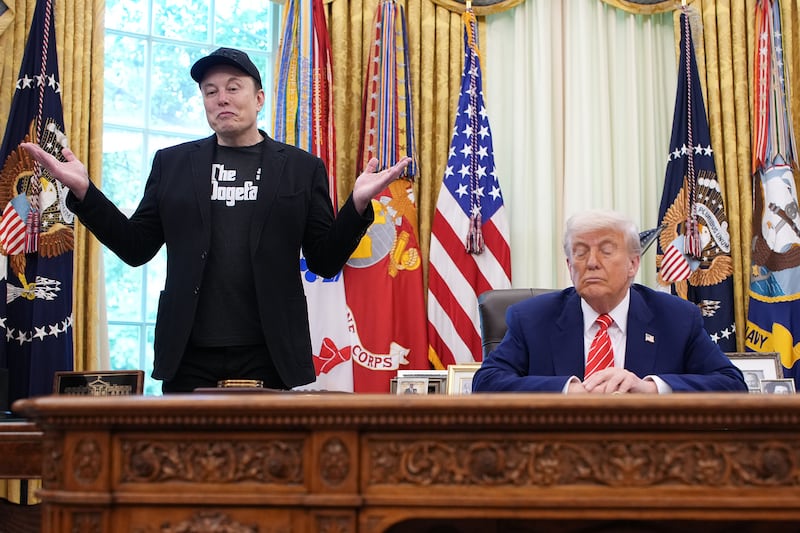
But somehow Musk, who has since funded pro-Trump PACs again, finds himself at the top table again. On Wednesday morning, he revealed that he was one of only two ultra-wealthy tech tycoons traveling to China on Air Force One with Trump. He emerged from the plane at around 8 p.m. local time, lurking behind the president.
The reconciliation is all the more striking given that he has appeared to deviate into the murky world of white supremacy. Last month, a Washington Post analysis of nearly 66,000 of Musk’s X posts found that six percent of his output over the past seven months—roughly 850 posts—concerned race, nearly triple his previous rate, with the overwhelming majority focused on perceived threats to white people. He posted on the subject on 166 out of 197 days.
This came after frequent Musk rants about non-existent “white genocide” in his native South Africa, a topic that his chatbot Grok would even spew at random after unrelated prompts from confused users.
Musk’s tangent coincides with Trump’s attacks on immigrant populations. Take Somalis, for example. The president’s tone towards the ethnic group has intensified of late. In December, he labeled Somali immigrants “garbage,” saying the East African country “stinks” and is “no good for a reason.”
He has also peddled tropes about Mexicans and even tried to terminate the Temporary Protected Status of about 350,000 Haitian immigrants last year. This new atmosphere has created fertile ground for the type of concerning race rhetoric that Musk appears to have embraced.
In January, Musk wrote on X that “Whites are a rapidly dying minority,” a post that has since accumulated more than 17 million views. In February, he declared that “there has been unrelenting hate and poisonous propaganda in the West against anyone White, straight or male over the past decade or more,” adding, “No more guilt trips. ENOUGH.”
In September last year, he replied “Yes” to a post suggesting White people faced a choice between being “conquered, enslaved, raped and genocided while being called ‘racist’” or reclaiming “our nations and our dignity.”
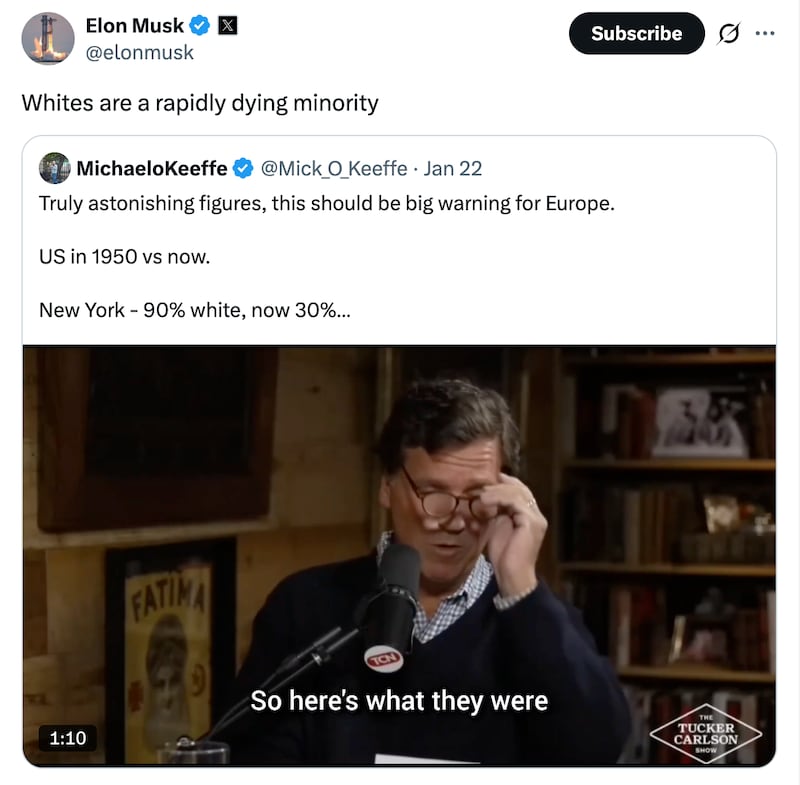
In a more recent post, he appeared to suggest white people should be considered Indigenous to the United States. Asked how long one’s ancestors must have been somewhere to qualify, he replied: “250 years sounds like plenty to me.”
Researchers who study extremism are unambiguous about what this amounts to. “As far as I can tell, Musk at this point agrees with standard talking points of white supremacy,” Heidi Beirich, co-founder of the Global Project Against Hate and Extremism, told The Post last month. “You just don’t get more white supremacist than the stuff Musk is signing onto or pushing.”
Ashley Jardina, associate professor of public policy and politics at the University of Virginia and author of “White Identity Politics,: called it “standard white supremacy,” adding that the absence of public sanction matters. “You don’t see a lot of that directed at Musk,” she said.
The pattern predates the Post’s analysis and his fallout with the president. At a rally celebrating Trump’s inauguration, Musk thrust his right arm straight out into the air—twice—prompting immediate comparisons to a Nazi salute.
Ruth Ben-Ghiat, a historian of fascism at New York University, said it was “a Nazi salute and a very belligerent one too.”
Musk brushed the controversy aside. “Frankly, they need better dirty tricks,” he posted on X. “The ‘everyone is Hitler’ attack is sooo tired.”
Where this spiral might have seen other CEOs face ruin, Musk appears to have thrived. The White House and representatives for Musk have been contacted for comment.