How Susie Wiles Burns Down White House With Wild Tell-All
Trump’s chief of staff has given us a disturbing glimpse behind the West Wing walls.

Elizabeth Brockway/The Daily Beast
The Ice Maiden is thawing.
For nearly 12 months, Susie Wiles has papered over the cracks at the White House with paper and string.
She is the first woman ever to hold the most powerful position in the West Wing next to the president. It should have meant so much more than coralling a Boys Club for political misfits.
But Wiles learned early on how to deal with difficult men with outsized egos. Her father, Pat Summerall, was beloved by many, but his alcoholism made relationships difficult for the few who really knew him.

Susie Wiles says there is no evidence to back President Donald Trump's claim that Bill Clinton visited Epstein's island.
Anna Moneymaker/Getty Images
In her interviews with Vanity Fair, she talks of Donald Trump having an “alcoholic’s personality,” an observation that the president does not argue with.
In dealing with alcoholics or addictive personalities, any counselor will tell you that honesty is crucial.
Sign Up for The Swamp Newsletter
By clicking “SUBSCRIBE” you agree to our Terms of Use and Privacy Policy.
As the conscience of the White House, Wiles has held it all together with a combination of pragmatism and common sense.

When she was asked questions by one of the country’s most respected and complete political writers, who was welcomed into the administration’s inner circle, she saw no reason to lie.
So she told the truth.
And it could well burn down the White House MAGA myth she helped create, that the administration was fervently following a cogent strategy.
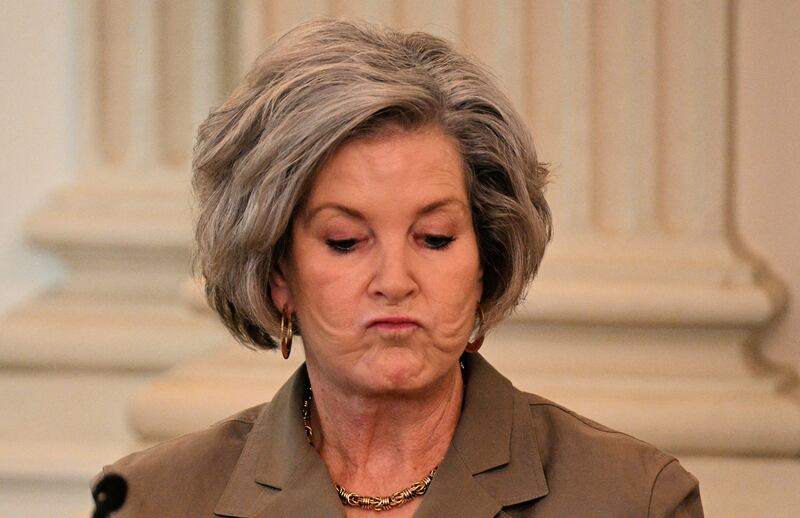
White House Chief of Staff Susie Wiles attends a roundtable about Antifa in the State Dining Room of the White House in Washington, DC, on October 8, 2025.
JIM WATSON/Getty Images
The first year of Trump’s first term was mayhem with Cabinet members losing their chairs every time the music stopped. It was chronicled by Michael Wolff in his 2018 bestseller, Fire and Fury: Inside the Trump White House.
This time around, thanks mainly to Wiles, the discipline has been tighter. Trump has resisted firing blundering acolytes like Pete Hegseth and Kash Patel, even when logic says they should go.
But the chief of staff has now revealed that 47 really isn’t so different from 45, after all. It is an administration run at the whim of a former reality star who, as she puts it, believes he can do whatever he wants.

They curated a writer. Chris Whipple is a Yale alum and a former CBS 60 Minutes producer, who wrote a seminal book about Wiles’s predecessors, The Gatekeepers: How the White House Chiefs of Staff Define Every Presidency.
And Wiles, 68, felt she had the authority after nine years at Trump’s side to tell Whipple what really happened in the White House.

At her desk or after church or doing the laundry, she said in 11 separate interviews that she wasn’t happy about Elon Musk’s erratic reign over DOGE, especially his decision to shut down USAID. It wasn’t the way she would have done it, she said.

U.S. President-elect Donald Trump and Elon Musk watch the launch of the sixth test flight of the SpaceX Starship rocket on November 19, 2024 in Brownsville, Texas.
Brandon Bell/Getty Images
Musk took ketamine, she told Whipple. He microdosed.
She was overruled when Trump wanted to announce his tariffs prematurely. She wanted him to solve domestic issues, not wars. She was unhappy about the way some immigrants were deported.
JD Vance was politically calculating and a conspiracy theorist. Pam Bondi made a hash of the Epstein files release. Of course, Trump was in the files, but he was a much younger man. A “playboy.”
Hers is the voice of reason, but reason is not what Trump’s MAGA supporters want to hear. They want to believe in the mission, not in chaos.

Wiles was always going to blame the media. The truth is sometimes hard when you see it written in cold, hard print.
The real issue is that she offered us a glimpse behind the White House walls.
And it’s every bit as bad as we feared.
See more of our coverage in your search results.

Got a tip? Send it to The Daily Beast here.
Register below to read this article for free or subscribe
to unlock unlimited access to The Daily Beast.
Monthly
$1
First month then $5.99/month
Annual
$35
First year then $59.99/year
Premium
$79
First year then $119.99/year
*Substack access provided by the next business day, using your subscription email. Choosing the Premium plan constitutes your permission to share your subscription email with Substack and your agreement to Substack’s Privacy Policy.
Already have an account? Sign In
Looks like you already have a subscription!
You're all set!
Thanks for subscribing.
Sign in or create an account
Login dialog
Loading comments…