Vladimir Putin’s war has come roaring back to his doorstep as Ukraine hammered Moscow with its largest-ever drone barrage.
Russia’s Defense Ministry said Sunday that its forces shot down more than 1,900 drones, along with eight guided aerial bombs, eight cruise missiles, and four rockets, overnight—a staggering tally that would mark Ukraine’s largest attack on record, according to CNN.
Moscow Mayor Sergei Sobyanin called the attack “unprecedented,” saying air defenses intercepted 450 drones on their way toward the capital Saturday night, the Financial Times reports.
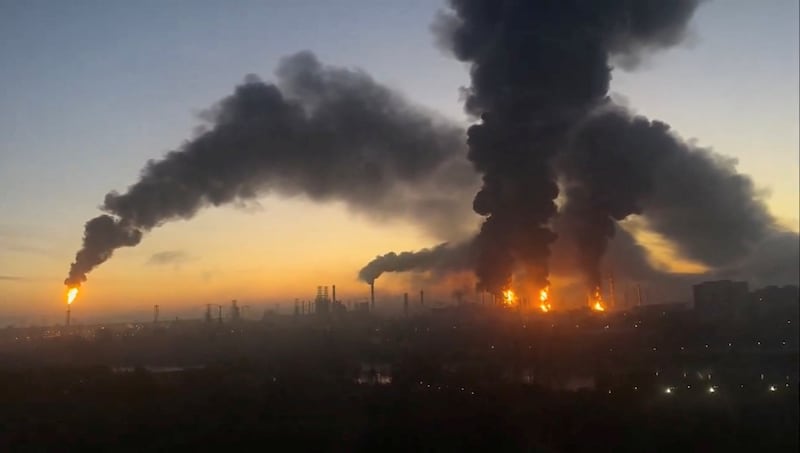
Some drones slipped through the defenses, striking the Gazpromneft-Moscow Oil Refinery, one of the country’s largest oil refineries.
Footage posted on social media showed fires blazing across Moscow as the sun came up Sunday morning, with one video showing an explosion tearing through the refinery. A power station, warehouse, and market near the refinery were also hit, according to FT.
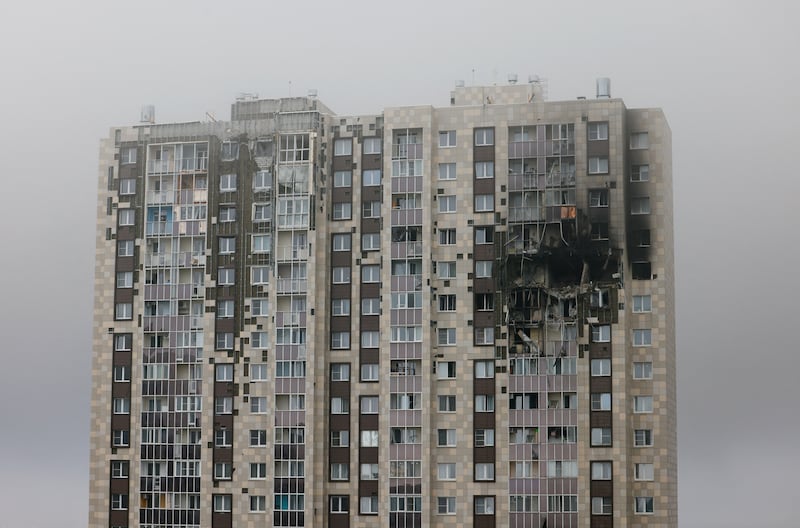
Residential buildings were also caught in the barrage, with photos showing a gaping black hole blasted into one high-rise. The governor of the wider Moscow region, Andrey Vorobiev, said three people were killed in the attacks, and another 20 people, including three children, were injured.
All three of Moscow’s main airports were forced to ground flights.
The barrage came as Russia’s stage-managed elections entered their final day of voting.
Sobyanin claimed the attack “was clearly planned with the aim of disrupting” the vote.

Ukrainian President Volodymyr Zelensky did not mention the election in a statement about the attack.
“Our long-range responses had a very significant impact in the Moscow region last night,” Zelensky said, adding that the targeted facilities were generating “billions of dollars that sustain the war machine.”
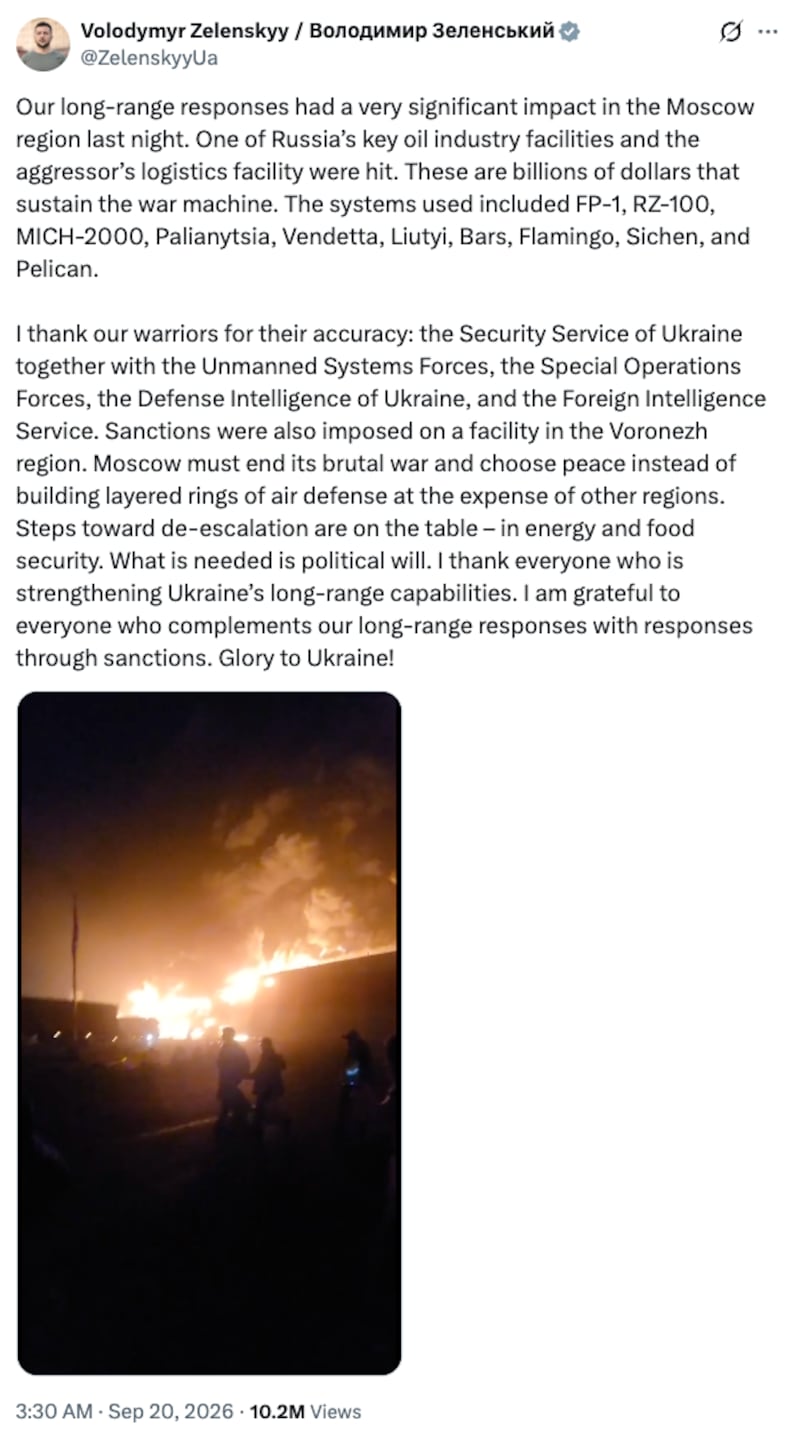
Meanwhile, Russia continued its assault on Ukraine with drones and missiles. Authorities in Kyiv said the overnight attacks killed three children and a woman.
Ukraine’s latest barrage on Moscow comes as Putin, 73, faces increased pressure after a bruising summer in the war he started more than four years ago, with Kyiv mounting a relentless campaign against energy, logistics, and military targets inside Russia.

Meanwhile, the dictator’s domestic problems have also been piling up after nearly five years of war. Russian air defenses have struggled to stop attacks, Ukrainian drones have crippled a third of the country’s oil refineries, and warehouses belonging to Russia’s biggest e-commerce company have gone up in flames.
Last week, Major General Anton Feliksovich Grunis, 46, who was trotted out on state media as an example of Russia’s military brilliance, was killed in a drone strike.
But even as the fallout from Putin’s so-called “special military operation” increasingly reaches ordinary Russians, with long lines at gas stations and plumes of smoke from drone attacks looming over daily life in many cities, the parliamentary election is unlikely to disturb Putin’s grip on power.
The election only features a lineup of Kremlin-run, pro-war parties, after Russia’s Supreme Court barred Yabloko—the only party to voice opposition to the war—from the ballot last month.