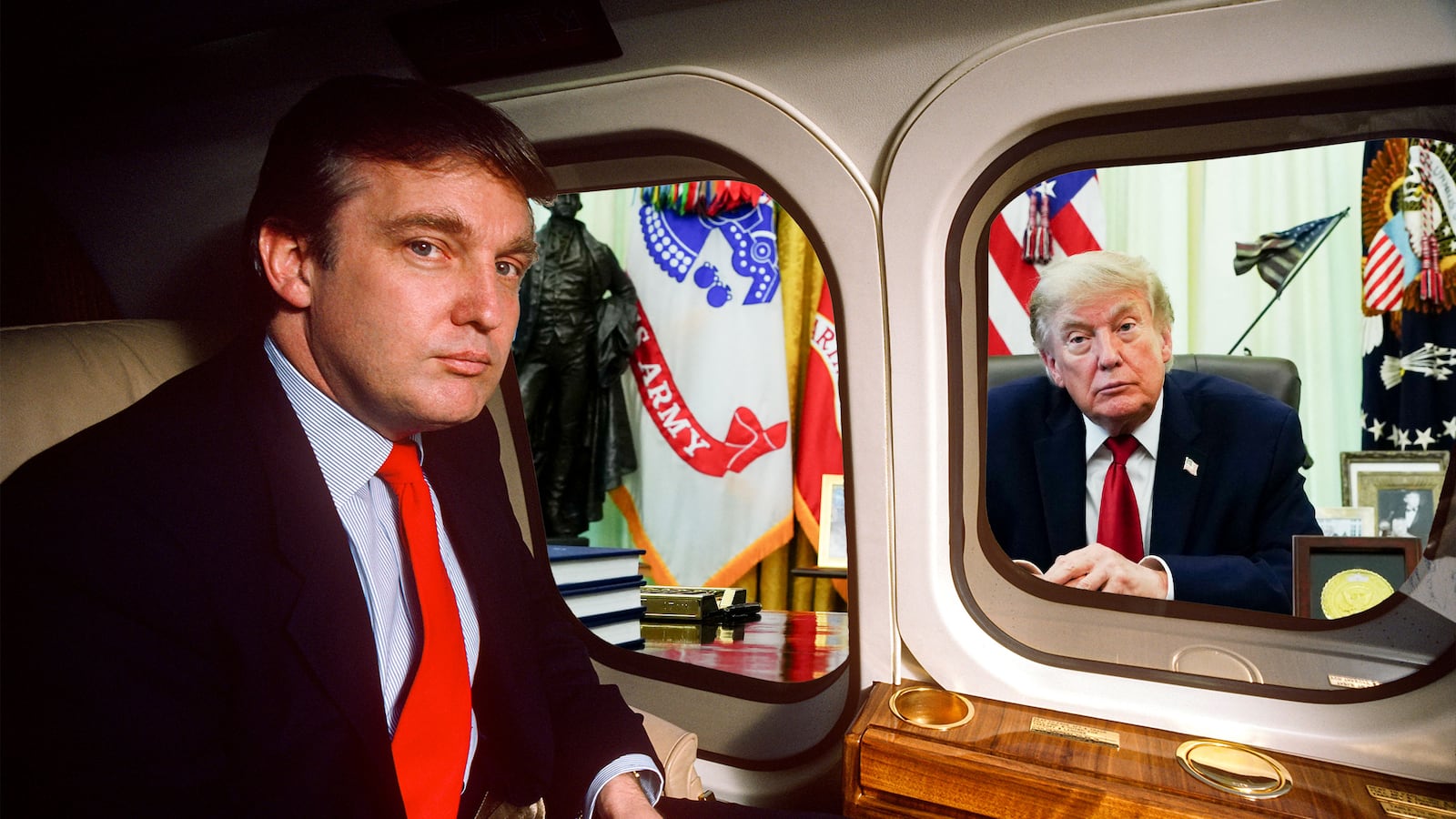
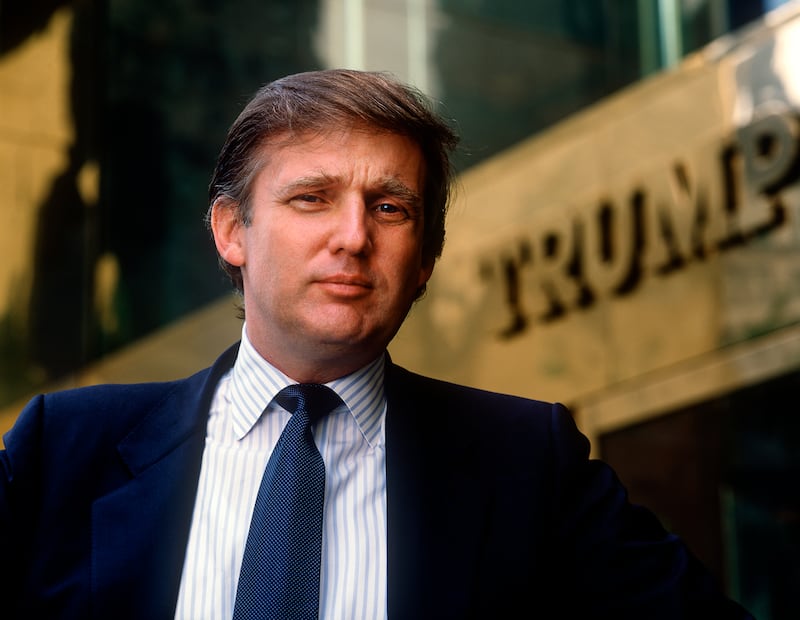
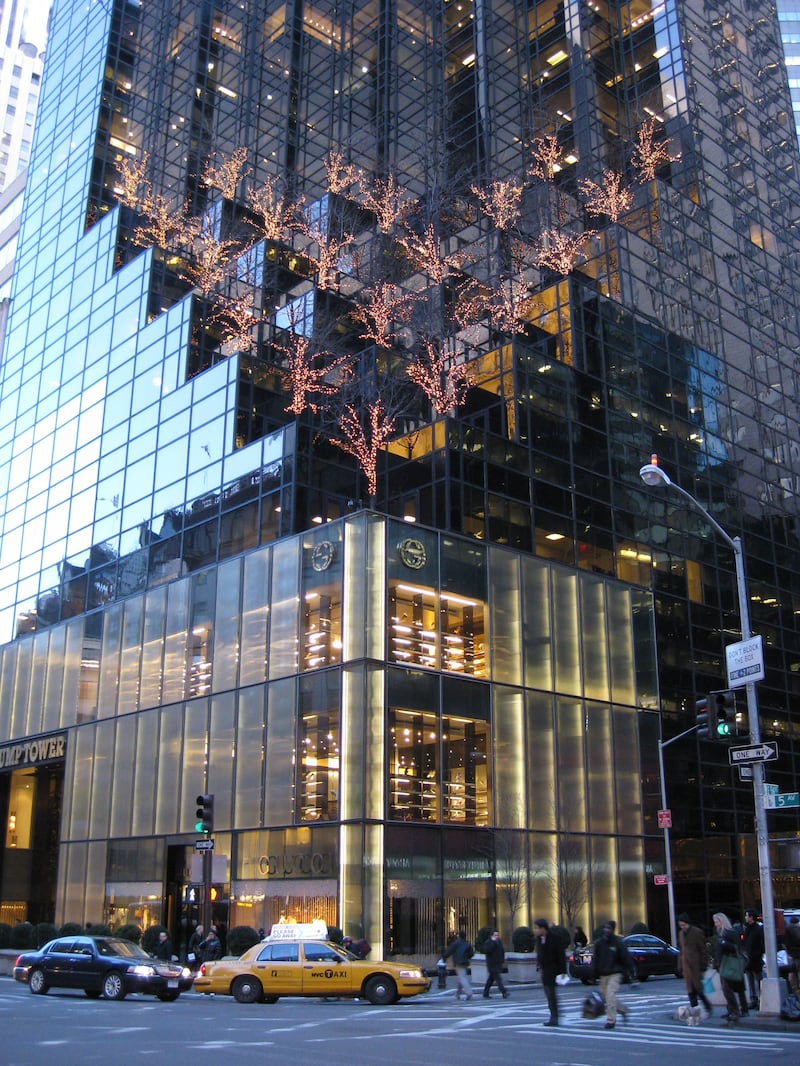
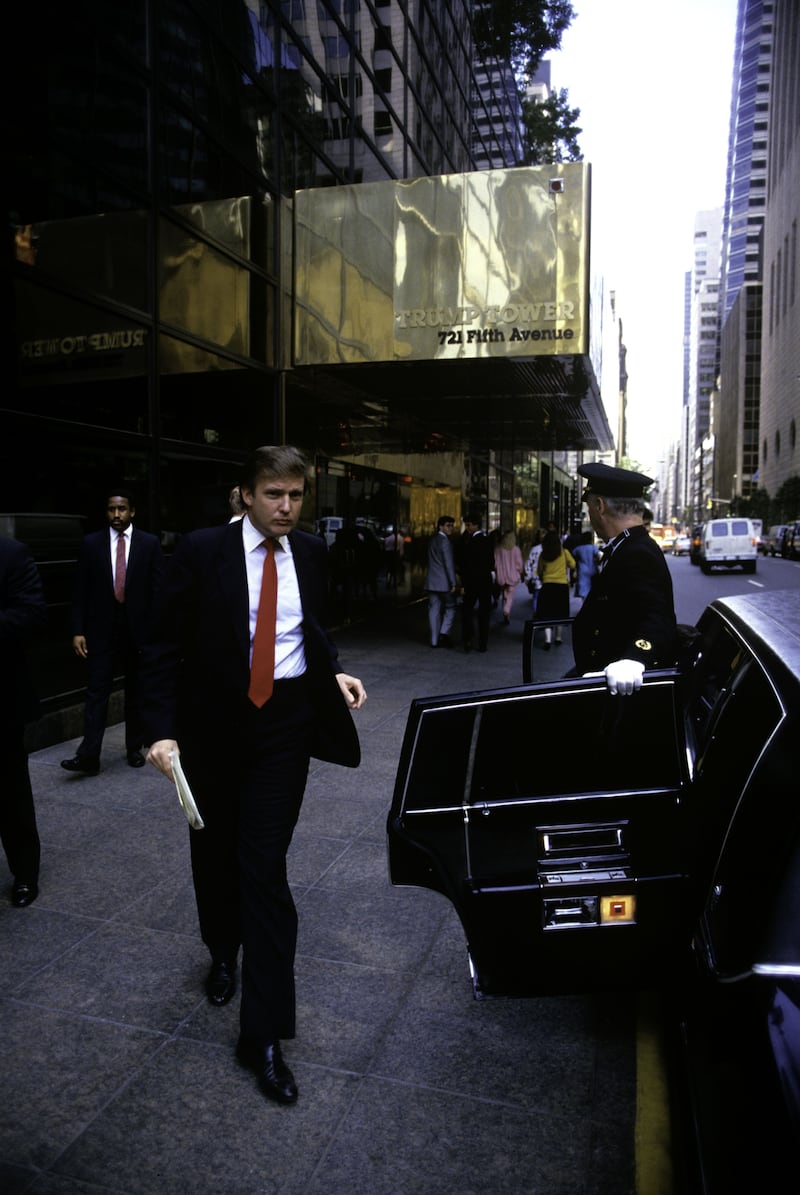
In the mid-1980s, before he became a star and before he became a president, Donald Trump would regularly leave his Trump Tower in Manhattan by the front entrance, even though his limousine was idling at a side door.
“If you really got to go somewhere, you leave by the side entrance,” a business associate told the Daily Beast.
Trump would stop, and stand on bustling Fifth Avenue with two bodyguards. He was waiting to be recognized by passers-by.
“He was craning his neck to find people that would recognize him,” the associate, who asked not to be named, said. ”He’d be staring them in their eye. And he would be bummed if not enough of them did."
This insufficiency of fame was likely a blow to his ego. But in the summer of 1987, it became much more: It was a looming crisis for the publisher Random House, because it needed to get people to buy his book The Art Of The Deal when it was published in November.
Astonishingly, Trump’s thirst for recognition, and Random House’s desperation, came together to create a publicity stunt which now haunts us all: A campaign for people to think Trump was running for president.
It began when the publicity team was meeting in Trump Tower, where fakery was never far away (Trump always said it had 68 stories; it actually only has 58). A secretary reported that his office had been contacted by a New England furniture maker with a big idea.
The image of Trump as a great businessman that the team was hoping to promote nationwide might not have many takers among passers-by on Fifth Avenue, but it had reached Mike Dunbar, a maker of Windsor chairs in Hampton, New Hampshire.
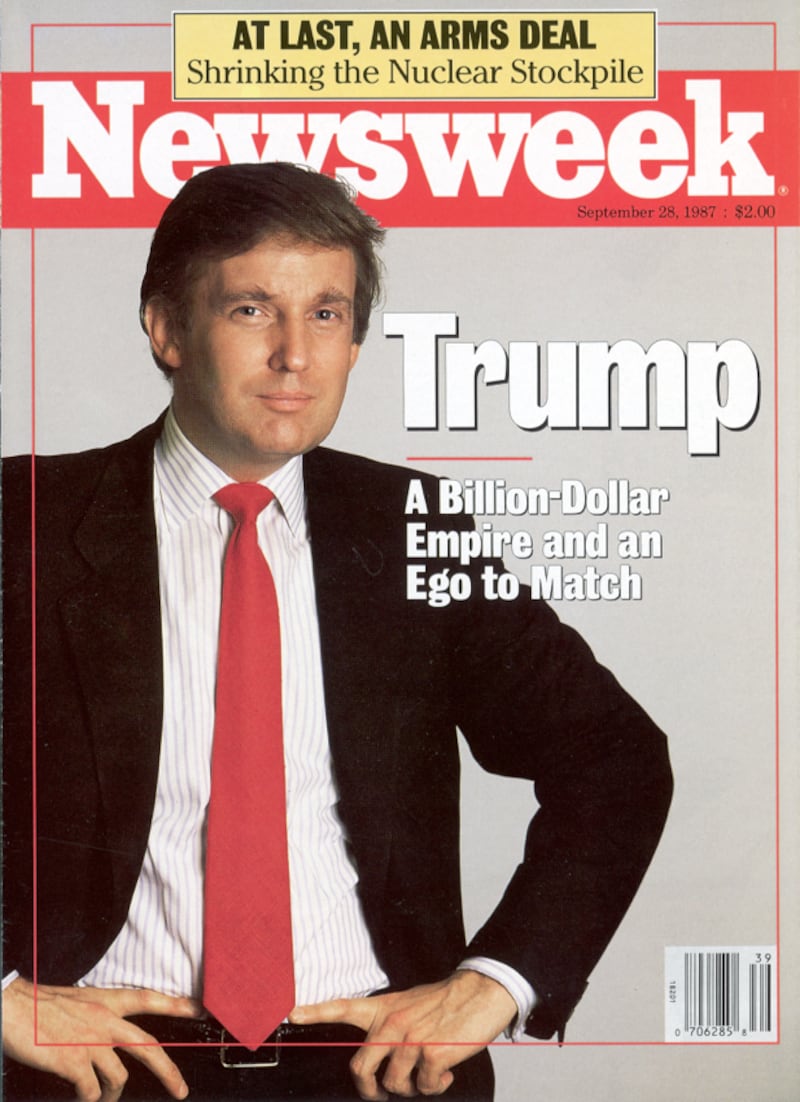
Dunbar, then 40 and a Republican activist in the first-in-the-nation primary state, had taken it further and was proposing Trump should be the next president.
“He was known as brash and daring. So, I concluded he was the guy. To get attention, I started a ‘Draft Trump’ movement,” Dunbar told the Daily Beast in 2016, when Trump was actually running.
Nobody on the publicity team in 1987 took the idea seriously, but they decided it would be a great way to promote the book. A member of the team recalled the strategy. “Let’s say you’re gonna run for president, and let’s take steps in that direction,” they said. “And when you’re asked, you’ll say, ‘I’m still thinking about it. I don’t know, right?’”
On Sept. 2, 1987, the team arranged for Trump to take out full-page ads in The New York Times, The Washington Post and The Boston Globe, proclaiming his displeasure with U.S. foreign policy under Ronald Reagan.
“There’s nothing wrong with America’s Foreign Defense Policy that a little backbone can’t cure,” the ad proclaimed.

The ad continued, in the form of a letter “To the American People.”
“For decades, Japan and other nations have been taking advantage of the United States… Why are these nations not paying the United States for the human lives and billions of dollars we are losing to protect their interests?… The world is laughing at America’s politicians as we protect ships we don’t own, carrying oil we don’t need, destined for allies who won’t help.”
At the bottom was what was likely the first widely viewed Trump signature with a black Sharpie.
As the publicity team hoped, the ads generated a flurry of news stories in which Trump said no, the ad did not mean he was running for president.
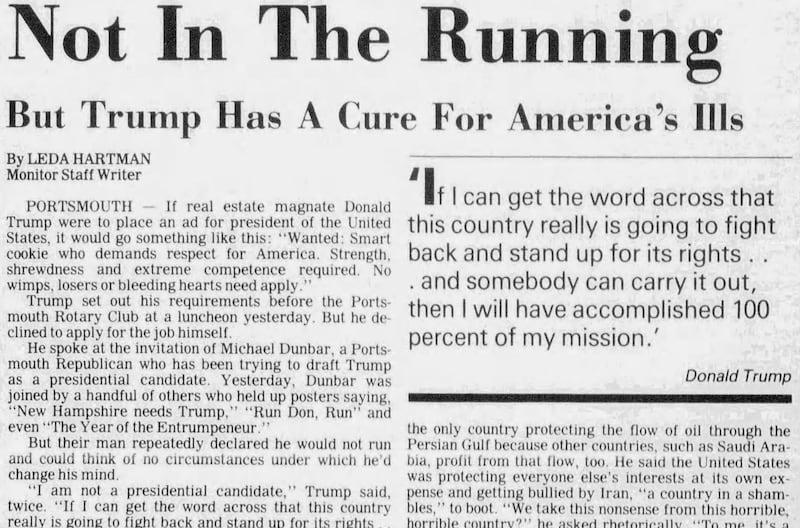
Dunbar had arranged for Trump to address a Rotary Club gathering at Yoken’s restaurant in Portsmouth, New Hampshire, a traditional campaign stop for actual presidential candidates.
On Oct. 22, Dunbar went to greet Trump’s helicopter. He was surprised to see a big crowd had gathered.
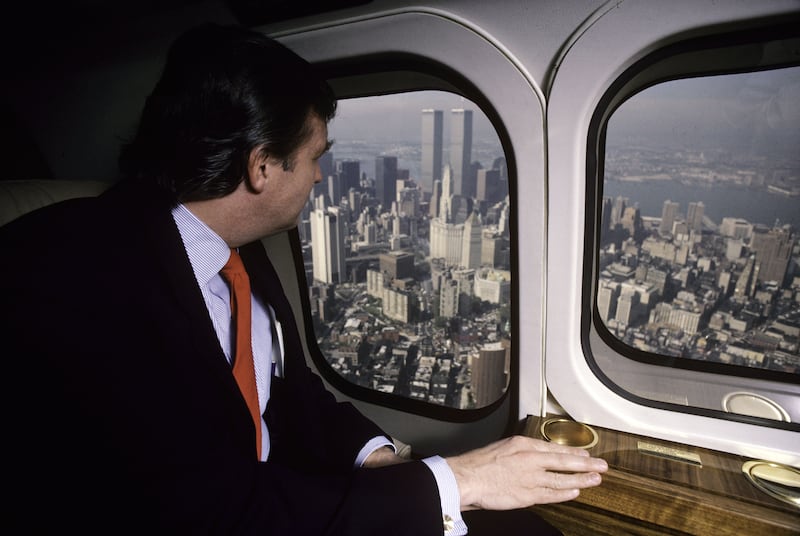
“And I hadn’t organized it,” Dunbar told the Daily Beast. “These people all knew who Donald Trump was and they showed up to greet him. One woman had a bouquet she gave him.”
Dunbar was unaware that Trump’s team had arranged the welcome and ensured that a capacity crowd of 500 filled the function room at Yoken’s.
“It was packed,” Dunbar says. “I mean just packed.”
Trump took the podium. He declared that America had gone weak and was headed for disaster.
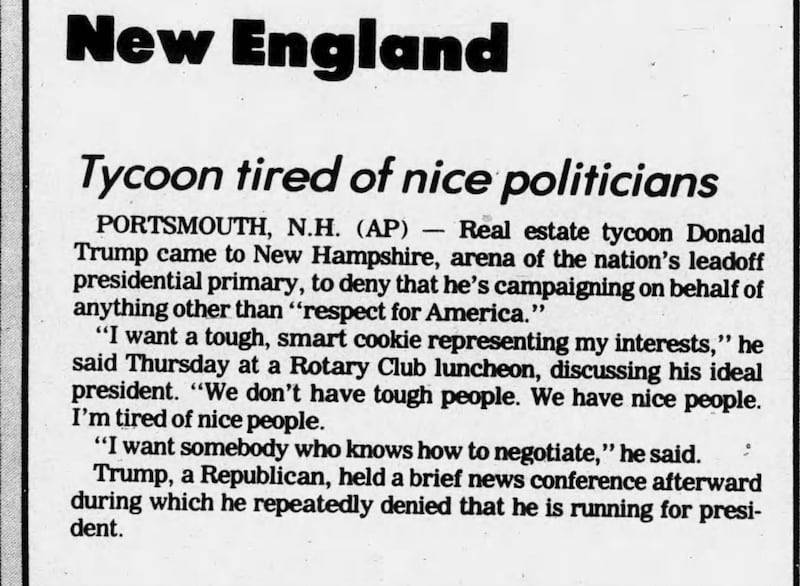
“We don’t have tough people. We have nice people,” he said. “But I’m tired of nice people, already. I mean, too much.”
He was denouncing the course the country was set on by Reagan, who was famously known as the nicest of guys. Reagan had appointed Trump’s sister, Maryanne Trump Barry, a federal judge four years before. But the script called for Trump to play a tough guy.
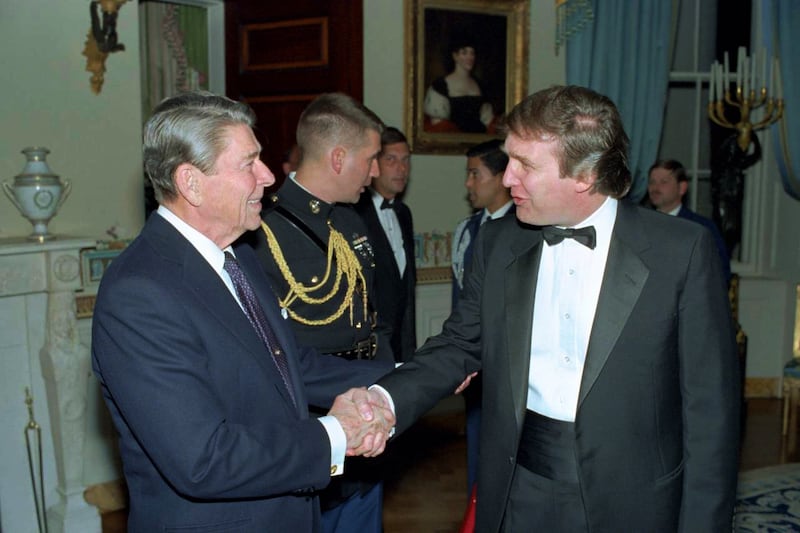
“Let somebody be in there who doesn’t just smile nicely, who’s not just shaking hands,” he told the rent-a-crowd. “I want someone in there who knows how to negotiate, because that’s what it’s all about now. And, if the right person isn’t in office, you’re going to see a catastrophe.”
The Trump of then sounded much like the Trump of now as he spoke of Iran, calling it “a horrible, horrible country.”
“Why couldn’t we go in and take over some of their oil?” he asked.
As for himself, Trump told the crowd, “I’m not here running for president. I’m here because I’m tired of our country being kicked around and I want to get my ideas across.”
What he really wanted at that time was to promote The Art of the Deal—and he did. First the local press in New Hampshire weighed in.
Then, the Associated Press blasted a story across the nation. “Real estate tycoon Donald Trump came to New Hampshire, arena of the nation’s leadoff presidential primary, to deny that he’s campaigning on behalf of anything other than ‘respect for America,’” the wire service reported. The story was carried in dozens of newspapers, the sort of gift a publicity team would celebrate.
Trump—who hadn’t even suggested what party he would run for; Dunbar was a Republican, but the property developer was a registered Democrat—went back to his Manhattan life. And early the next year New Hampshire Republicans voted for George H.W. Bush and the state’s Democrats went for Michael Dukakis, with Bush winning in November.
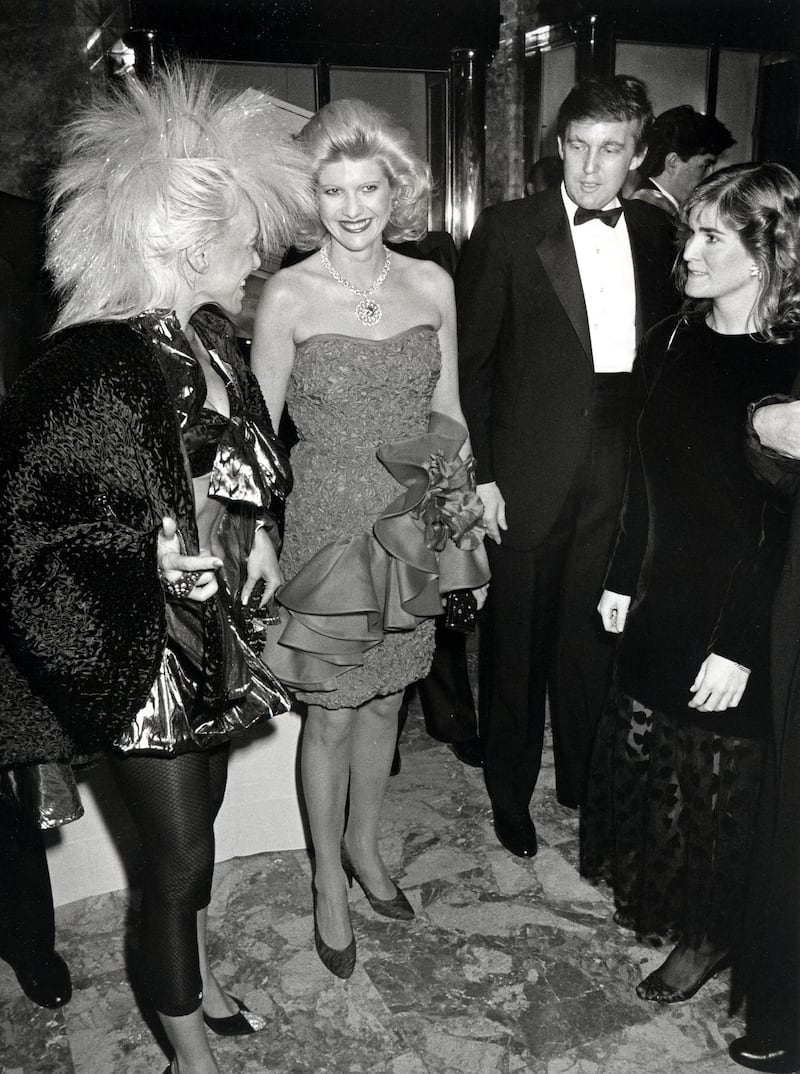
The book was released a month later with a glitzy party in Trump Tower. Everyone was there: Ivana Trump; Dr. Ruth, Michael Douglas; Don King; Barbara Walters; and a smiling, grinning, gesticulating Donald Trump. The book became a number-one bestseller.
The publicity team decided they had pulled off the greatest book promotion in history.
“It was a total scam,” one of them told the Daily Beast. “Planned and plotted.”
But Trump had changed. The business associate who had seen the pre-book Trump wait in front of his tower to be recognized told the Daily Beast that the attention accompanying the successful promotion had acted on him like a drug.
“When you get that high, you’re going to want to repeat it,” the associate suggested.
And the more attention Trump got, the more he wanted.
“He’s an in-the-moment guy,” the associate said.
He also seemed propelled by a need to feel aggrieved. That also made politics a perfect pursuit for him.
“Trump is never happy, unless he’s unhappy,” the associate said. “He needs and thrives off the enemy, and the more public the enemy is, the better he feels. “
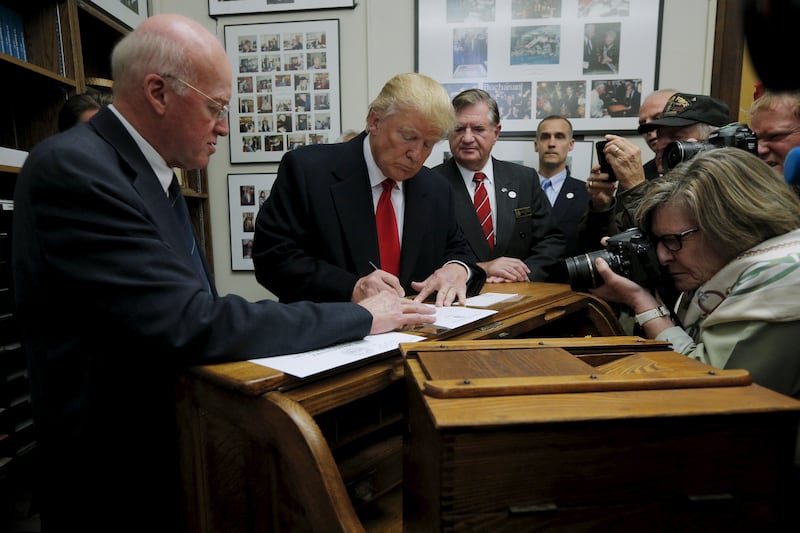
Dunbar had long stepped completely away from politics to concentrate on raising his family when Trump returned to New Hampshire in 2015 while actually running for president. Dunbar did not even attend when Trump spoke at his son’s high school. But the original Trump booster did vote for his original choice: Trump.
As we all know, Trump won one election in 2016 and lost the next in 2020, even if he still groundlessly insists it was rigged. He actually did win again in 2024. And while seeking ever more power as a ruler, he has himself been ruled by an addict’s insatiable need for more, more, more.
He who once stood outside Trump Tower hoping to be recognized has been affixing his name and face everywhere possible. Our history is being governed by someone who exists only in the instant.
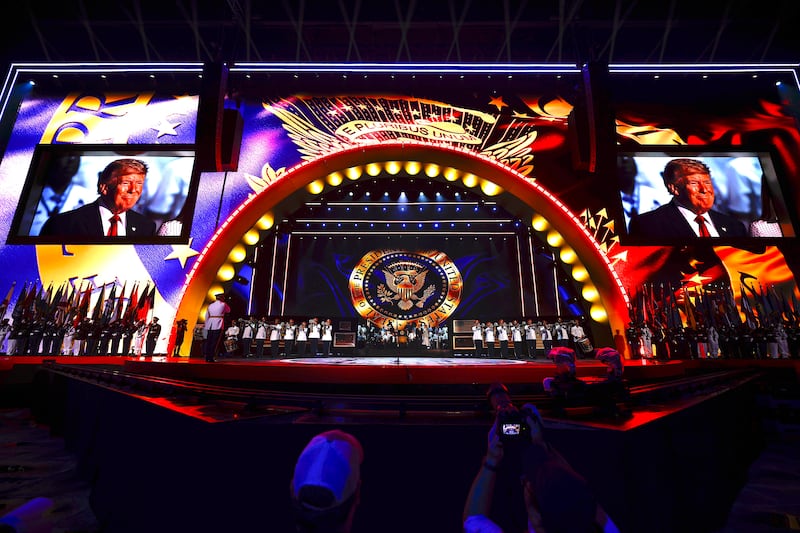
And, as we celebrated America’s 250th birthday, Trump sought to supplant the nation as the center of attention.
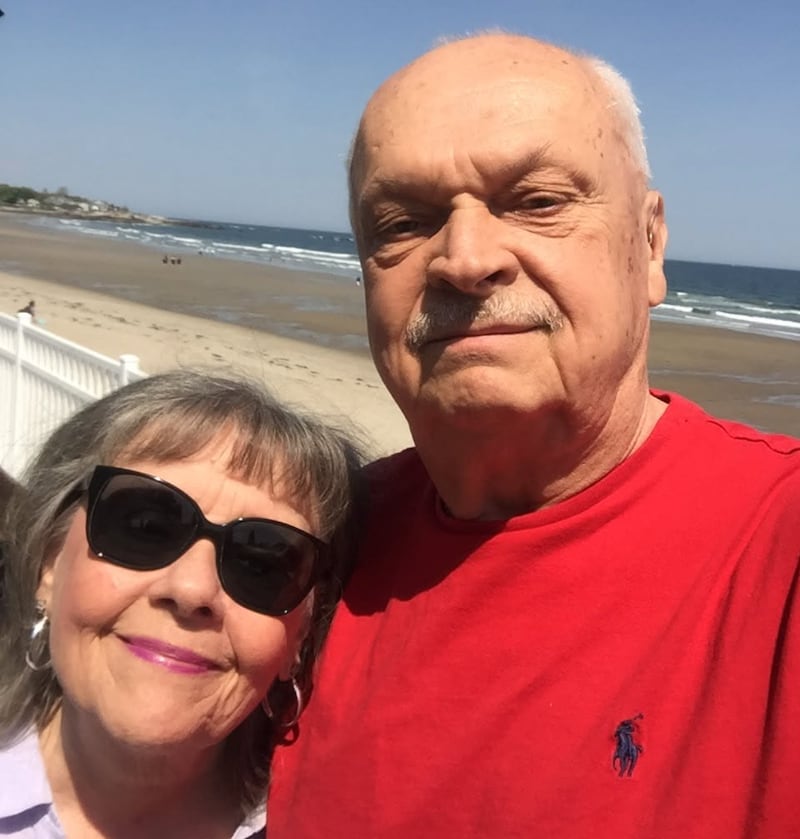
The New Hampshire chairmaker who arguably started it all could not be reached for his current views on the outcome.
We do know one person who seems to have been taken in by 1987’s fake presidential run: Trump himself. The inscription in a signed copy of the book he sent to Dunbar suggests he had experienced a tingle of what it would actually be like to run for president with actual crowds.
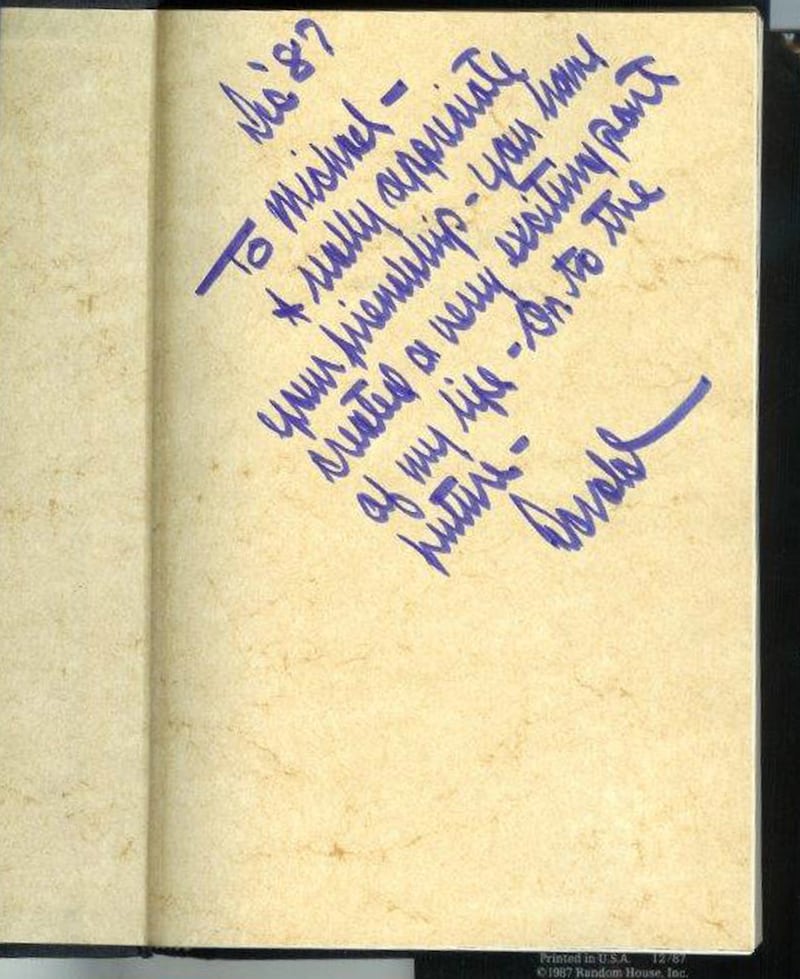
“To Michael,
I really appreciate your friendship—you have created a very exciting part of my life—on to the future.
Donald”
The fake campaign had become real.