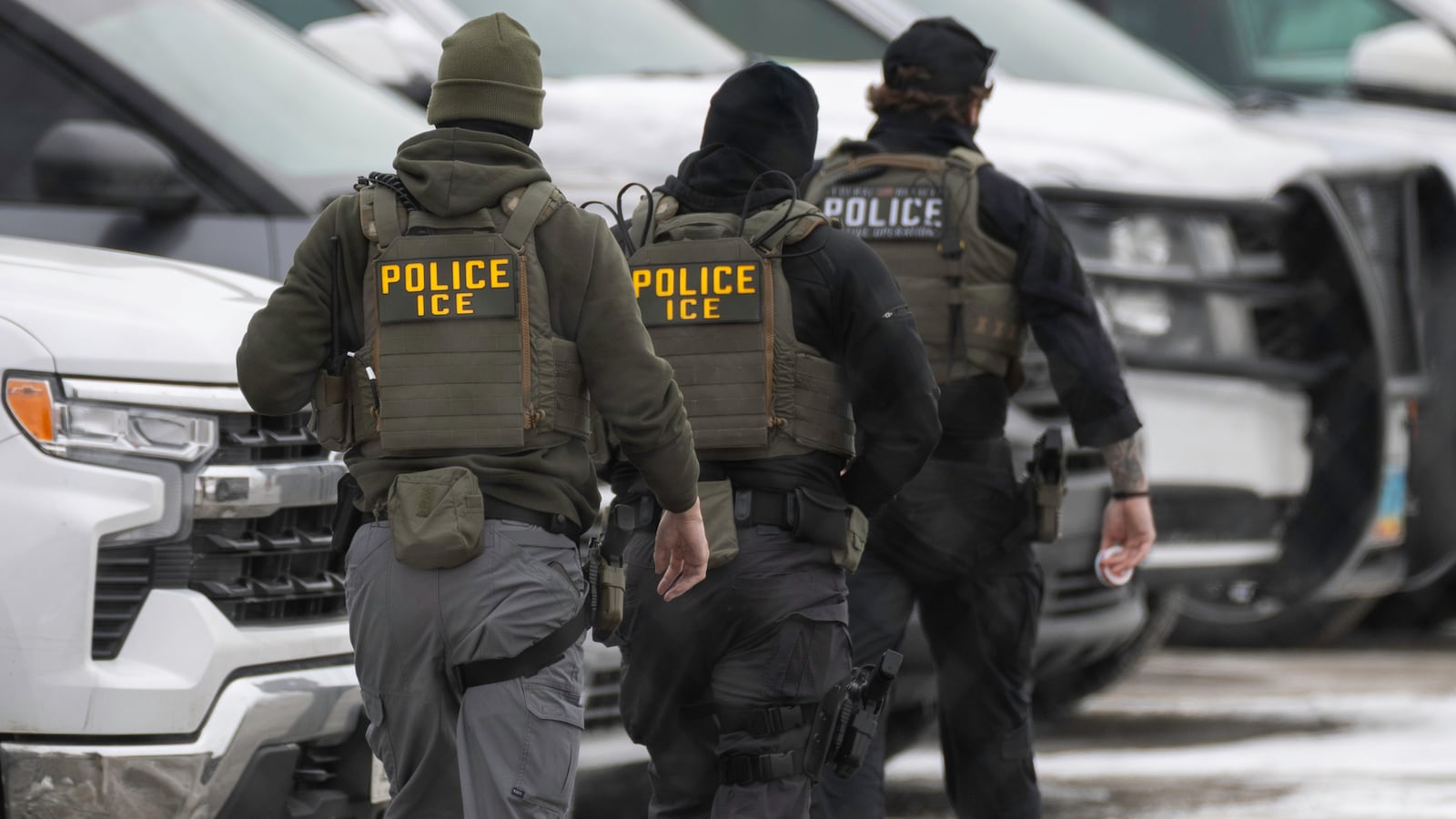
Immigration agents have admitted to using new surveillance apps as they scrambled to satisfy a lofty deportation quota set by Stephen Miller and Kristi Noem.
In a rare court testimony last December, ICE agents identified simply as “J.B.” and “D.R.” detailed their use of apps called Elite and Mobile Fortify to identify neighborhoods and people they could target in Woodburn, a city in Oregon just south of Portland that was rocked by an immigration blitz in October.
The agents’ testimony and cross-examination centered on the October 30 operation that saw at least 31 people get swept off the streets of Woodburn, a largely Latino city that is home to agricultural workers. The ICE blitz led the city council to declare a local state of emergency as fear kept residents from showing up to work and to school.

J.B., a deportation officer in Colorado who has been with ICE for five years, said his team of nine to 12 agents was given a goal—orally, “not in writing”—of making eight arrests per day. His team was linked to Operation Black Rose, a Department of Homeland Security initiative in Portland.
The U.S. attorney representing J.B. objected to the use of the term “quota,” but was overruled by the judge.
“Did I comply with it? I made as many arrests as I could, as long as it was lawful,” J.B. said.
Last May, Miller and Noem laid into top immigration officials and demanded that they arrest 3,000 people a day. Miller, 40, has been widely credited as the architect of the Trump administration’s hardline immigration agenda, while Noem, 54, was Homeland Security secretary at the time. She has since been fired by President Donald Trump.
In the two months that followed their ambitious directive, however, data showed that ICE arrests dropped by nearly 20 percent. But that didn’t stop DHS from touting the supposed success of its deportation blitz—including Operation Black Rose, which had yielded more than 1,240 arrests by December.
“In less than a year, President Trump has delivered some of the most historic and consequential achievements in presidential history—and this administration is just getting started,” Noem said in a statement at the time.
J.B. revealed that ICE agents used an app called Elite to identify targets, even as he acknowledged that it sometimes gave inaccurate information.
“It tells you how many people are living in this area and what’s the likelihood of them actually being there,” he explained. “It’s basically a map of the United States. It’s kind of like Google Maps.”
J.B. said the app pulls information “from all kinds of sources.” In January, 404 Media reported that the tool was developed by the software firm Palantir and obtained people’s addresses from the Health Department, among other sources.
But the app wasn’t foolproof, J.B. said.
“The app could say 100 percent, and it’s wrong. The person doesn’t live there. And so it’s not accurate. It’s a tool that we use that gives you a probability, but there’s no such thing as 100 percent,” he explained. “You can’t rely on one system that says this person is 100 percent there and they’re illegal. You still do your checks.”
Another ICE deportation officer in Colorado, identified only as D.R., said agents also used a DHS app called Mobile Fortify. The agency said the app uses AI to match faces and fingerprints with existing government records, but maintained in previous statements that “the application does not access open-source material, scrape social media, or rely on publicly available data.”
A CBP officer part of J.B.’s team said in his court testimony that he used Mobile Fortify while conducting an arrest on October 30 last year. He used the app on a woman—the lead plaintiff in the case, identified as “MJMA”— but it yielded two matches, so he “wasn’t sure if it was her or not.”
J.B.’s team wrote in their arrest records that MJMA entered the U.S. unlawfully, even though she came into the country with a valid visa last year. They took her to a detention center in Washington state, and she was released the next day “without explanation and left her to find her own way back home to Oregon,” according to district judge Mustafa Kasubhai, a Biden appointee.

“To serve the President’s demands for 3,000 immigration arrests each day nationally, evidence shows that ICE officers deployed to Oregon communities and arrested an ‘extraordinary’ number of Oregonians in October of 2025 with little regard for conducting lawful arrests,” Kasubhai wrote.
The DHS did not immediately return a request for comment on this story.