
Homeland Security Secretary Kristi Noem’s frantic ICE hiring push saw applicants with no experience bypass crucial training before being sent into the field as the result of a humiliating tech glitch.
The agency relied on an artificial intelligence tool to vet applicants and identify candidates with prior law enforcement experience, NBC News reports, but that technology mistakenly fast-tracked people who’d simply used certain keywords in their resumes.
Applicants who mentioned past experience as a “compliance officer,” for instance, or who expressed their ambition to become an “officer,” were reportedly treated as trained law enforcement officers.

The hiring surge unfolded under Noem’s push to add 10,000 new officers as part of an effort to support President Donald Trump’s mass deportation agenda, with top White House aide Stephen Miller demanding some 3,000 arrests per day. The administration has denied that any such quota existed even as immigration raids visibly ramped up across the country.
“They were using AI to scan résumés and found out a bunch of the people who were LEOs weren’t LEOs,” one official told NBC News of the bungled vetting process.
Candidates with prior law enforcement experience are eligible for the agency’s Law Enforcement Officer, or LEO, program, which consists of four weeks of online training.
Applicants without such experience are required to complete an eight-week, in-person course at the Federal Law Enforcement Training Center in Georgia, where instruction includes immigration law, firearms handling, and physical fitness tests.
As a result of the tech error, many recruits routed to the shorter training track had no experience in law enforcement but were rushed through anyway.
The majority of new applicants were classified as law enforcement officers by the system, officials said, even though many lacked relevant credentials.
Both officials interviewed emphasized that ICE field offices provide additional instruction before officers are deployed and said those affected by the AI error likely received further training. The officials spoke to NBC News on condition of anonymity because they were not authorized to discuss the matter publicly.

The Department of Homeland Security has been asked for comment.
The mistake was identified in mid-fall, more than a month into the recruitment surge, and ICE began taking corrective steps, including manual résumé reviews, the officials said. “They now have to bring them back to FLETC,” one official said, referring to the Federal Law Enforcement Training Center.
Officials were unable to say how many recruits were improperly trained or how many may have been sent out to conduct immigration arrests before the error was discovered.
The Daily Beast previously revealed frustrations behind the scenes of ICE’s hasty hiring push, which has been plagued by reports of sloppy vetting and questionable hires.
ICE was mandated to hire 10,000 officers by the end of 2025 and offered new recruits $50,000 signing bonuses using funding from Trump’s One Big Beautiful Bill. One official said that while ICE met the target on paper, the need to retrain misclassified recruits meant the agency did not actually put 10,000 new officers on the street during 2025.

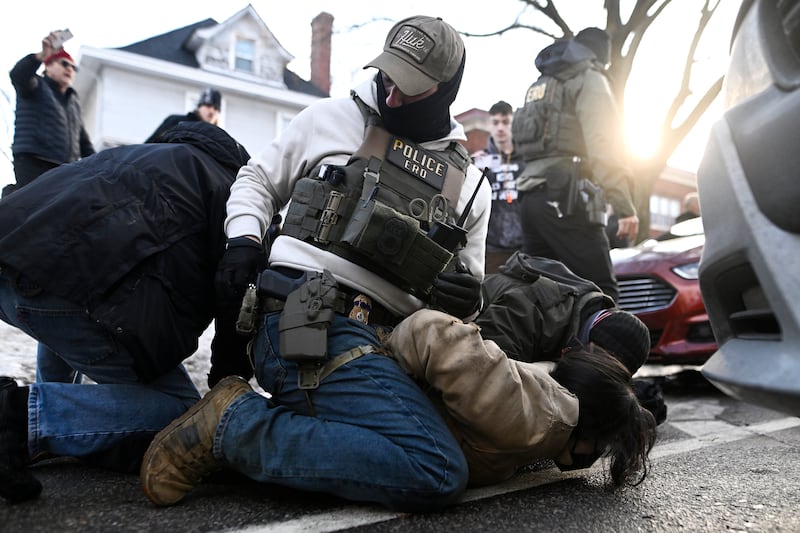
The news comes amid heightened concerns over the agency’s heavy-handed tactics, with more than 40 cases over the past year that showed agents using chokeholds, neck restraints, or prolonged pressure on people’s backs or necks, according to a ProPublica investigation.
A DHS spokesperson told the Daily Beast that the technological “snag” was rectified and did not impact final hirings. “No candidate has been placed on enforcement duties without appropriate training and credentials,” they said, claiming that only 200 out of the 12,000 hires—or less than 2 percent—were affected.
“Two-thirds of the applicants were not hired. The 200 completed their onboarding with ICE and reported to FLETC for full law enforcement officer training,” the spokesperson said.
“ICE is hiring the best of the best to get the worst of the worst criminals off America’s streets,” they added. “Our historic unprecedented nationwide recruitment campaign has shattered expectations, hiring more than 12,000 officers and agents in less than a year. The vast majority of new officers brought on during the hiring surge are experienced law enforcement officers who have already successfully completed a law enforcement academy. This population is expected to account for greater than 85% of new hires.”