Inside the Experimental Search for Dark Matter
Although dark matter is believed to exist in large quantities, the best way to find and measure dark matter continues to elude scientists.
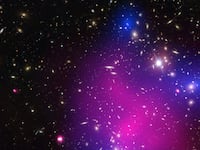
Courtesy Smithsonian Institution
By Anthony Williams, Professor of Physics, University of Adelaide
Dark matter is believed to be five times more prevalent in the universe than ordinary matter.
But it interacts so weakly with other matter—like the protons and electrons that make up the stuff around us—that, to date, it has defied our attempts to detect it directly. It doesn’t even interact with light, which is why we call it dark matter.
But that doesn’t mean it’s impossible to detect. We can search for dark matter in a number of ways.
We can try to produce dark matter using high-energy particle accelerators, such as the Large Hadron Collider at CERN. We can also look into regions of space where dark matter is concentrated, such as at the centres of galaxies, for signs of dark matter decaying into ordinary matter.
Get the best of The Beast delivered right to your inbox
By clicking “SUBSCRIBE” you agree to our Terms of Use and Privacy Policy.
Finally, we can directly search for signals of dark matter by building highly sensitive detectors that can detect when a dark matter particle bumps into a particle of ordinary matter.
In January 2017, work will begin on the construction of just such a detector, a kilometre underground in the Stawell Gold Mine in Victoria.
There are many different direct searches for dark matter underway around the world, but the experiment at the Stawell Underground Physics Laboratory (SUPL) will be the first of its kind in the Southern Hemisphere.
The reason we’re putting the sensors so deep underground is to prevent them being swamped by unwanted noise from cosmic rays, the high-energy particles that constantly rain down on Earth. These cosmic rays are very energetic, so it takes a lot of material to block them and prevent them from interfering with the experiment.
So far, there has been only one claim of direct detection of dark matter from the DAMA-LIBRA experiment, deep underground in the Gran Sasso laboratory in Italy. It used thallium-doped sodium iodide crystals, which should give off a barely perceptible flash of light if dark matter collides with the ordinary matter atoms in the crystals.
However, this detection appears to be inconsistent with other experiments. These use different target materials and detection methods, such as the LUX and XENON experiments, which have not seen any dark matter signals and have greater sensitivity. It has proved very difficult to construct theories of dark matter that allow DAMA-LIBRA to be consistent with these other experimental searches.
Dark matter for all seasons
Our spiral galaxy is thought to be rotating inside a large, diffuse sea of static dark matter. As the galaxy rotates through the dark matter, the Sun experiences a constant “wind” of dark matter.
Because Earth’s speed with respect to the sea of dark matter around us changes as Earth rotates around the Sun, we expect to see a variation in the dark matter signal over the course of a year. This variation is called an annual modulation.
This is what DAMA-LIBRA reported. By having a new and improved experiment, called SABRE, with detectors in both hemispheres, we can rule out any possible seasonal effect that might be giving the appearance of an annual modulation.
We think the Stawell Gold Mine is the perfect location to do that experiment. It is a “decline mine”, meaning there’s a sloped path leading underground that loops back on itself. It’s a 30-minute drive down 15km of winding underground tunnels before you reach the SUPL lab site.
The primary laboratory space will be housed in a 10-metre-wide, 35-metre-long void that will be freshly gouged into the rock. The walls of the void will be reinforced with dozens of long bolts penetrating deep into the surrounding rock, and then the walls will have a thick layer of shotcrete sprayed onto them for further stability.
The excavation and reinforcement will happen in early 2017 and the lab will be constructed in mid-2017. The southern component of the SABRE experiment will go into the lab and begin operation in late 2017.
The SUPL lab is expected to house several other experiments in the coming years, ranging from nuclear physics to studies of biological systems in extreme and low-radiation environments.
We are hopeful that this experiment will finally provide clear evidence for the elusive dark matter.
Anthony Williams is a professor of physics at the University of Adelaide. This article was originally published on The Conversation. Read the original article here.
See more of our coverage in your search results.

Got a tip? Send it to The Daily Beast here.
Register below to read this article for free or subscribe
to unlock unlimited access to The Daily Beast.
Monthly
$1
First month then $5.99/month
Annual
$35
First year then $59.99/year
Premium
$79
First year then $119.99/year
*Substack access provided by the next business day, using your subscription email. Choosing the Premium plan constitutes your permission to share your subscription email with Substack and your agreement to Substack’s Privacy Policy.
Already have an account? Sign In
Looks like you already have a subscription!
You're all set!
Thanks for subscribing.