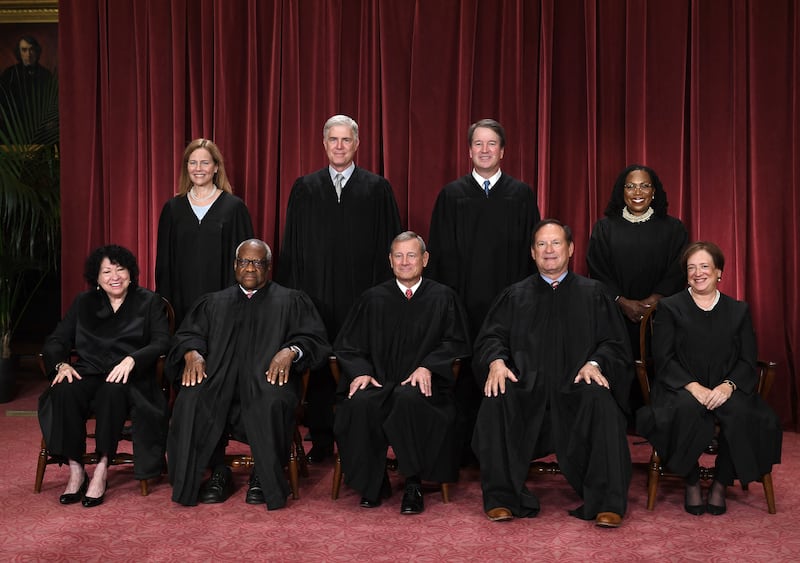
Justice Ketanji Brown Jackson flamed her conservative colleagues’ “misguided” decision to make it easier for border agents to detain green card holders returning to the country.
Justice Jackson wrote a scathing dissent after the court ruled 6-3 in favor of permitting agents to treat returning permanent residents as “applicants for admission,” making them susceptible to detainment based on unproven criminal allegations.
“I worry that the Court has now handed the Government a massive blank check,” she wrote.

Fellow liberal Justices Sonia Sotomayor and Elena Kagan joined Jackson in dissent.
Jackson, an appointee of former President Joe Biden, wrote that the high court “cavalierly swept aside” the rights of green card holders and may have even undermined Congress.
Tuesday’s ruling, she wrote, allows the Trump administration—and future administrations—to rip away one’s status as a green card holder “so long as the government is able to show later that he was eventually convicted.”
“That sequencing undermines the plain terms and basic operation of the relevant statutory scheme, which guarantees that [lawful permanent residents] will not be ‘regarded as seeking an admission’ at the border unless certain exceptions apply,” she added.
Jackson wrote that lawful permanent residents, or LPRs, should not have to juggle such uncertainty as they return to the country they have chosen to call home.
“Having enshrined a returning LPR’s already-admitted status, Congress could not have meant for the guarantees it was affording to be so cavalierly swept aside,” she wrote. “By law, LPRs are as close to citizenship as one can get absent naturalization.”
She added, “Today, the majority ignores that crucial fact and empowers Government officials to act accordingly.”

The issue reached the high court after Muk Choi Lau, a Chinese national who has been a green card holder since 2007, sued to block his deportation after he was convicted of third-degree trademark counterfeiting. He argued that the offense was too minor to constitute grounds for deportation.
Lau visited China while indicted but not yet convicted. When he returned to the United States, he was paroled into the country on temporary status instead of as a permanent resident, making him susceptible to deportation, which the Department of Homeland Security then sought.
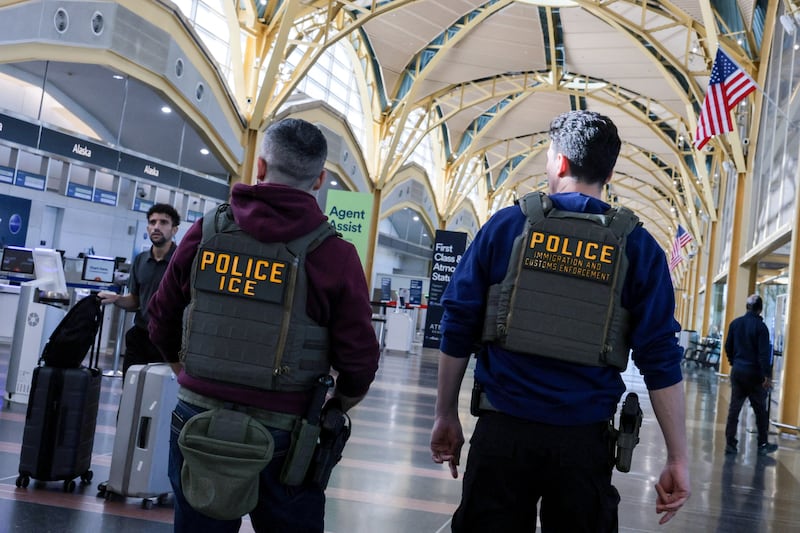
An immigration judge sided with DHS and ordered Lau to be deported, but the decision was overturned by the U.S. Court of Appeals for the Second Circuit. The matter was taken up by the Supreme Court, which ruled in favor of the Trump administration and determined DHS had the right to strip Lau of his legal status and deport him.
Green card holders typically face no issues being admitted back into the United States under the same status if their trip abroad was brief. The Immigration and Nationality Act restricts their entry as a permanent resident only under a narrow set of circumstances, including when they are accused of committing a crime “involving moral turpitude,” such as fraud.
Jackson wrote in her dissent that the appeals court had correctly ruled that the accusations against Lau were insufficient to downgrade his legal status. Meanwhile, she said the SCOTUS ruling was both “counterintuitive and consequential.”