Kentucky’s First Female Master Distiller: Marianne Barnes
Meet the woman in charge of making the spirits at the bourbon-obessed state’s new Castle & Key distillery.

Handout
Putting the lie to the creaky old notion that women don’t make whiskey, Marianne Barnes has just fired up the stills at Kentucky’s new Castle & Key distillery. In doing so, she’s the bourbon-obessed state’s first female master distiller, since at least before Prohibition.
This, of course, flies in the face of the idea that making spirits is a man’s job. There are still relatively few women in the distilling business. Historically, in the United States, women have been more prominent in the fight against the consumption of alcohol than in the making of it. The prohibitionist legacy of Carrie Nation, Frances Willard, and their hatchet-swinging followers may have something to do with why whiskey-making in America has been, even into the 21st century, largely a boys’ club.

There have been notable exceptions. Peggy Noe Stevens rose to master taster at Brown-Forman (the spirits conglomerate that makes whiskies including Woodford Reserve, Old Forester and Jack Daniel’s). And Allisa Henley worked as a distiller at Tennessee’s George Dickel (which she just left for the newish Popcorn Sutton distillery where she will be master blender.
But it is a notable breakthrough that Barnes, who worked her way up through the ranks at Old Forester to become a master taster, has graduated to the rarified job of master distiller for Castle & Key, a start-up poised to be a large-scale bourbon producer.
Despite the industry’s old boy network, Barnes has been given opportunities and her success has been widely embraced. “I’ve received nothing but great support from the other master distillers,” she says.
Get the best of The Beast delivered right to your inbox
By clicking “SUBSCRIBE” you agree to our Terms of Use and Privacy Policy.
Castle & Key is a new brand, but not a new distillery. In 1887, American whiskey pioneer Colonel E.H. Taylor, built a sort of limestone fortress in Frankfort, Kentucky, complete with crenellated battlements. Save for during Prohibition, the castle made bourbon, under various owners, until 1972. During the last 40 odd years it has slowly and charmingly moldered, becoming a relic of bourbon’s first golden age.
It’s a ruin no more. An investment group rescued the old distillery from the relentless advance of kudzu vines and over the last couple of years has put millions into rebuilding the facility, retaining vintage equipment where possible, and modernizing where it makes sense.
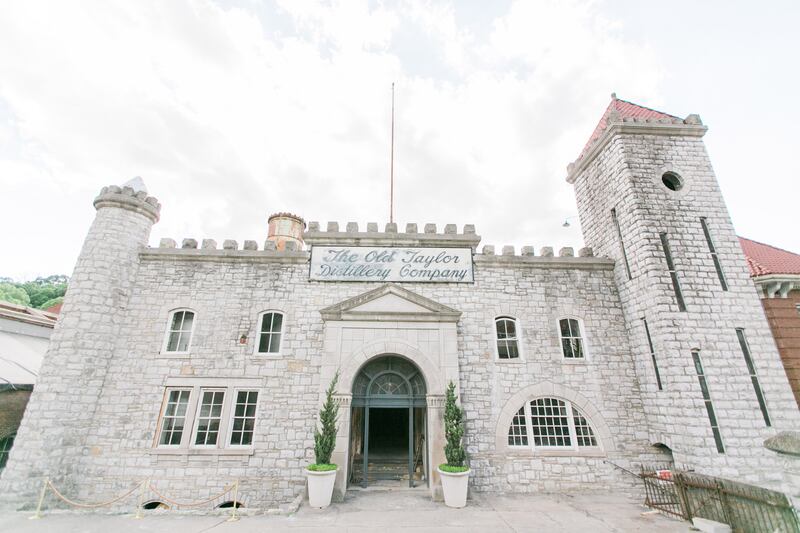
Revived and restored, the Old Taylor Distillery won’t go by that name. When the distillery fell into disuse and neglect, the Taylor name did not—it was just sold off. The Old Taylor and E.H. Taylor Jr. brands are now owned by Sazerac.
Barnes plans to make a variety of whiskies, including, of course, bourbon, rye, an American single malt whiskey and a wheated bourbon. Barnes and company will also produce a vodka and gin using the unaged bourbon as a base and flavored with locally sourced botanicals. That attributes give them a Kentucky story to tell, but more important gives them a product that can be sold right away.
The bottled-in-bond bourbon that will be Castle & Key’s signature spirit will, by law, have to age at least four years. Barnes says they will not take the short cut so common in the industry of buying and bottling off-the-rickhouse-rack whiskey from another producer. “We’re going to make our own and wait for it,” she explains.

To help find a house style, Barnes has sought out vintage bottles of pre-Prohibition, castle-produced Old Taylor whiskey. “It’s very sweet,” she says. “It has some complexity, but isn’t spicy or floral.” Col. Taylor preferred using white corn in his mash, Barnes says, which she will do, too. She has also sought out heirloom strains of yeast she thinks will help capture the original Taylor style, which she hopes to update for sophisticated modern palates. “We’re shooting for classic with a little more complexity.”
How will she achieve that goal? She thinks woman, if anything, have certain natural advantages in the world of whiskey. “Women do have a more sensitive palate,” she notes. “Women should be able to create more nuanced spirits.”
An undergraduate degree in chemical engineering from the University of Louisville suggests that Barnes is not without technical bona fides. But it was at Brown-Forman that she learned how to develop flavors during the brewing process, coax them out with the still and refine them in the barrel. These are skills that involve chemistry, but can’t be executed in the lab alone.
“Right out of college, I could have built an efficient ethanol plant,” Barnes says, “but it wouldn’t have tasted very good.”
See more of our coverage in your search results.

Got a tip? Send it to The Daily Beast here.
Register below to read this article for free or subscribe
to unlock unlimited access to The Daily Beast.
Monthly
$1
First month then $5.99/month
Annual
$35
First year then $59.99/year
Premium
$79
First year then $119.99/year
*Substack access provided by the next business day, using your subscription email. Choosing the Premium plan constitutes your permission to share your subscription email with Substack and your agreement to Substack’s Privacy Policy.
Already have an account? Sign In
Looks like you already have a subscription!
You're all set!
Thanks for subscribing.