The extraordinary war of words between King Charles and Princess Diana’s brother has reignited a nearly 30-year-old family feud which threatens to endure over the coming weeks.
My sense is that revulsion is building at Earl Spencer’s decision to sit like a dragon on the egg of his most explosive allegation about the king, only to sell it to the Daily Mail in the run-up to the 30th anniversary of Diana’s death.

In his new book Swan Song: Diana, My Sister, he claims that in the days after the Paris crash the then-Prince of Wales “hissed” down the phone at him: “Rest assured, we’ll forget her soon enough.”
While my own experience of grief makes me quite certain that regrettably sharp words may well have been exchanged, the Palace’s response, that “the pain of fraternal grief can cloud reason, affect judgment and colour memory in ways others do not recognise, even many years after such a loss,” was a carefully worded way of saying the king believes a bitter and twisted Spencer has made it up.
The statement also says the Palace usually steers clear of making statements about books. It is worth bearing in mind that the Palace made no public statement upon the release of Harry’s autobiography, Spare. And while the late Queen did say “recollections may vary” after his and Meghan’s notorious Oprah appearance, the strength of the King’s response to Spencer’s claim is phenomenal.
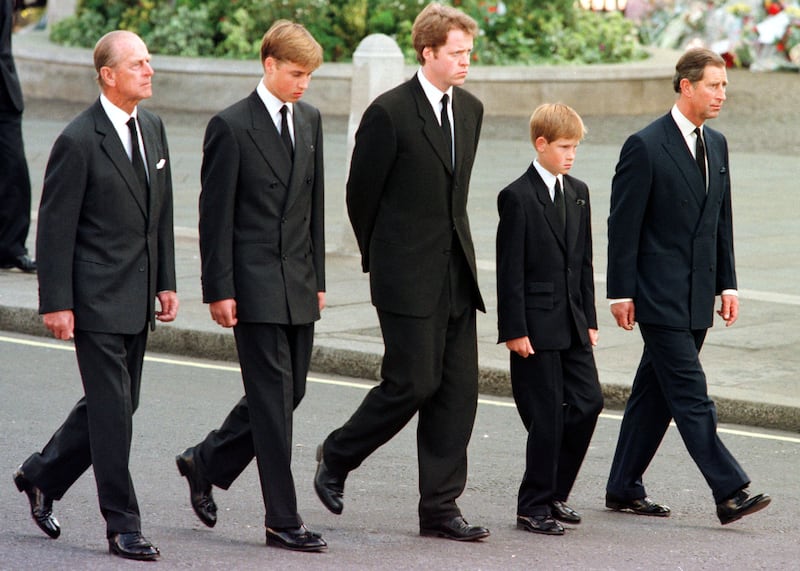
The argument which led to the alleged outburst centered around whether William and Harry, 15 and 12 in 1997, should walk behind their mother’s coffin at her funeral. It was at that funeral that the whole world saw Spencer make a pointed pledge in front of the royals.
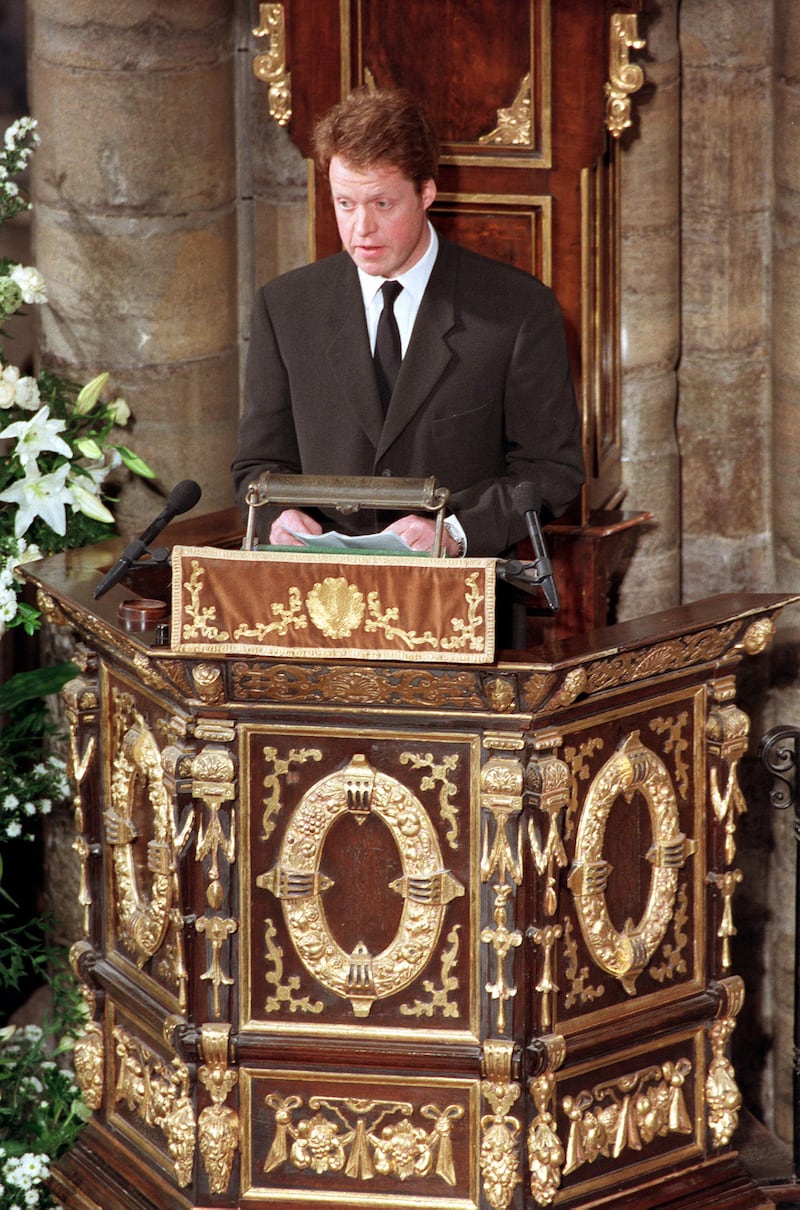
Speaking at Westminster Abbey, Spencer said that Diana’s “blood family”—i.e. he himself—would protect the boys “so that their souls are not simply immersed by duty and tradition, but can sing openly as [she] planned.”
The comment exacerbated the growing chasm between the public and the Windsors after Diana’s death, with the British people quickly angered at the royals’ cold courtliness.
In the 21st century, however, Charles’s allies have been quick to defend him. Julian Payne, who ran the king’s communications for five years from 2016 and worked alongside the then-prince during the 20th anniversary of Diana’s death in 2017, has told BBC Radio 4’s Today program he did not recognize “the way the King is being characterized in those remarks.”
He said: “He was absolutely emphatic that we were to respect her memory and not undermine it in any way. When he was telling us there was never to be any criticism or pushback, that wasn’t about him. That was absolutely about the late princess and her memory.”
He added: “So it seems to me very odd that in the moment itself, with the grief of his family and his own shock, that he would choose that moment to use those words. It’s just not language that I recognise.”
Courtiers have briefed British media that the alleged remark was “just not in his nature and it certainly wasn’t in his nature at that time, when he was a man absolutely grief-stricken,” adding that the Prince of Wales was “paralysed with grief” and defied protocol by insisting Diana be given a full state-style ceremonial funeral, with her coffin draped in the royal standard on its return from Paris.
Some recollections may vary here too.
Much reporting over three decades has concluded that then-Prime Minister Tony Blair pushed the reluctant royals toward a big public funeral, a flag at half-mast over Buckingham Palace, and a walkabout among the flowers. And although Charles did fly to Paris to bring the body home, and the Royal Standard draped over the coffin was his call, the picture of a lone prince fighting the system for Diana is, well, his truth.
I am not one to lavish praise on the king for no reason. But I covered that week. It was my first summer in journalism, working at the London Evening Standard near Diana’s Kensington Palace home, and for eight weeks you could not get to the office without pushing through the crowds heading to lay flowers at the gates.
I remember the fury over the decision-making. I remember, too, that half the country thought the other half had gone mad. It was an incredibly fractious, divided time, and I do not find it unbelievable that sharp words were exchanged.
As for Spencer, many people watching a man with four marriages, two ruinous divorces and a £60 million land deal behind him sell the secrets of his sister’s misery to a tabloid, will conclude that he is doing what a great many others have done since 1997: monetizing Diana.

The King was right to respond, and to respond fast, rather than let this drift for weeks, as he has with Harry and Meghan. It is a vile allegation that required a line in the sand.
Want more royal gossip, scoops and scandal? Follow all Tom Sykes’ reporting at The Royalist on Substack or listen to The Royalist podcast on YouTube.