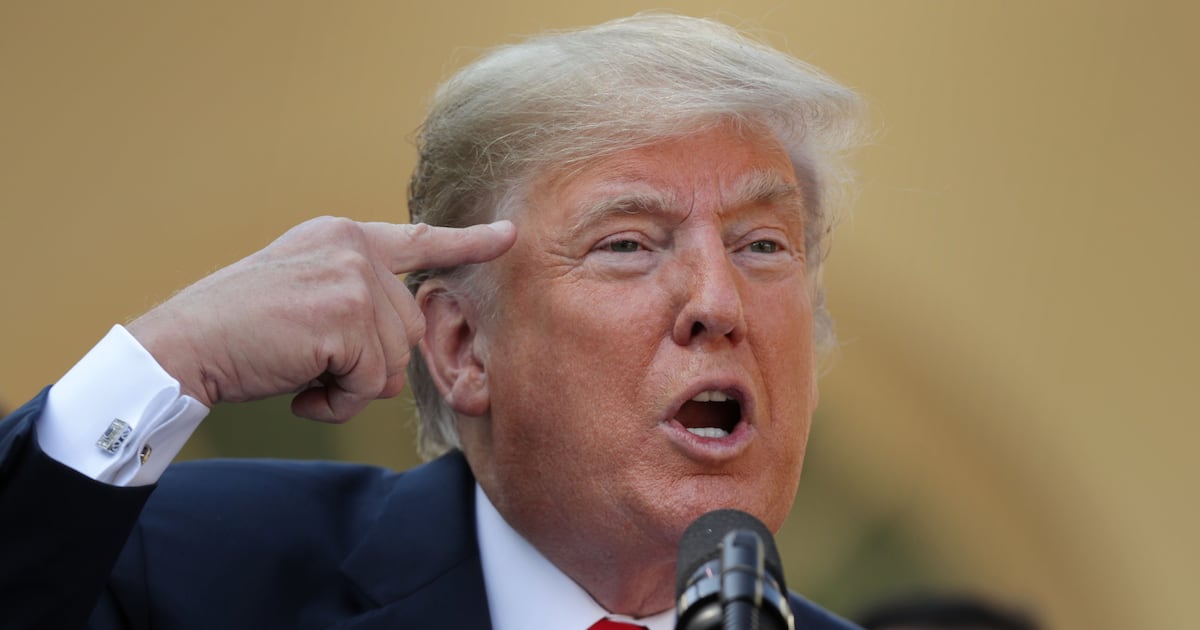
A Republican congressman struggled to explain away the president’s apocalyptic Iran threat—insisting Trump’s brazen words actually mean something else entirely.
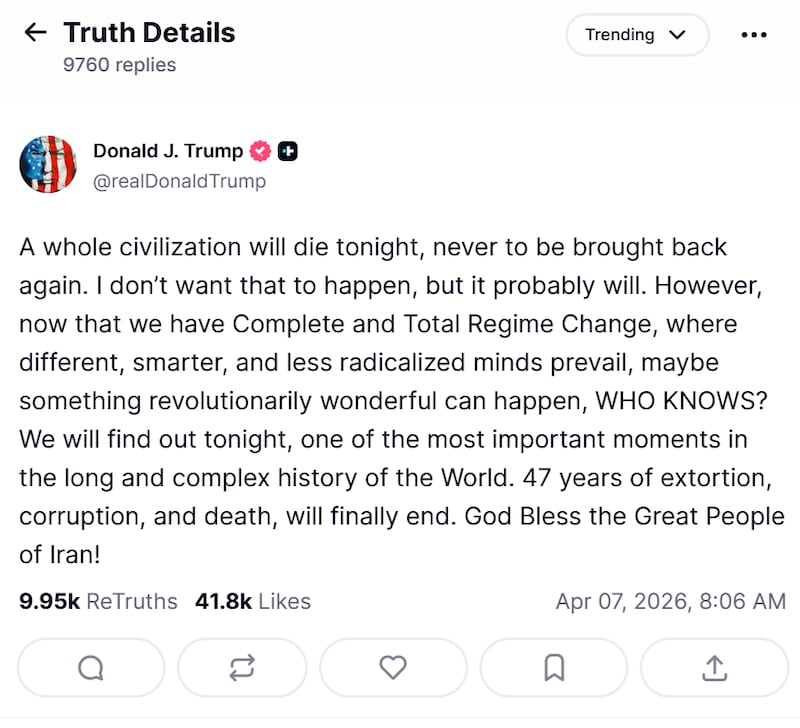
Rep. Mike Lawler, 39, found himself on the defensive Tuesday morning when CNN’s John Berman pressed him on Trump’s latest Truth Social post, in which the president warned that “a whole civilization will die tonight, never to be brought back again.”
Berman, 54, cut straight to it: If Trump, 79, follows through on his self-imposed 8 p.m. deadline, would Lawler support wiping out “a whole civilization”?
The Foreign Affairs committee member didn’t hesitate to condemn the genocidal threat—at least at first.
“No, I don’t support making a whole civilization die,” Lawler said, before quickly pivoting to defend the administration’s broader military campaign. “I do support what the administration has done over these past five weeks to decimate their capabilities.”
The New York congressman repeatedly framed the escalating conflict as a necessary effort to prevent Iran from obtaining a nuclear weapon, echoing the administration’s central justification for a war now dragging into its sixth week—despite earlier assurances from White House press secretary Karoline Leavitt, 28, that it would last no longer than four to six weeks.

Instead, the war is intensifying—and exacting a growing toll.
Oil prices have surged after Iran moved to close the Strait of Hormuz, a critical global chokepoint responsible for roughly a fifth of the world’s oil supply.
Berman wasn’t interested in letting Lawler hide behind talking points for the escalating conflict.
“I have a series of follow-up questions, congressman,” the anchor said, before Lawler cut in—attempting to steer the conversation away from Trump’s language and toward military strategy.
“The next step is to take action against their oil and civilian infrastructure,” Lawler said, adding that such measures are not “something we want to do.”
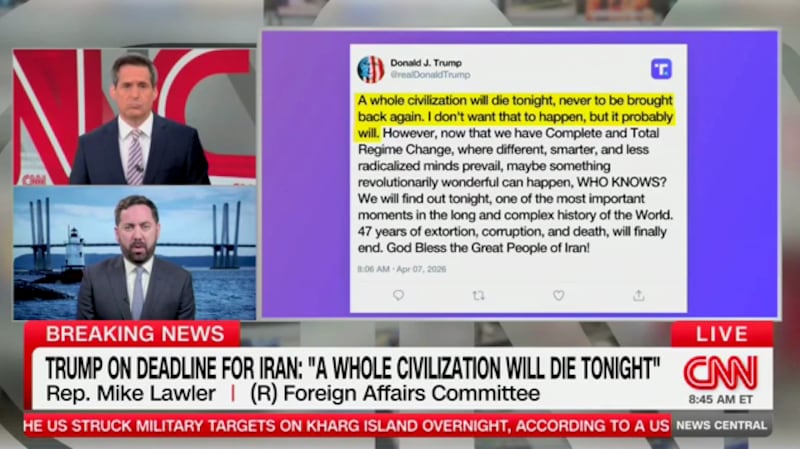
But Berman dragged the conversation back to Trump’s actual words.
“You say the president doesn’t want to do it,” he said. “Does being reluctant to end a civilization make it OK?”
That’s when Lawler took a more extraordinary turn—effectively arguing that Trump didn’t mean what he said.

“I don’t think we’re talking about ending a civilization,” he insisted.
Berman immediately pounced. “Do you not believe the president’s threat?” he asked, cutting Lawler off mid-response.
Cornered, Lawler acknowledged Trump’s rhetoric while simultaneously reinterpreting it, suggesting the president was really referring to strikes on “civilian infrastructure, including roads and bridges” aimed at crippling the Iranian regime—not annihilating its people.
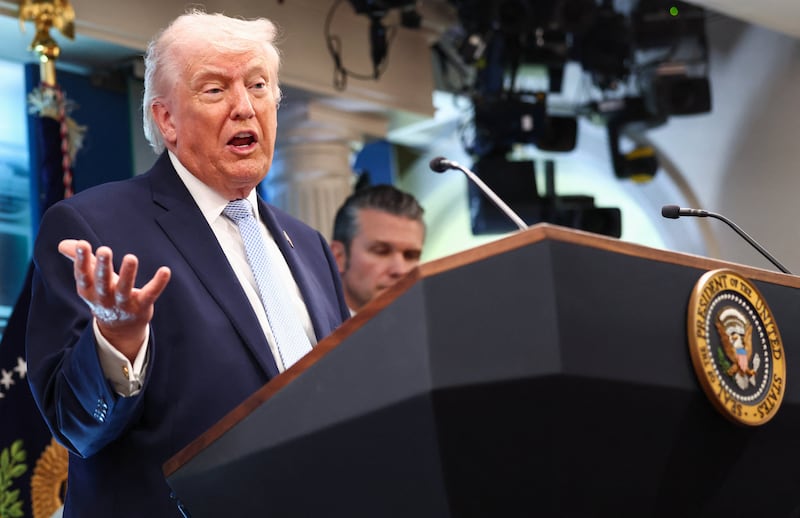
Berman followed up by zeroing in on the gap between Trump’s language and Lawler’s explanation.
“You don’t take him at his word that he will end a whole civilization,” he said flatly, pressing Lawler on whether he had any direct conversation with Trump to support that interpretation.
Lawler admitted he had not—but doubled down anyway, again asserting that despite the presidents explict words, “he’s not talking about obliterating innocent people.”
As Trump’s allies scramble to sanitize his increasingly extreme war rhetoric, Trump’s threats have only escalated.
In another Truth Social post over the weekend, the president declared on Easter Sunday that “Tuesday will be Power Plant Day, and Bridge Day” in Iran, before adding: “Open the f—in’ Strait, you crazy bastards, or you’ll be living in Hell—JUST WATCH!”
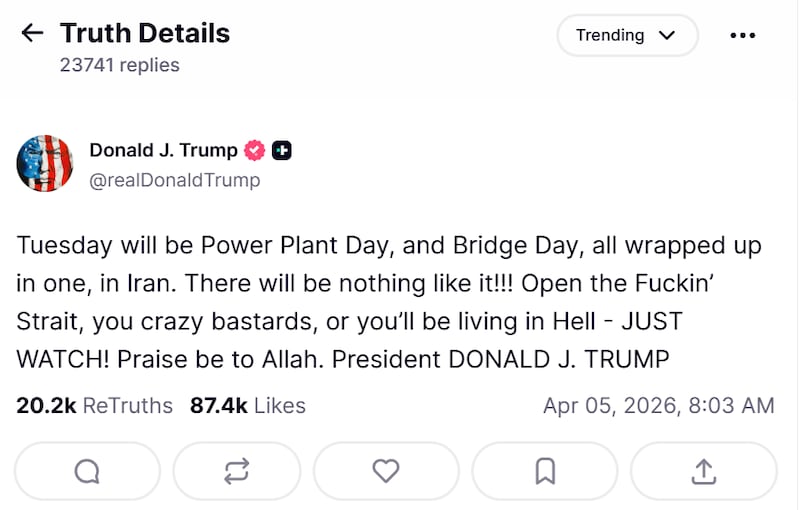
The language appears to be rattling even some of Trump’s usual Republican cheerleaders for the Iran war, with Sen. Ron Johnson, 70, among those openly hoping the president doesn’t mean exactly what he says.
“I am hoping and praying… this really is bluster,” the Wisconsin Senator said on Monday. “I do not want to see us start blowing up civilian infrastructure. I do not want to see that.”