Murdoch Paper Tears Into Trump’s New ‘Madness’
Trump is enjoying “showing off his new tariff bazooka,” the Wall Street Journal claimed.

via REUTERS
The Wall Street Journal’s editorial board has eviscerated the “madness” behind President Donald Trump’s economic policy.
Trump, 80, enacted a nearly 100-year-old tariff act to hit Canada with 50 percent levies on a plethora of goods, all because our northern neighbors hit the U.S. with retaliatory measures over Trump’s original penalty from March last year.

The mess was described as “senseless” by the Murdoch-family-owned paper’s influential board. “The more Mr. Trump keeps swinging recklessly, the more Americans are likely to think there’s only madness in his tariff methods,” it wrote in an opinion piece on Tuesday.

Canadian Prime Minister Mark Carney with Trump.
Jim Watson/Getty Images
Trump’s tariff war with Canada has unfolded in waves, turning America’s closest trading relationship into a tit-for-tat fight.
In February 2025, Trump announced plans for sweeping tariffs on Canadian imports, initially threatening a 25 percent levy on most goods before delaying implementation.
Sign Up for The Swamp Newsletter
By clicking “SUBSCRIBE” you agree to our Terms of Use and Privacy Policy.
In March last year, the U.S. imposed 25 percent tariffs on many Canadian goods, while applying a 10 percent tariff on Canadian energy products. Canada responded with 25 percent counter-tariffs on around C$30 billion ($21.28 billion) worth of U.S. goods.

By April last year, Trump’s separate 25 percent tariffs on imported vehicles took effect, hitting Canadian-made cars and trucks, though USMCA-compliant vehicles received partial exemptions. Canada later maintained 25 percent retaliatory tariffs on selected U.S. vehicles, steel, and aluminum.
Throughout 2025 and 2026, the U.S. kept additional tariffs on Canadian steel, aluminum, copper, and lumber, with duties reaching as high as 50 percent on some metals.
This month, Trump escalated the dispute again by announcing 50 percent tariffs on a broad range of Canadian goods, including wine, hockey sticks, and cement, accusing Ottawa of unfair treatment of U.S. farmers, automakers, and alcohol producers. Canada’s Prime Minister Mark Carney warned that “all options” were on the table as the two sides returned to negotiations.
This, the WSJ board wrote, is evidence of Trump enjoying “showing off his new tariff bazooka.”
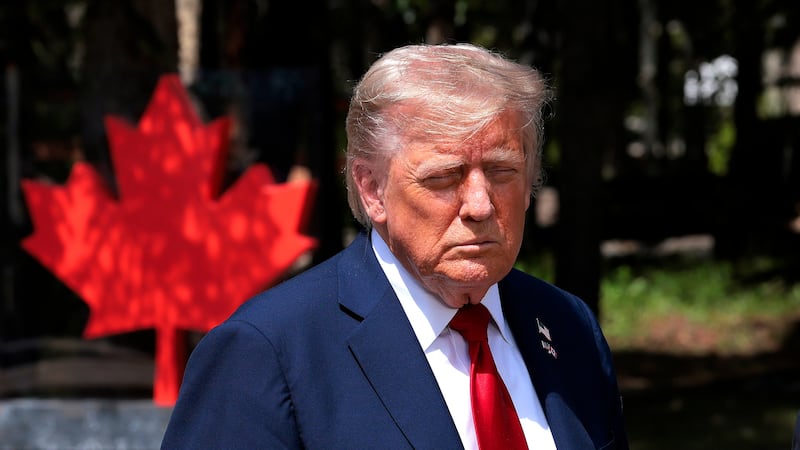
Trump has sparred with Canada throughout his second term.
Chip Somodevilla/Getty Images
The result is a trade war between two deeply intertwined economies, with Washington and Ottawa repeatedly using tariffs as leverage while trying to avoid a wider economic rupture.
“The trade brawl could leave both countries with more bruises than a hockey fight,” the WSJ board argued.
Trump’s latest tariff escalation followed an outing with Carney, 61, as the two watched the World Cup final between Spain and Argentina from a VIP box of New Jersey’s MetLife Stadium and later took part in the medal ceremony.
After returning to Joint Base Andrews from the game, Trump told reporters that he had a “good” conversation with Carney and said he complained about the smoke from Canadian wildfires drifting into the U.S.
“I told him, I mean, ‘You got to stop these fires from coming in and, you know, poisoning our air,’” the president said. He added that he has a “good relationship” with Carney before suggesting he could impose more tariffs to punish Canada over the wildfire smoke, a threat he had first made in a Truth Social post on Friday.
However, a senior Trump official told Axios that Monday’s new tariffs were unrelated to Trump’s earlier wildfire tariff threat, while noting that such measures remain on the table.
“President Trump’s use of Section 338 tariffs on Canadian imports are narrow, targeted, and in response to unfair Canadian trade practices that Canadian officials have failed to change over the past year during trade talks,” White House spokesman Kush Desai told the Daily Beast.
“No amount of armchair pontificating will deter the president from standing up for American workers and industries.”
See more of our coverage in your search results.

Got a tip? Send it to The Daily Beast here.
Register below to read this article for free or subscribe
to unlock unlimited access to The Daily Beast.
Monthly
$1
First month then $5.99/month
Annual
$35
First year then $59.99/year
Premium
$79
First year then $119.99/year
*Substack access provided by the next business day, using your subscription email. Choosing the Premium plan constitutes your permission to share your subscription email with Substack and your agreement to Substack’s Privacy Policy.
Already have an account? Sign In
Looks like you already have a subscription!
You're all set!
Thanks for subscribing.
Sign in or create an account
Login dialog
Loading comments…