
This piece first ran on the Obsessed by Kevin Fallon Substack. Subscribe here to read more like it!
Allow Julian Shapiro-Barnum to reintroduce himself.
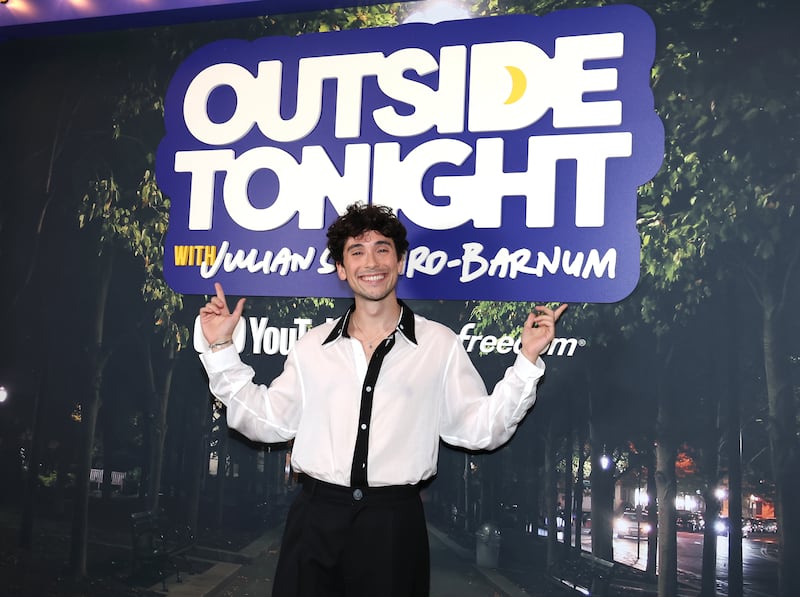
He may be the internet’s most viral host, with his hit digital series Recess Therapy and Celebrity Substitute—two adorable, hilarious, and sneakily profound shows that are essentially the digital age’s answer to Kids Say the Darndest Things. Now, the 27-year-old is manning a project a bit more grown-up, where he interviews actual adults, not just precocious grade-school kids, on the new YouTube series Outside Tonight, which he calls “the internet’s late-night show” and “the future of late-night.”
Addressing the audience who may only know him as the Recess Therapy guy at the show’s first episode, he says, if you only know him as the Recess Therapy guy, “All you need to know is that I’m a comedian, writer, 6’ 2”, 160 pounds soaking wet—which is always, dog uncle, love to party, mostly sober, poppers only, god-fearing with a single earring, unable to drive, willing to learn, very willing to dream. A passionate lover, and even more passionate about late-night television.”
He laughs when I bring up that humorous intro during our interview for the new episode of Obsessed: The Podcast. “I do know how to drive,” he admits. “We just thought that was funny. But, yeah, that’s me. That’s all you need to know. This was funny because, for the past five years, all I’ve done is interview kids. That’s what the public knows me for.”
For years, we’ve watched Shapiro-Barnum ask children questions about life, or interact with celebrities like Millie Bobby Brown and Tom Holland as they teach a master class to excited elementary schoolers. Now, it’s Shapiro-Barnum himself who is saying the darndest things.
Outside Tonight is an homage to the late-night genre that Shapiro-Barnum admires and respects, but completely upended to make sense for a generation that doesn’t just consume content differently, but also are inherently content creators themselves. That’s where the idea to film each episode outdoors in a different area of New York City came from.
“All these kids of the internet, we don’t dream of studio shows anymore because it feels very inaccessible to us,” Shapiro-Barnum says. “You go to Washington Square Park, there are many people with their phones filming things. New York City has become the studio, and I feel like I wanted to just lean into that because I love how accessible it is.”
Of course, it’s not just the al fresco venue that is setting Outside Tonight apart. Shapiro-Barnum represents a new kind of late-night host. The Jimmys Kimmel and Fallon, for example, aren’t disclosing their use of poppers in opening monologues.
Early episodes of the series have included a dog pageant to determine which entrant has the gayest vibes; a bit where celebrity guests had to determine whether audience members were drunk, high, overcaffeinated, or sober; a segment in which Shapiro-Barnum interviews a panel of people he went on dates with and then rejected him; and discussions of topics like sending nude photos, ketamine use, and his anxiety over whether he’s given enough b--- jobs to still consider himself bisexual.
I don’t recall Seth Meyers updating his guests on that.
Outside Tonight, then, raises a fascinating question: Is there room for young people—and the things they talk about—in late night?
“I was thinking about having my friends on and making something that I would want to watch,” Shapiro-Barnum says. “The show is, like, pretty goofy and queer. And there’s a lot of alt comedians in it, and it is pretty young. I think typically late night does speak to a much older audience. And my hope is that in welcoming these topics and these people and these ideas into late night, people my age will want to watch. Because I think everybody does watch late night, whether they realize it or not. Especially clips on TikTok and Instagram and YouTube.”
“Late night just like is so deeply ingrained in culture, and there’s all this conversation about late night struggling and are people really watching it,” he continues. “I think it’s struggling from the network level. But people are really, really always watching late night. I think what is happening is I don’t think late night is speaking to people in a way that it may be used to.”
The timing of the launch of Outside Tonight, then, is certainly conspicuous, coming just months after Stephen Colbert’s Late Show was canceled and Jimmy Kimmel’s series temporarily off air because of their respective political content.
“The topics that are being talked about on late night have gone in two directions,” Shapiro-Barnum says. “It’s gone either completely political, which I think is awesome and needed and cool, and it’s gone completely apolitical. And I think what Outside Tonight is trying to do is put on a really fun comedy show that has a clear, far-left heartbeat, but is talking about things that people actually care about and think about and do. The goal is to just like make something that resonates and without being try-hard.”
It’s not just late night, but across all media and culture, where the question of “how much Trump?” existentially weighs.
Whether you’re writing news articles, coming up with headlines, producing podcast episodes (hi!), or starting a late-night talk show, the Trump of it all is something to be reckoned with. Do you make your content obsessed with Trump, or a Trump-free zone? Because there are readers and viewers who will make your traffic spike through the roof if you talk about Trump, and there are people who don’t want to associate with that content at all, because they don’t want to think about that man.
“We weren’t like, let’s not talk about Donald Trump,” Shapiro-Barnum says. “I think the show has always been like a comedy show. I think comedy is political. I also think the bodies you choose to put in a show is political. And I think if you look at the stories we’re telling, the bits we’re doing, and the types of people who are populating Outside Tonight, to me, that is a political statement.”

“No, we weren’t, like, avoiding Trump,” he continues. “I also just didn’t want to talk about Donald Trump. It didn’t feel like the space to talk about that. There are other late-night shows that are doing that better and smarter. It didn’t feel like my arena.”
This arena, still, is a different one than his fans are used to seeing Shapiro-Barnum in. Suffice it to say that these topics we’re discussing and that are brought up on his show about politics and sex lives and partying and, frankly, all the things that a 27-year-old bisexual man in New York City should be preoccupied with, are not the same ones that come up in his viral interviews with children at the playground.
His personal life was never part of the conversation on Recess Therapy or Celebrity Substitute, and, as such, he kept his social media private as well, never posting photos from his actual life on Instagram. One of the reasons to launch Outside Tonight was to do a project that allowed him to be truer to himself.
Leading up to the show, he and his social media manager did what he jokes was his Disney kid, “Wrecking Ball”-era Miley Cyrus style of a rebrand, going in the opposite direction of what he had been comfortable doing by posting shirtless photos, a video of himself learning how to smoke a cigarette, and “all these thirst traps.”
Ultimately, he landed somewhere in the middle.

“In having the exercise of a fake rebrand, I felt like I was able to show people the more silly adult side of myself, and then it paved the way to being able to be more open and honest,” he says. “It felt like I broke out with a joke and then landed with a more true version of myself. And I like it.”
“I just feel like I was so careful for so long because, when you work with kids, I felt like there was this big exercise in getting people to trust me,” he adds. “I was a really friendly, kind person. But I feel like I’ve been doing this for so long that I’m not worried about that anymore. I know people know me. I think people know my heart, and I feel welcome and accepted. I work with the Department of Education at this point. I don’t feel like there’s this onus on me to do that anymore. Now I feel like I can do a show like this and still work with kids. And that to me is very freeing.”
It’s a really, for lack of a better word, adult way of viewing this point in his career. He’s still so young, of course. But he’s been a viral star for over five years, thanks to Recess Therapy and, now, Celebrity Substitute, which just had another major moment when Tom Holland was asked by a young student if he was married, rendering Spider-Man tongue-tied.
Maybe it’s because he’s worked so much with kids, but during our conversation and, especially, if you watch him on Outside Tonight, it seems like anxiety over aging is very much on Shapiro-Barnum’s mind. In fact, he’s even written a book about just that, coming out Aug. 4, called How to Grow Up Without Becoming a Grown-Up: Big Lessons From Little Kids.
“The reason I wrote a book is that I was starting to feel like more impactful than the things kids were saying was the way that kids were acting,” he says. “I feel like the way that kids move through the world and interact with each other and people and problems, to me, was really speaking volumes. That was the kind of stuff that I couldn’t condense to a one-minute clip. So three years ago, I started to work on some essays about all the ways that I felt like adults could be happier if they actively were like kids, and now I have a whole book about it.”
A book and a late-night show? Seems pretty grown-up to me.