Between the second season of Peacemaker and the one-two theatrical punch of Superman and Supergirl, the newly revamped DCU has gotten off to a decidedly cartoony start. Yet Lanterns, HBO’s Green Lantern-centric series, has helped alter that course, situating the franchise in a more grounded reality without losing any of its superpowered strength.
And with its bombshell-heavy finale, it completes a sterling first season that inspires newfound hope in the future of the comic-book universe.
[WARNING: Spoilers follow]
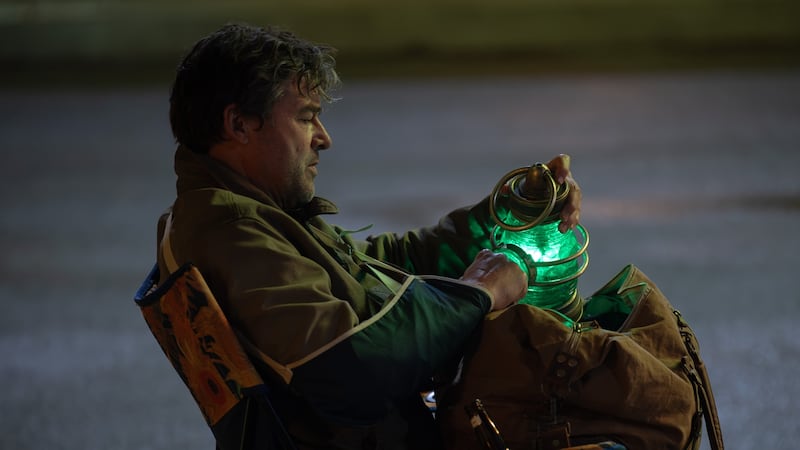
In Sunday night’s “Dirt and Stars,” Lanterns at last revealed the killer of Earth’s original Green Lantern, Hal Jordan (Kyle Chandler), to be none other than his sheriff girlfriend Kerry Kane (Kelly Macdonald), who shot him in a moment of protective maternal anguish and panic in order to cover up the fact that her teenage son Noah (Shea Pritchard) is Rushville, Nebraska’s second Manhunter.
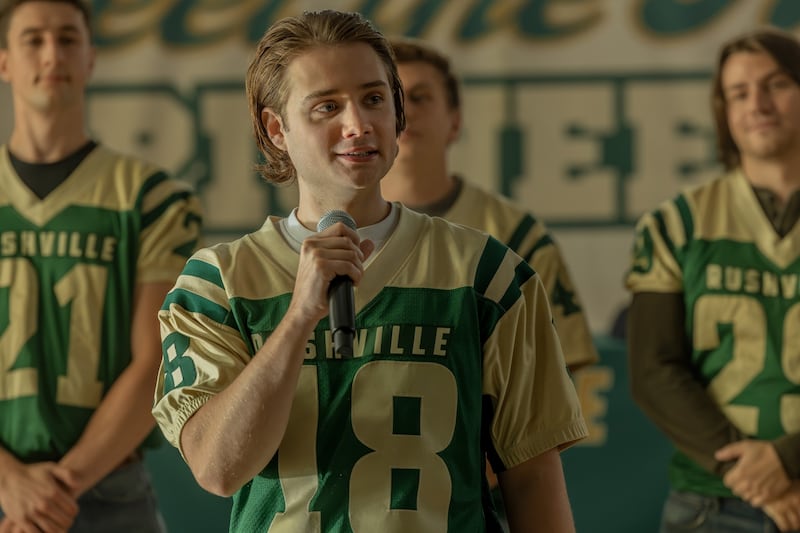
Noah, it turns out, was working with Sinestro (Ulrich Thomsen) on a plot to take revenge on the Guardians, and Hal’s discovery of this scheme was the catalyst for his demise. Consequently, it was up to Green Lantern-in-training John Stewart (Aaron Pierre) to try to stop Noah. Yet rather than using force, the military veteran put his trust in the alien boy’s ability to fight his toxic “programming” and choose his own destiny—all as he used Hal’s ring and a lantern crafted by Sinestro (for Noah) to become an independent Green Lantern.
Resolving its nature-vs-nurture tensions while also elevating John to proper superhero status, Lanterns’ conclusion wrapped up its overriding mystery in a way that spoke directly to its season-long concerns—a testament to the vision of creators Damon Lindelof, Tom King, and Chris Mundy.
Nonetheless, it left more than a couple of loose ends dangling, and what its tale means for the larger DCU remains tantalizingly unknown. Thus, we couldn’t resist sitting down with Lindelof, the mastermind behind Lost, The Leftovers, and Watchmen, to discuss the finale’s revelations and unanswered questions—including, most pertinently, whether a follow-up is in the cards and if the deceased Hal is destined for a resurrection.
First and foremost—are there plans for a second season of Lanterns?
I have created a silo of plausible deniability for myself that is actually genuine. While I remain very close to Chris Mundy, and definitely close to Tom [King], James [Gunn], and Peter [Safran], I can look you in the eye and honestly say that I do not know anything about the creative for a second season of Lanterns. However, I do know that there are conversations swirling around it, and I’ve read the same things you have.
Working here on the Warner’s Lot on my next HBO project, I’m in proximity to the individuals who are working on a second season, and I’ll tell you this, which is the thing of which I am most proud: nobody wants to do it just because the first season was successful. That is to say, everyone’s approaching it with the point of view of, should there be a second season? Is the creative worthy of a second season? That is very refreshing in this business, when something is successful, because automatically it’s like, let’s do a sequel.
They’re trying on different permutations of what a second season could be. But James and Peter, as well as Casey Bloys, Sarah Aubrey, and Joey Chavez at HBO—and particularly and most specifically, Chris Mundy—don’t want to do it unless it’s going to be awesome.
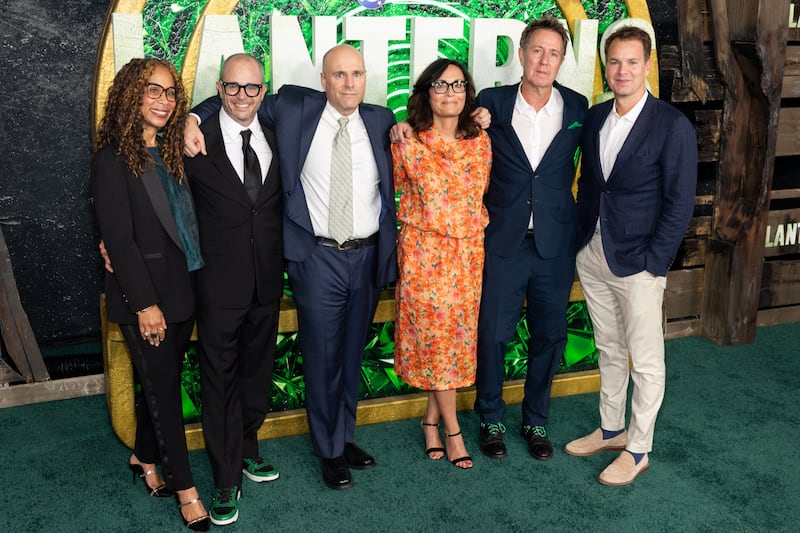
Lanterns is part of a larger franchise, and we know that Aaron Pierre is going to be in next summer’s Superman sequel, Man of Tomorrow. How much of that becomes a complicating factor in creating a potential sophomore season?
I definitely think it’s a complicating factor. I mean, everything’s complicated when you talk about anything with a “U” in it. [laughs] The DCU, the MCU. Because normally, the job, which is borderline impossible, is to just make 8-10 episodes of anything that is good. But then when it has to be interconnected with a U, that makes the job harder.
I will say that, fortunately, we were doing our Lanterns work at a time when the only piece of the U that existed was James’ Superman movie. Obviously, we inherited Guy [Gardner, played by Nathan Fillion] and talked about how to use Guy in our show. But James and Peter were like, we don’t want to inhibit you guys from what you want to do with Hal and John. “Help us help you” versus “Here are the things that you’re not allowed to do.” For example, when we first told them what our plan was for Hal, we thought, they’re going to fire us, and they’re not going to do it. But they both really responded to it, and HBO responded to it, even knowing what you now know—which is, it wasn’t a fake-out. We weren’t going to buy it back.
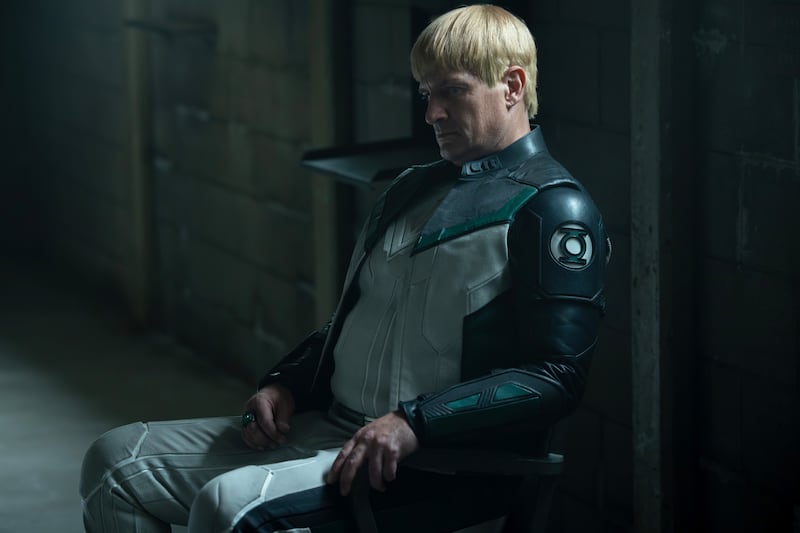
How concerned were you about the fan reaction to Hal’s death?
There may be part of the fan base that’s disappointed by that, but we felt like it would be infinitely more disappointing if we did a rug pull and were like, oh, he’s still alive. Like, Patrick Swayze has come back to life at the end [of Ghost], and he’s going to be with Demi Moore now, and he and Whoopi and Demi are going to go have a sandwich somewhere [laughs]. That movie only works because of the death, and everybody bought in on that idea.
There had to be an acknowledgment [from the studio] that the premise of the first season, which was a buddy show or a rom-com in the Lethal Weapon/Midnight Run model, wouldn’t be sustained moving forward because Hal was gone. The fact that they accepted that was really cool.
Nonetheless, there is some wiggle room with regard to revisiting Kyle’s Hal in one form or another.
A younger version of Hal Jordan still exists in a past version of the DCU. In James’s vision for the DCU, there have been superheroes and an understanding of extraterrestrial beings going back decades, so he can tell stories anytime in that space. Then, of course, we know that Aaron is appearing in Man of Tomorrow. So these characters exist in the movies as well.
There is a template for this: WandaVision, which is the first Marvel show as well as a sequel for Wanda to Infinity War and Endgame. And yet, there doesn’t need to be a second season of WandaVision. Now we’re going to get Vision Quest, and I don’t know if Wanda is in it or not, but what has it been—five years? It’s like, you tell the story you want to tell at the time you want to tell it, it defies the traditional understanding of a sequel (or prequel, or a second season), and it’s just called the character now.
I find it both more complicating and also exciting in its own way. I would watch a one-off season just called Snape, that was about Snape at any point in his life, and I don’t need it to interlock with whatever the new Harry Potter show is, you know?
You obviously planned to kill Hal and the Halogram at the start of this creative process, but does that decision get complicated by the fact that, once you begin shooting the show, it quickly becomes clear that Kyle and Aaron’s chemistry is off-the-charts great—and, thus, something you don’t necessarily want to end as quickly as you originally envisioned? Did any second-guessing come into play?
I love the way you phrased that question because the honest answer is yes to everything you just said. Yes, there’s second-guessing. The first scene we shot with those guys is the scene in the pilot where Kyle is the hologram, right after the car is crashed and John is quite put out. The moment they started talking to one another, Munday and Tom King and I just looked at each other and were like, oh, what have we done? [laughs]
The banter is great, but it’s limited in terms of, this is the grumpy grizzled one and this is the young idealistic one—especially once the series starts to show you who these guys are, why they want the ring, what the emotional conflict is between them, and also who they are independent of one another. Here’s who John is, and it has nothing to do with Hal—although Hal getting the ring is part of John’s origin story—and here’s who Hal was before he even knew John Stewart existed.
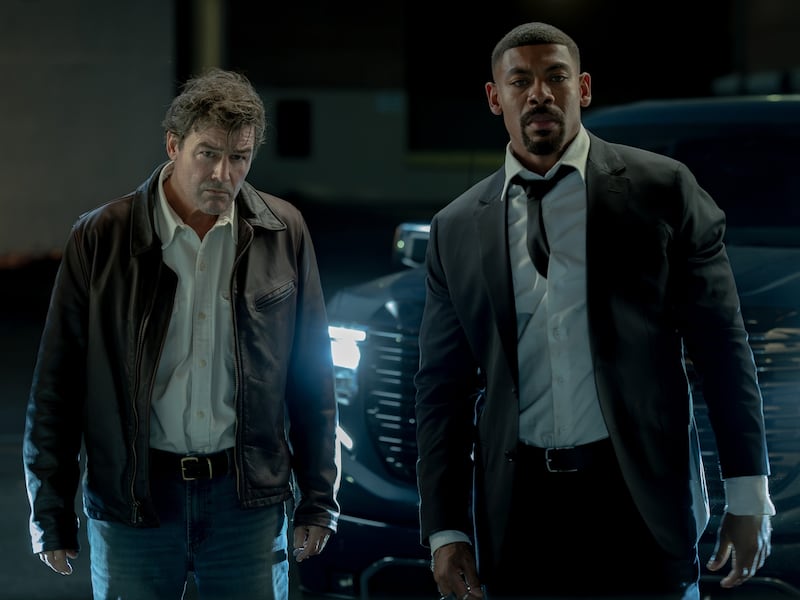
You start to realize that the banter is finite, and ultimately, the premise and the promise of the first season is, two guys, one ring, and only one of the guys is going to get it. And we knew that the guy who was going to get it was John.
That only leaves you with so many options.
What that leaves you with is either Hal is retiring, or one of them is already dead. It became more and more clear to us what the answer was, despite the fact that every time I watch the show and see Kyle Chandler, I’m basically, like, boy, did we fucking kill the Golden Goose? [laughs] The fact that we did makes us appreciate the gold, because there’s no more gold to be laid. There’s got to be some kind of hint of yellow in future seasons of Lanterns that I know nothing about. But yes, regret, second-guessery, and also a resignation and confidence in the original set of choices that we made so the show would be felt intensely.
While the finale brings everything to a self-contained close, certain elements remain open-ended, be it the fate of Sinestro or the nature of John’s new lantern. How much did discussions with the DC brain trust dictate those decisions?
I think Chris Mundy could answer that question more directly in terms of how many conversations he had with James and Peter. What I was experiencing was, if we had an idea that we felt might run afoul of whatever the larger plan for the DCU was, I ran it by Tom King, who had a foot in both worlds because he was developing Mr. Miracle and had an understanding of Supergirl as it was being written. We were told by James and Peter that our job was to just focus on Lanterns and not worry about anything else, and if anything was going to run afoul of and/or limit them in any way, Tom would let us know. And that did not happen.
I’m sure that was creatively liberating.
I think of when I saw Tim Burton’s first Batman film and when I saw Chris Nolan’s The Dark Knight film, where you’re like, they’re killing the Joker? I just met him, and they’re killing him in this movie? But it’s also immensely satisfying and forces you to move on to the rest of the Rogues Gallery. And now, of course, Matt Reeves gets to do his version of the Joker, and Suicide Squad gets to do their version of the Joker.
Killing Hal Jordan in this iteration of the DCU… I’m 53 years old, and I think this is my fifth formal iteration of the DCU in terms of television and filmed entertainment. As a comic book guy, there’s a grand tradition of a writer and an artist doing their run. [Brian Michael] Bendis was doing Ultimate Spider-Man for hundreds of issues, and Alan Moore basically just does three years of Swamp Thing, and others do a ten-episode run. Lanterns was part of my run. Some elements of season one move forward, but it could be handed off to an entirely new creative team.
Post-merger, who the hell knows what’s going on? Everybody assumes that James and Peter are still going to be the creative stewards of the DCU as long as they want to be. But you have to walk that line between absolute, sacred reverence for the canon and trying something original and new without that violating the sacred part I want to see as a fan.
That’s the eternal paradox, right? Fans want fidelity, and yet also complain if nothing new and exciting is brought to the table.
I don’t want to see the same old, same old. Let’s not just debate about what the costume looks like. Let’s talk about, are there new ideas here, or are we expanding upon old ideas, or are we bringing things that are the best parts of the John Stewart canon and tweaking the knobs a little bit of the Hal Jordan canon? Yes, Hal’s father has to die in a test-piloting accident, but can we change the context of the death so that it brings Hal and John closer together?
That’s the part where I feel like we were given a tremendous amount of trust and creative latitude from James and Peter and HBO. And that’s where it was really fun to play.
One of the tweaks I liked best in Lanterns was John becoming an agent of his own fate—which goes against the classic Green Lanterns-are-chosen tradition. Was straddling the line between honoring and altering conventions the most exciting aspect of the project?
The frame of your question makes me want to give you an answer that’s worthy of it. Here’s a trope: chosenness, which is obviously John’s nickname. The show wants to be aware of the trope, but the more interesting idea—embedded in the Williams sisters and Tiger Woods-style upbringing that John is subjected to—is that he has a manufactured destiny versus a destiny from the gods. He has to be convinced, like King Arthur, that he’s supposed to pull the sword from the stone. But he gets very confused, both as a child and then as a young adult, as to whether or not he wants it or it’s just something he was convinced that he wanted.
The only way for him to get any clarity about what he wants is to be in the desert for a while and live some life. That’s why we needed to do the time jump, where he gets to pursue the things he cared about, like architecture and art, after that box of crayons was subbed out for a sniper’s rifle. That’s a relatable concept for so many of us whose parents wanted us to be what they were (doctors, lawyers, construction workers, etc.) and how scary it is to break away from the family business. Also, as a Gen Xer, there’s the idea of getting into your 20s and going, what do I want?
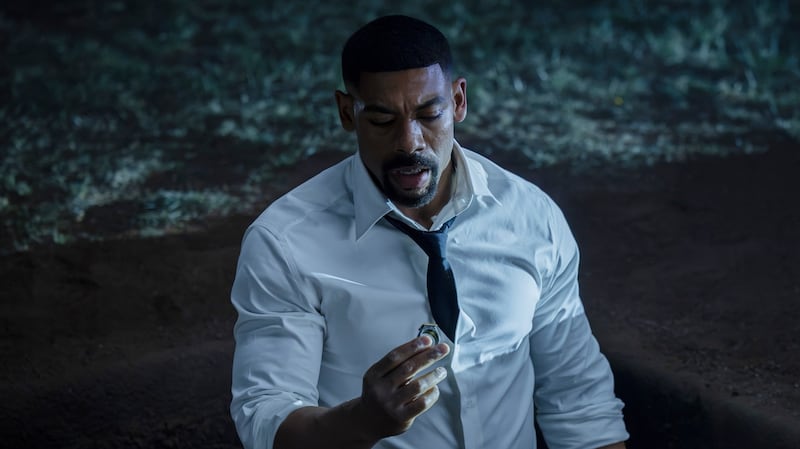
We loved the idea that all these things needed to happen in order for John to say, I think I actually want this ring now. I want to be the Green Lantern, and I want to do it on my own terms, not on the terms that my parents or the Guardians or even Hal Jordan laid out for me. That was always going to be on the right-hand side of the equal sign of our story and character equation.
How heavily do fans’ concerns prey upon you when you’re creating the show? And has it been satisfying that so many have responded positively to those changes—which I predict will also be the case with the finale?
This article will run after the finale, so I can only speak to the experience I’m having so far. And the feeling I feel is relief. I know this is nonspecific to Lanterns; I certainly feel this way most of the time inside a creative process. It’s just magnified when you’re doing preexisting IP or an adaptation. I felt it so intensely on Watchmen, and it’s correlative to your own relationship with it. Watchmen was tied to a text that I had a religious relationship with. I lived in a constant state of terror that we were going to screw it up, that we weren’t doing it right, that we were violating rules, or that Alan Moore or the the fans would hate it.
It’s so disingenuous to say, all that matters is that we like it. That is not true. Now, that’s all you can solve, because you’re the people in the room. But it does matter that you connect, especially with a preexisting fandom. This is not to disparage anybody who’s being introduced to the Lanterns canon for the first time through this show, but I care much more acutely about the people who have a pre-existing relationship and affinity for it. They feel protective of it, they care about it, and so if they feel like they’ve been done dirty—or even worse, that the show was made by people who didn’t really care about the characters and the canon the way they did—that’s the apple you have to shoot off the head.
Were there particular fears that plagued you?
Our fears manifested in different ways. Tom King’s were manifested through, are we violating the canon? Chris Mundy’s were, I’m not as familiar with Lanterns as I should be, and they’re going to smell it on me. And I was basically like, by some miracle people like Watchmen, but now I’m going to get killed on this one because how could it possibly work twice? [laughs]
We were scared all the time, and then you try to mitigate your fear by doing what Hal and John do, which is shake it off and manifest some constructs. When it aired, I was prepared for any and all of it; all responses are fair. You don’t want to be too thirsty, but even though we liked the show, we still hoped for it to connect. I’m the kind of person who, if there are ten social media comments and nine of them skew positive and one of them is, “How did you get this job, you hack?,” I go, that guy’s onto something! And it is a guy. I’m going to gender it.
Fortunately, it seems like those comments have been pretty rare.
I think the fandom is relieved too, right? The relief. We have high expectations for this thing. We care about it. So, if the people watching the show are relieved, then I’m certainly relieved.