
For all its merits, modern television is rarely aesthetically artful—which is what makes Lord of the Flies, a new four-part BBC-produced adaptation of William Golding’s seminal 1954 novel, so bracing.
Following up last year’s acclaimed Adolescence with yet another stinging psychological profile of young boys driven by terrible impulses to devious and destructive ends, Jack Thorne crafts a knockout with his latest miniseries (May 4, on Netflix).
Collaborating with director Marc Munden on a version of Golding’s familiar tale that’s visually and sonically rich and devoid of even an ounce of unnecessary preachiness, the esteemed writer once again proves that, in the right hands, TV is just as capable as its big-screen counterpart at evocatively showing as much as telling.
Buoyed by terrific performances from its pint-sized cast, it’s a powerhouse that does justice to the enduring literary classic.
Lord of the Flies takes few liberties with its source material, opening on a remote island where bespectacled Piggy (David McKenna) awakens, alone and confused. Exploring his tropical environs, whose rich foliage and abundant fruit are a source of fascination and temptation, Piggy finds another survivor of the plane crash that, it’s clear from the outset, has landed him in this predicament.
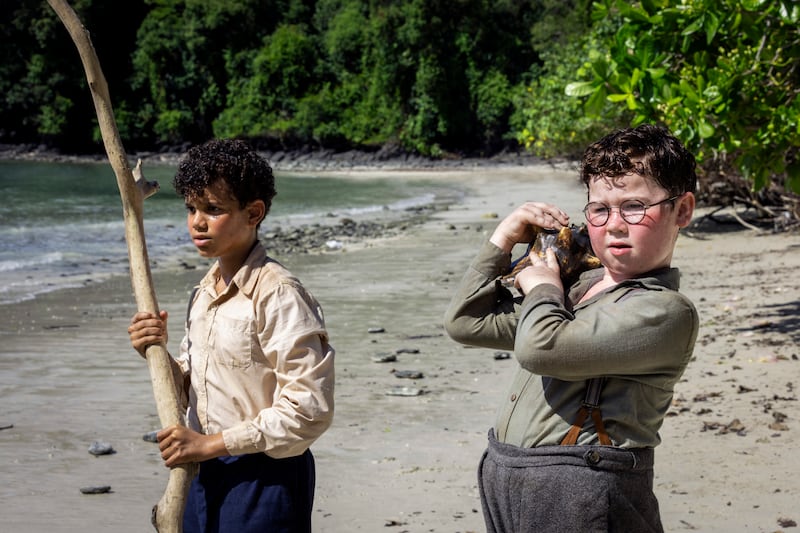
That boy is Ralph (Winston Sawyers), who quickly befriends him, agreeing to teach him to swim, and in the shallow water, Piggy discovers a conch shell that will soon become the focal point of their, and everyone else in this mysterious locale’s, subsequent ordeal.
Blowing the conch attracts the remaining kids, including a collection of robed choirboys led by the haughty Jack (Lox Pratt), who more than slightly resembles Harry Potter nemesis Draco Malfoy.
As he does throughout the series, director Munden employs intense close-ups of these children’s muddy, shellshocked, upturned faces. He establishes an additional recurring visual motif with the introduction of Jack and his fellow singers, who emerge from a fuzzy, slow-motion haze that conveys a sense of bewilderment and menace, which only grows graver as these stranded youths attempt to figure out their initial course of action.
First and foremost, that involves choosing a leader, and in a majority-rule vote, Ralph wins, much to Piggy’s delight. This despite the fact that Jack mocks him as “fatty” and, in response, Ralph reveals—against Piggy’s stated wishes—his hated nickname.
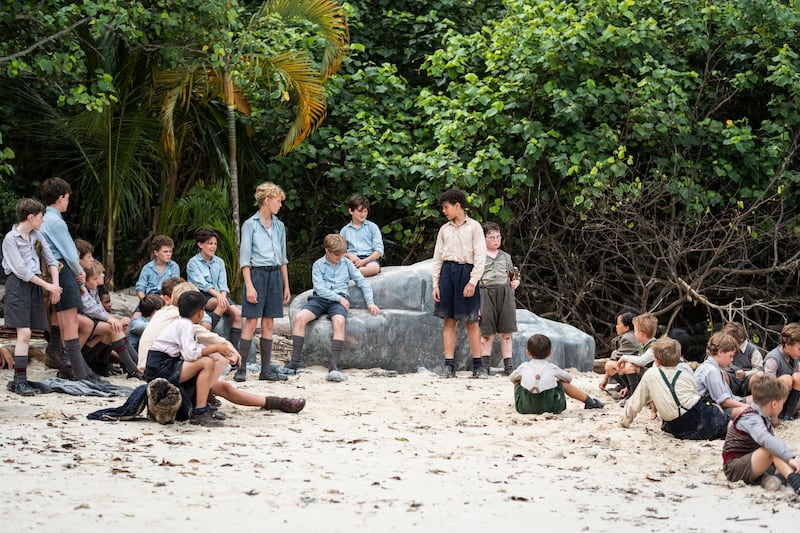
From the start, this group’s dynamics are easy to discern, with Piggy the intellectual who’s derided and devalued because of his physical appearance, Jack the handsome, fair-haired bully who commands the respect of his fellow jerky acolytes, and Ralph the relatively stable, middle-ground good kid trying to bring equilibrium to these topsy-turvy circumstances.
Shot on location, Lord of the Flies immerses viewers in this hostile milieu, and director Munden’s pans across thick jungle, rugged beach, and perilous mountaintops lend the material its ominousness. So too does a score by Benjamin Britten, Hans Zimmer, and Kara Talve that blends discordant, anxious strings with ominous and angelic choral music to a hauntingly operatic effect.
An air of doom encases the proceedings, with Jack agreeing to Ralph’s election and stating that he and his choral mates will serve as the community’s hunters. It further escalates when, during their maiden exploration, they come upon a dead pilot strapped to a plane seat, and Jack promptly rolls him off a high embankment to the ground below, justifying this heartless conduct by stating, “We say it matters, what one does and how one does it.”
While Piggy cares about creating shelters and toilets, Jack has other priorities, and it’s not long before commonly held norms begin to decay. Lord of the Flies hews closely to Golding’s original, detailing the step-by-step breakdown of enlightened morals and customs that’s fueled by Jack, who eventually decides that he’s had enough of Ralph and Piggy’s “boring” grown-up behavior and sets up his own fun “adventure island” camp where the boys can indulge in unchecked savagery.
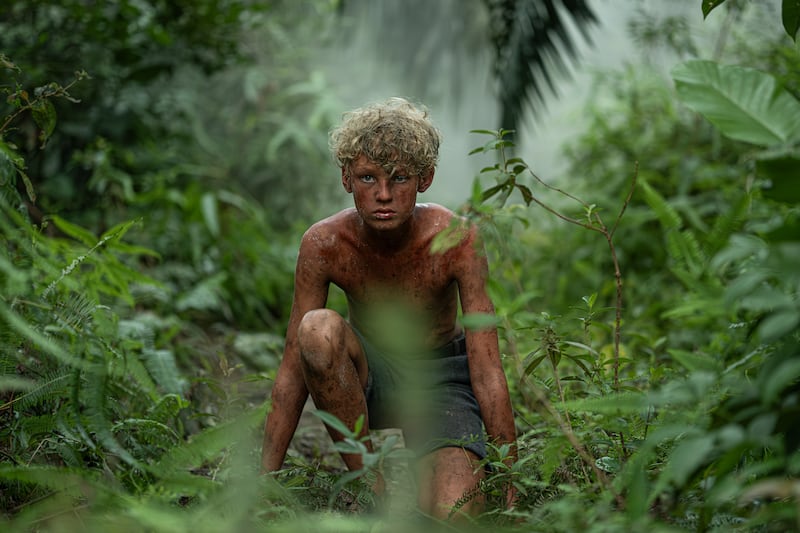
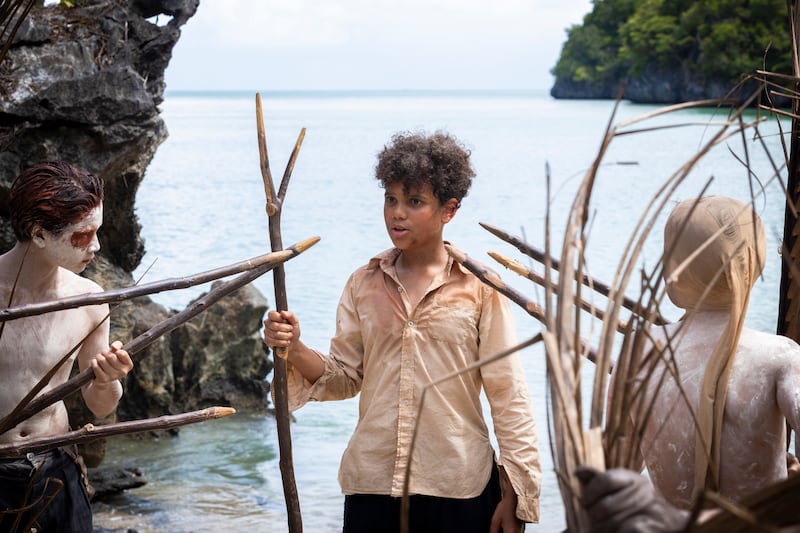
Thus, the series clarifies its central conflict between civilization and anarchy, with Ralph and Piggy left to fight for the former on behalf of the “littluns” in their charge, and Jack resorting to primal viciousness, complete with crude war paint and scary homemade masks.
Madness flourishes in Lord of the Flies, such as in the heart of Simon (Ike Talbut). A chorus member with a complicated connection to Jack, who opts to side with Ralph and Piggy, Simon’s dwindling grip on reality—rooted in his investigation of the “beast” that the tykes believe roams the island—is dramatized with hallucinatory fuzzy-red malevolence.
In one of the series’ many striking compositions, the director imagines the boys walking along the beach holding hands in distinct The Seventh Seal terms, underscoring the dance of death these prepubescent individuals are inadvertently performing. At the same time, though, Thorne and Munden let their actors do much of the heavy lifting, with McKenna and Pratt delivering standout turns that get to the heart of the story’s caustic critique.
Intermittent flashbacks to some of the boys’ pre-calamity lives provide insight into their present-day decisions and instincts, but Lord of the Flies doesn’t overdo it in that regard. Instead, it strikes a confident balance between delineating its characters as unique, three-dimensional creatures and using them as proxies for its broader sociological examination of mankind’s nature.
As impressively, Thorne maintains empathy for most of his primary players—including Jack—for the majority of his four hour-long installments, avoiding easy villainization to deliver a nuanced and affecting look at the roiling internal forces driving his devolution into feral brutishness.
At least on par with Peter Brook’s 1963 feature-film version, this Lord of the Flies gains power by avoiding contemporary updates or distracting additions. Even at its most self-conscious, Munden’s exceptional stewardship evokes both these protagonists’ struggle to stay true to themselves and their ideals and, conversely, their transformation into their base selves. A portrait of the thin line between order and disorder in society and in man’s (and kids’) heart, Thorne’s latest is as assured and compelling a nightmare as his award-winning Adolescence—and even more chilling.