In the new romantic comedy One Night Only, it’s been three years since the United States outlawed premarital sex. According to the opening titles, “it’s been a lot.” Frankly, that’s a serious undersell.
Imagine it: a world where sex is banned for unmarried people. It would be chock-full of the angriest, most frustrated, pent-up people you’ve ever seen. America would be plunged into an apocalypse-like state at the snap of a finger.
This is a film that takes a high-concept and treats it like any other law. One Night Only takes place in a sex-free New York City, but the city itself hasn’t changed. Well, it’s uglier, but that’s attributed more to the film’s flat, unenticing visual language that makes it look more like a commercial than a movie rather than the fact that there’s no more sex.

There is an exception: One night a year, the ban is lifted. For 12 spectacular hours, the singles of America can have sex with anyone and everyone they want (as long as it’s consensual, of course). The only stipulation is that condoms must be used. It’s like The Purge, but horny.
Owen (Callum Turner), a pizza shop owner, is ready to surprise his girlfriend Malika (Maya Hawke) with a marriage proposal to celebrate their night of intimacy. But Malika has plans of her own, and wants to sleep with another man. According to her, Owen is too “programmed” and needs to get out of his carefully curated box.
Then there’s Allie (Monica Barbaro), a single gal in the big city who sings jingles for medical ads for a living (one for something called Vag-a-Clear to the tune of “A Thousand Miles” is hysterical). She’s a daydreamer, a free spirit, and the opposite of Owen. Unlike millions of singles just looking to get laid, Allie wants to find her special someone.
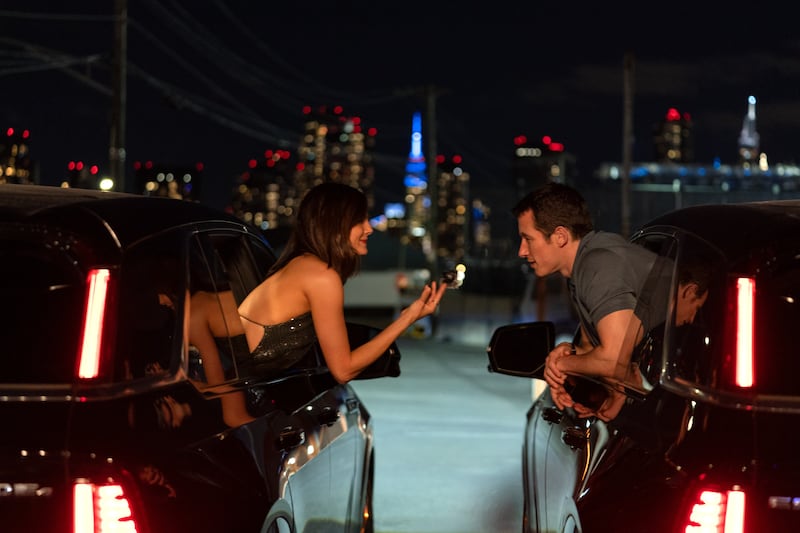
The two have their meet-cute bumping into each other in the street. Or at least it was cute, until Owen throws up all over the place.
One Night Only has a lot of fun taking familiar tropes of the genre (including a great take on the karaoke cliché) and twisting new life out of them. The film moves at a blistering pace, and there are some great jokes. And Barbaro is fantastic, taking a frustratingly thin character and breathing life into her. She reminds us why she picked up her first Oscar nomination for A Complete Unknown. Doing what she does with Allie, it won’t be surprising if more noms are in her hopefully bright career.
There are a ton of questions that come with a law that bans sex. How do you enforce it? How can you tell if people are using condoms? How do they decide which day to let people go at it? Why aren’t more people rallying against the law? If condoms are legally required, why does so much of the movie revolve around people trying to find condoms? Why aren’t more condoms available? Everyone knows which day the sex is legal—why didn’t people get condoms ahead of time?
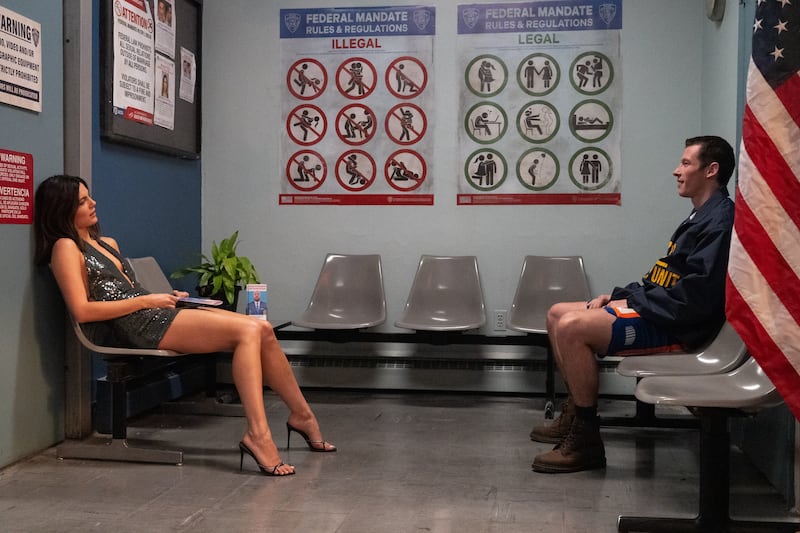
Some of these questions are answered, but they mostly lead to more questions. It makes everything so much more confusing than it needs to be, turning what should be a fun, breezy rom com about sex into an enigma wrapped in a mystery.
There’s various posturing about how this law came into effect. Two characters argue about old men who happily enacted laws that don’t affect them. It all boils down to a riff on an old 30 Rock joke between Tina Fey’s Liz Lemon and Jane Krakowski’s Jenna Maroney:
Liz: “Do you want a bunch of old men behind closed doors deciding what you can and cannot do with your body?”
Jenna, excitedly: “Ooh, and how do they tell me their decisions? Do I get shocked whenever I do the wrong thing?”
I’m not going to spoil the movie for you, but the most baffling thing about it is that it very weirdly—and very uncomfortably—seems to have a worldview more aligned to Jenna’s unhinged response than you’d expect.
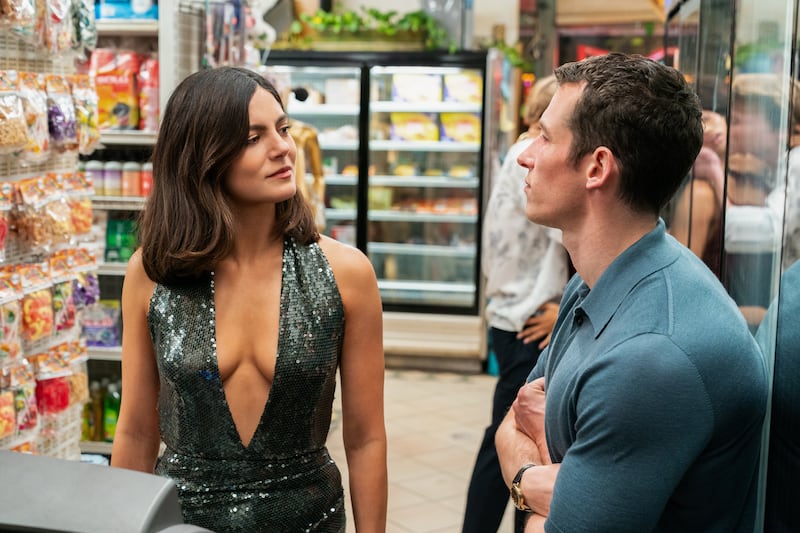
A congressman in a TV interview explains why the law is working: STI’s are all but eradicated, teen pregnancy is practically non-existent, and it’s become a badge of honor to be an incel.
These are all regarded as equally positive, with no further interrogation of these ideas whatsoever. Apparently the sex ban doesn’t cause a rise in any untoward behavior (except, you know, incels) either. One Night Only genuinely suggests that banning people from having sex is a good thing!
I know what you’re thinking: it’s a rom-com! Who cares about the politics of it? That’s a valid question, but the answer is that the movie seems to care a great deal. It’s constantly reminding you of them.
At one point, Allie asks a police officer, “Where’s your conscience?”
“With my pension,” the officer responds.
There are mentions of specific politicians (like Obama, but not Trump). There are benefits to fighting against the law. Posters for and against the ban can be seen around the city.
One Night Only could be a great romantic comedy. But its characters are thin, it’s drowning in a sea of product placement, and it’s far more interested in throwing them into one wacky situation after another than it is in making them feel like real people.
Its underdeveloped yet overwhelming politics feel hackneyed to the point of exhaustion. At least the incels will be glad to get such a positive shout-out.