“I don’t tell people not to be offended,” proud provocateur Ricky Gervais claimed ahead of his latest Netflix original. “I tell them I don’t care if they are.”
Alley Cats, essentially a misanthropic, suburban Homeward Bound in animated form, suggests he’s also stopped caring about nuance, purpose, and writing any “jokes” that don’t substitute a punchline for the “c-word.” In fact, the most offensive thing about his six-part series, a point further emphasized by the 25th anniversary celebrations of his mainstream breakthrough, is its sheer laziness.
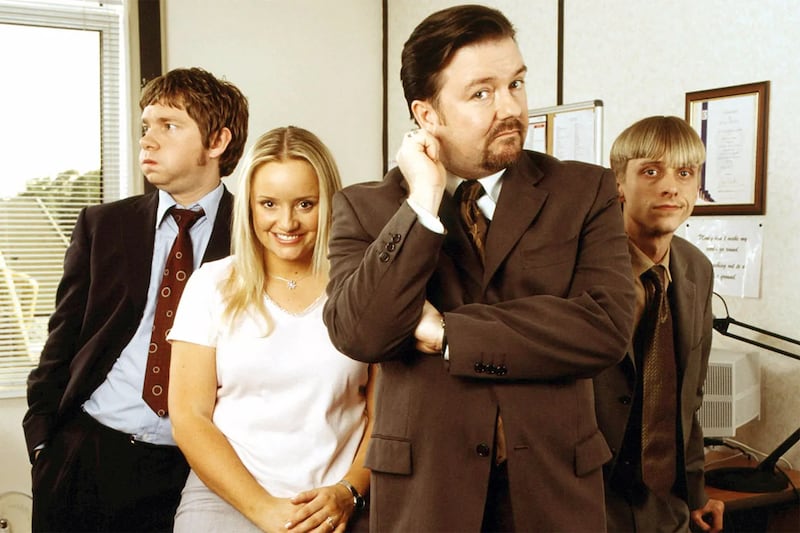
The Office, which Gervais curiously chose to commemorate alone instead of contributing to a BBC retrospective, reframed the capabilities and conventions of the modern sitcom before spawning one of the most successful transatlantic adaptations in TV history. It perfectly captured the drudgery and minutiae of the 9-to-5 while recognizing it as a prime source of humor. It somehow imbued characters with warmth and humanity that, in real life, you’d cross the road to avoid. And it engineered an excruciating, but entirely deliberate, new level of cringe that compelled you to watch through your fingers.
For many, it’s the first comedic masterpiece of the 21st century.
Showbiz satire Extras, and particularly its glorious state-of-the-nation Christmas special, immediately proved Gervais was no one-hit wonder. Unfortunately, however, he’s since adhered to the law of diminishing returns, flitting between self-congratulatory stand-up specials that thrive on punching down, pale retreads of former glories (Life’s Too Short, David Brent: Life on the Road), and sitcoms that mistake over-sentimentality for pathos (Derek, After Life).
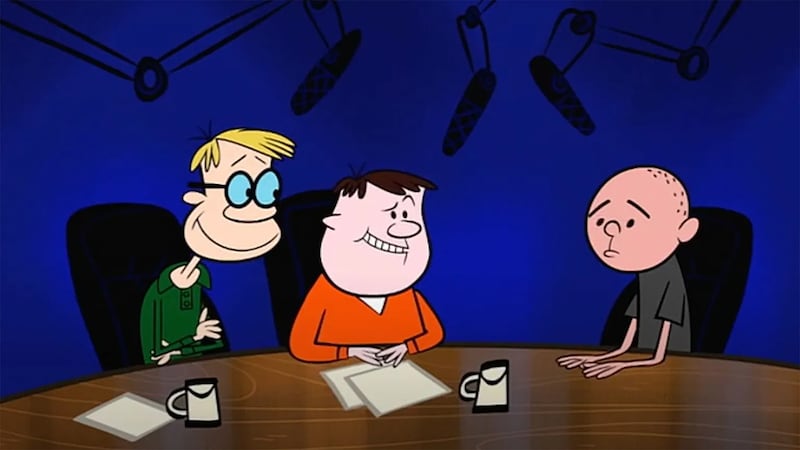
Alley Cats has more in common with the latter than his previous cartoon series The Ricky Gervais Show, which animated the self-described “pointless conversations” from the same-named podcast that gave us Karl Pilkington. The new show desperately searches for profundities on life but instead ends up resembling the trite slogans you’d find in a big box store’s wall art aisle (“We live on in the memories of our friends and families,” “Life is a gift”).
Scenes involving euthanization, a hit-and-run, and an unvaccinated cat also enable Gervais to address his favorite topic of atheism with the subtlety of a sledgehammer (“What God would make a little kitten this ill?”). And his nihilistic streak is manifested in several characters’ “watch the world burn” mentality and the closing line of, “We’ll all be dead soon.”
The soundtrack throws up few surprises, too. Given his past as a new romantic pop star and music supervisor, you’d expect Gervais to do a little more crate-digging. But he continues to rely on the same small jukebox of artists (Cat Stevens, James Taylor, Coldplay) to heavily signpost “this is where you’re supposed to feel things.”
Even when he does stray from the norm, he aims for the bleeding obvious. The gang’s central quest to reacquaint a lost kitten with her family home begins with a neighborhood walk set to Vanessa Carlton’s “A Thousand Miles.” And The Smiths’ “There Is A Light That Never Goes Out” gets the literal treatment, playing over a first-date montage that ends with one puss nearly getting killed by a “10-ton truck.”
There’s a similar “this will do” approach to its voiceovers. Gervais specifically directed the cast, who, as the remarkably smug teaser trailer points out, are composed of After Life regulars, to speak in their natural, unaffected manner to maintain a sense of realism (exactly what you want from a cartoon about anthropomorphic felines). However, the likes of Diane Morgan, Tom Basden, and Andrew Brooke sound thoroughly bored throughout, no matter whether the gang is getting spooked at the sight of cucumbers or tripping balls on catnip.
Furthermore, you’re always fully aware that leading tabby Gus is simply a mouthpiece for Gervais rather than a new creation worthy of joining Stimpy, Gumball, and Garfield in the upper echelons of cartoon TV cats. Yes, turns out he, too, is also a straight shooter with a deeply buried heart of gold!
Still, at least that makes him more multi-dimensional than his pals. As their on-the-nose names suggest, David Earl’s Puke is the kind of flea-infested, sexually depraved stray you feel itchy just watching. Basden’s Ponce is a spoiled pedigree who, much to the group’s annoyance, repeatedly attempts to improve the gang’s booksmarts. And Brooke’s Fang is a gluttonous bruiser who encourages Gus to lean into his meanest impulses, none more so than when they plot to kill a fat kid for shits and giggles (“Have another bit of cake. Yeah, shove it down your f---ing throat, you little foie gras fatty f---er”).
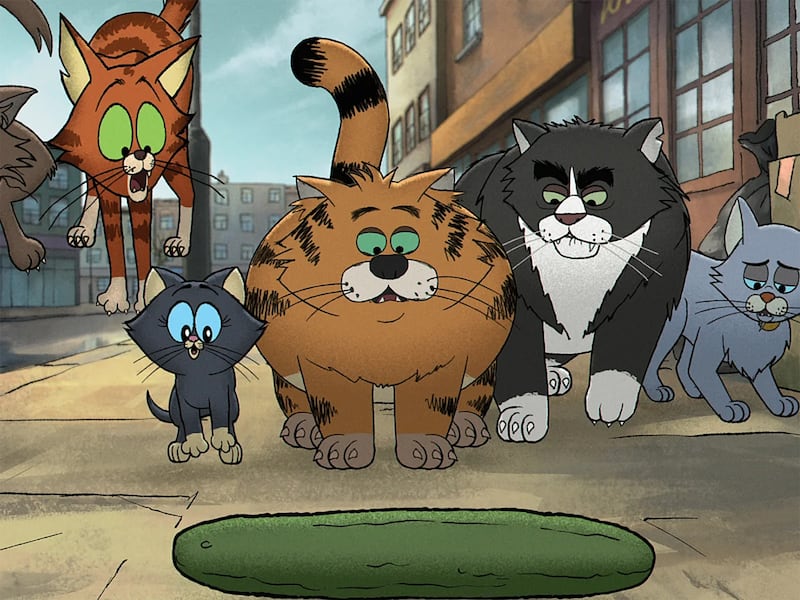
Despite such easily defined personalities, the show still struggles to get a grip on them. Morgan’s Olive, for example, is introduced as a scatterbrain who makes Philomena Cunk look like the head of Mensa. Yet later, she’s somehow able to correct Puke that urinating only helps to heal a jellyfish sting, not an allergic reaction. It’s a minor quibble, for sure, but indicative of how much Alley Cats appears to be phoned in.
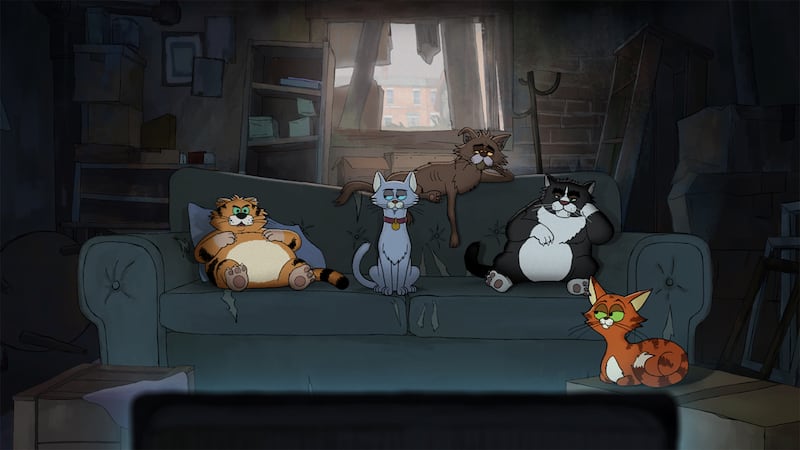
Even the insults, typically bandied about as the gang watches TV from the comfort of their decrepit, abandoned hovel, feel half-hearted. Whether they’re mocking Ponce’s real name (“Rupert the Bear? More like Rupert the C---”) or berating snails (“It’s a f---ing bit of snot in a f---ing shell, innit? C---”), there’s little wit or imagination on display. It’s little surprise to learn the dialogue, recorded before a single frame was drawn, was heavily improvised.
Indeed, Gervais appears to believe there’s still shock value in “cutesy animals saying the naughtiest things.” Yet arriving more than a decade after the depraved narcissism of Bojack Horseman and more than 20 years after the devil-worshipping Woodland Critters of South Park, there’s no longer any novelty in a bunch of animals talking like Andrew Dice Clay. Premiering several months on from Prime Video’s Kevin, it’s not even the first, or best, “cats go rogue” adult animation this year.
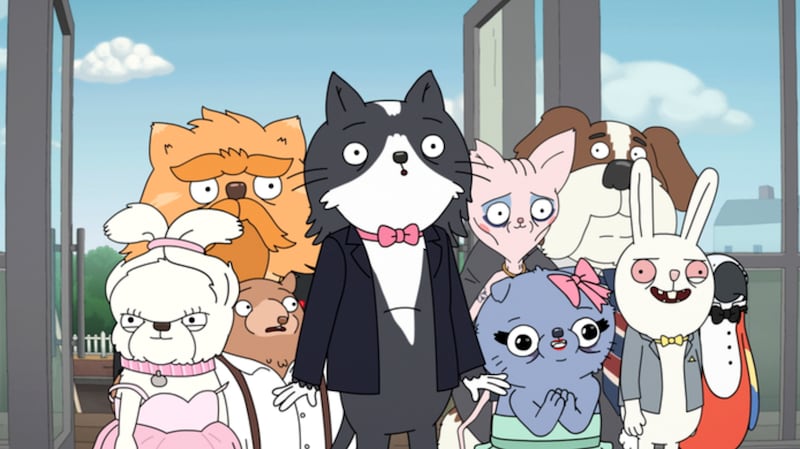
Still, at least Gervais largely avoids the anti-woke rhetoric that’s dominated his stand-up sets over the past several years. Although there’s the occasional politically incorrect rant and a few near-the-knuckle quips involving AIDS and the building capabilities of third-world countries, Alley Cats wisely swerves the hot-button issues you might expect.
There’s none of the “I identify as a cat” jokes you’d expect to have been an open goal, for instance, and there’s only a hint of self-pitying about cancel culture. (“Suddenly all your opinions are out of date and everyone finds you offensive,” Ponce remarks about getting older.)
Perhaps Gervais is maturing after all.
He certainly appears to be a little more self-aware. “A lazy, rude, opinionated creature with fangs, who’s not as smart or brave as he thinks he is,” is how he’s described his role. “So quite a stretch.”
Acknowledging that you’re coasting, though, isn’t a get-out-of-jail-free card. Gervais acolytes will no doubt lap it up. But it’s unlikely many will still be purring about Alley Cats in a year, let alone 25.