The Least Famous ‘Odyssey’ Star Gives Its Best Performance
In a film that features the world’s biggest movie stars, one underrated actress outdoes them all.

Melinda Sue Gordon/Universal Pictures
It’s only fitting that an actress playing a powerful sorceress delivers The Odyssey’s most bewitching performance.
By the time the Greek king Odysseus (Matt Damon) and his crew dock at the island of Aeaea in writer-director Christopher Nolan’s take on Homer’s epic poem, they’re exhausted and starving. Their fellow soldiers have been decimated, first by the cyclops Polyphemus and then by a violent tribe of attacking giants on the stops they’ve made thus far. They’re also lost at sea.
Taking the winding route back home to Ithaca from Troy has led them into uncharted territory—in more ways than one.
As Odysseus sets off with his bow, promising to hunt down dinner for his men, the rest of them make the long trek inland, heading for the isolated cottage they’d spotted smoke rising from. And that’s where Circe, played by British actress Samantha Morton, 49, finds them when she returns home.
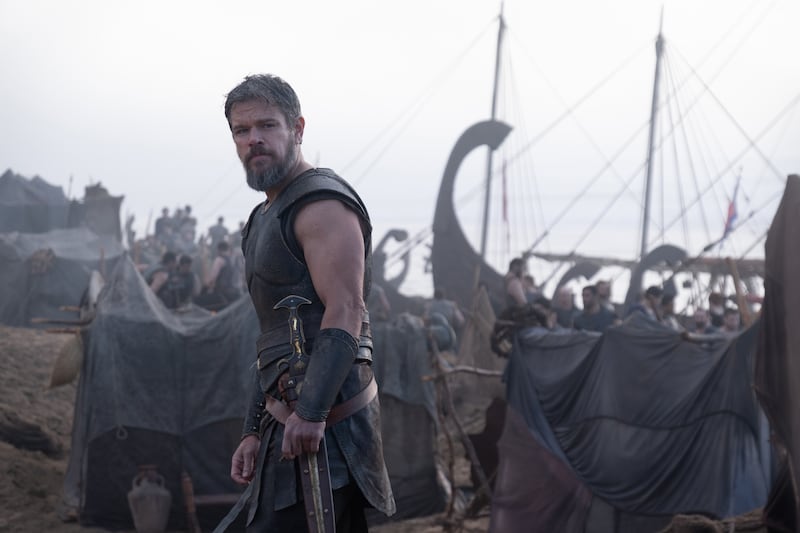
Matt Damon is Odysseus in THE ODYSSEY, written, produced, and directed by Christopher Nolan.
Melinda Sue Gordon/Universal Pic/Melinda Sue Gordon
Terrified at the sight of these strange men, all of whom are armored and bear weapons, she reflexively flees, pleading with the pursuing Eurylochus (Himesh Patel) not to hurt her. He’s framed as looming above her, a visual that makes her appear even more vulnerable. The men won’t hurt her, he promises. All they want is some food.
When Circe persuades them to leave their weaponry and armor outside in exchange for a meal, the camera lingers over the site of previously discarded arms, half-covered by the growing grass. It’s the first sign of trouble. Why weren’t these retrieved by their owners? What happened to them? It doesn’t go unnoticed, but gnawing hunger wins out over fleeting worry. Then the men settle down with bowls of steaming meat stew.
Get the best of Obsessed delivered right to your inbox
By clicking “SUBSCRIBE” you agree to our Terms of Use and Privacy Policy.
As they eat, however, the dynamic in the room gradually shifts. “Why do you have so much meat?” Eurylochus asks, only now realizing how odd it is that someone who lives alone should have such a disproportionate quantity of food.
“You never know when strangers will come,” Morton’s Circe replies, in a tone that suggests she knows exactly how to deal with them when they do.
The soldiers go from ravenously devouring their meal to being seemingly unable to stop. Their eyes grow pained. The earlier grunts of satisfaction now sound like choking.
“Too much is never enough,” Circe continues, seemingly answering Eurylochus’ question but mocking the men’s boundless gluttony at the same time. As she moves around the table, she refashions the soldiers into the animal most suited to reflect their sloppy, base attitudes.

Zendaya appears as the goddess Athena opposite Matt Damon in “The Odyssey.”
Melinda Sue Gordon/Universal Pic/Courtesy Universal Pictures
Speaking to The Hollywood Reporter about how she approached the role, Morton said, “I could identify with her. She felt like my sister, my mother, my gran, my aunt, my neighbor.”
“She just feels so whole, so fully realized yet you’re not there with her for an incredibly long amount of time,” she added. “But it doesn’t feel rushed. It doesn’t feel forced. It feels that she’s every woman. She’s all of us. I just really connected with that. I thought that I would bring, for want of a better word, myself into it. I just wanted to own it. I wanted to possess it and own it and be it.”
If most audiences recognize Morton, it’s probably from her role as the “precog” Agatha in Steven Spielberg’s Minority Report (2001), in which she more than held her own against Tom Cruise after his character kidnaps her. She has earned two Academy Award nominations for her supporting work in Woody Allen’s 1999 comedy Sweet & Lowdown, and then for playing the lead in Jim Sheridan’s In America (2003).
Morton has worked consistently in the decades since, including small but pivotal roles in 2022’s The Whale and She Said. But it’s been a long time since the BAFTA-winning actress has been given a showcase for her abilities like this one.
In The Odyssey, she not only anchors Nolan’s first full-blown body-horror sequence—spoiler alert: she turns the men into pigs—but also undergoes her own transformation, her demeanor morphing from a frightened woman to a powerful witch.

In contrast to their terror, she moves with the calmness of a sculptor at work. While she molds the men’s faces as though they’re made of clay, traces of exertion only appear when she pulls their jaws into a snout or, more horrifyingly, shoves a hand down their throats.
When Odysseus returns, his fellow soldiers are now within Circe’s pigpen, and the witch sets her sights on ensnaring him next, having seen him approaching.
“Are you hungry?” she asks sweetly, any sign of the fear she first showed Eurylochus now long gone. As Circe adopts a teasing, singsong tone with Odysseus, her playful attitude is that of someone who relishes being the only one in on a secret.
She drops cryptic remarks about them not being alone, calls him out for his deception in presenting himself as a sailor and not a warrior—all the while putting on an act herself—and says she might tell him where his men are, only to renege on the offer. She even tells him he could slaughter one of her pigs to eat, gleefully setting him up to murder one of his men.
It’s only when Odysseus threatens to harm her pet raven, correctly intuiting that the bird means something to her, that she relents, her terror genuine.
Furious, she castigates him for sending in a group of men—“filthy soldiers, with empty bellies and hot blood”—to the house of a lone woman. She didn’t turn Odysseus’ men into pigs, she says. She just revealed who they really were. Their transformation back into men is a far gentler one, after which Circe sends Odysseus off with directions to Hades.
Nolan’s producer—and wife—Emma Thomas revealed that Morton’s performance received the first standing ovation from the cast and crew of a Nolan film since Heath Ledger’s Oscar-winning turn as The Joker in The Dark Knight (2008). Nolan himself called her the “fulcrum” of the movie, saying it would’ve either “lived or died” depending on her approach.
And this is a movie that, in addition to Damon, contains performances by megastars like Zendaya, Tom Holland, Charlize Theron, Anne Hathaway, and many others.
It’s high time Morton got her due. While she’s been working for over three decades, she’s long been a criminally underrated performer.
In The Odyssey, she’s simply spellbinding.
Obsessed with pop culture and entertainment? Follow us on Substack and YouTube for even more coverage.

Got a tip? Send it to The Daily Beast here.
Register below to read this article for free or subscribe
to unlock unlimited access to The Daily Beast.
Monthly
$1
First month then $5.99/month
Annual
$35
First year then $59.99/year
Premium
$79
First year then $119.99/year
*Substack access provided by the next business day, using your subscription email. Choosing the Premium plan constitutes your permission to share your subscription email with Substack and your agreement to Substack’s Privacy Policy.
Already have an account? Sign In
Looks like you already have a subscription!
You're all set!
Thanks for subscribing.
Sign in or create an account
Login dialog
Loading comments…