There’s vengeful anger coursing through The Rivals of Amziah King, but also a compassion and love that’s so strong, it’s just about overpowering—highlighted by the feel-good scene of the cinematic summer.
Writer/director Andrew Patterson’s follow-up to The Vast of Night is a thrillingly engrossing tale of a beekeeper named Amziah King (Matthew McConaughey), his former foster daughter Kateri (newcomer Angelina LookingGlass), and the motley individuals who populate their neck of the rural Oklahoma woods. A fable of idiosyncratic personality and unconventional rhythms, it’s unlike anything else that’s premiered in theaters this year, and it crescendos with an early off-the-cuff musical number whose enveloping empathy is nothing short of inspiring.
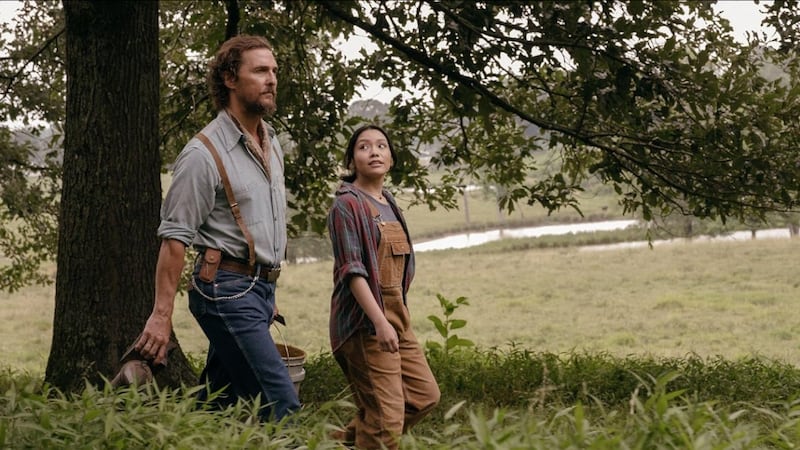
In The Rivals of Amziah King (in theaters now), Amziah’s life—spent making and preparing honey for sale and performing bluegrass with his friends—is transformed by the return of Kateri, whom he welcomes back into his fold with instinctive, easygoing warmth. A regal southern raconteur, Amziah is a king among men and, also, one of the boys, and the way in which he immediately (literally and figuratively) opens his arms up to his prior ward, beginning at a neighborhood get-together where he explains the ins and outs of a traditional potluck, is part and parcel of his benevolent nature.
Following that gathering and, then, a trip to his apiary—where, in a mesmerizing sight, he demonstrates the hive’s loyalty to its queen by having them swarm around his hand—Amziah takes Kateri to his home, which he shares with an amiable pup named Tater Tot. No sooner have they walked through the door than Amziah is talking up, and then showing off, his mandolin, “a religiously iconic almond-shaped instrument that projects music that transcends time and space.”

To prove that point, King calls out his front door to his Brazilian neighbors to come join them. In an instant, they’re cajoling him to play the song he can’t stop playing (specifically, The Last Bison’s “Quill”) and, moreover, to have the reluctant Kateri learn it.
Kateri protests that she’s not a singer. Amziah, however, isn’t having that; to him, everybody is a singer and “you just gotta drop some of that armor you got on ya.” As he tells her, “this is just music,” but it’s also a lot more than that.
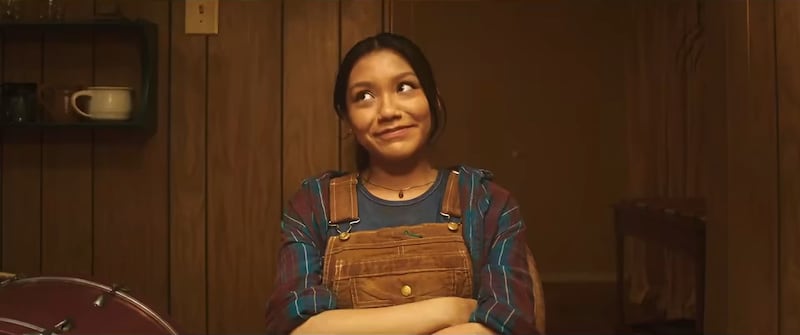
At the kitchen table, he teaches her the simple wordless melody of the tune’s chorus. A smile dawns on her face, born from the realization that they’re all impressed—and, additionally, that “it’s just us,” so it doesn’t matter how professional she sounds. Nonetheless, she’s still stunned when Amziah rolls up his blinds and tells two other neighbors (one of whom is The Last Bison’s Ben Hardesty) to bring over their gear in order to rock an impromptu full live band version of the song.
Kateri claims being forced to participate in this performance will give her a panic attack (“this is my deepest nightmare”). Amziah, though, shrugs that off, and before she knows it, she’s surrounded by musicians and her ex-foster dad, a twinkle in his eye, is kicking things off.
What ensues may not, according to the Oscar-winner’s protagonist, be a concert, but it is something close to euphoric, with Amziah leading the group and, with a playfully encouraging look, guiding Kateri through the chorus. Ensconced in the center of this close-knit group, Patterson’s camera repeatedly pushes in on LookingGlass’ face, and her grin—at once amused, surprised, and overwhelmed—reflects the ecstasy of the spontaneous moment. Amziah feels the spirit of music as well as of bees, people, and community, and in this showstopping recital, he conveys it all with big, openhearted exuberance.
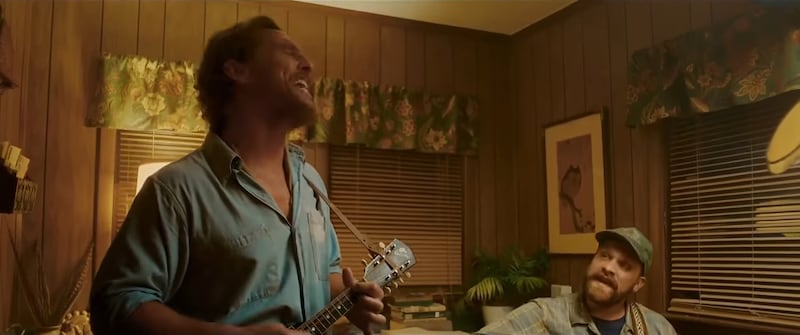
Having spent months learning to simultaneously play the mandolin and sing—a process he describes as “like walking and chewing gum at the same time”—McConaughey’s unaffected turn is a thing of beauty: confident and yet kind, proactive and yet laid-back; wise and yet unpretentious. The Rivals of Amziah King’s centerpiece, however, doesn’t reach its high notes without LookingGlass, whose genuinely delighted reactions are contagious.
This single, graceful scene encapsulates the film’s uplifting portrait of the safety and support that comes from family; the power of music to unite; and the bliss of letting down one’s guard and being open to unexpected possibilities. Kateri is so touched by this entrée into a clan she didn’t know she wanted (or wanted her) that, when she concludes by stating, “I’m never doing that again,” it’s clear that nothing could be further from the truth.
An exultant expression of the joy of art and togetherness, it’s as moving as 2026 summer movies get, and the emotional foundation of a story that understands goodness and happiness are priceless.